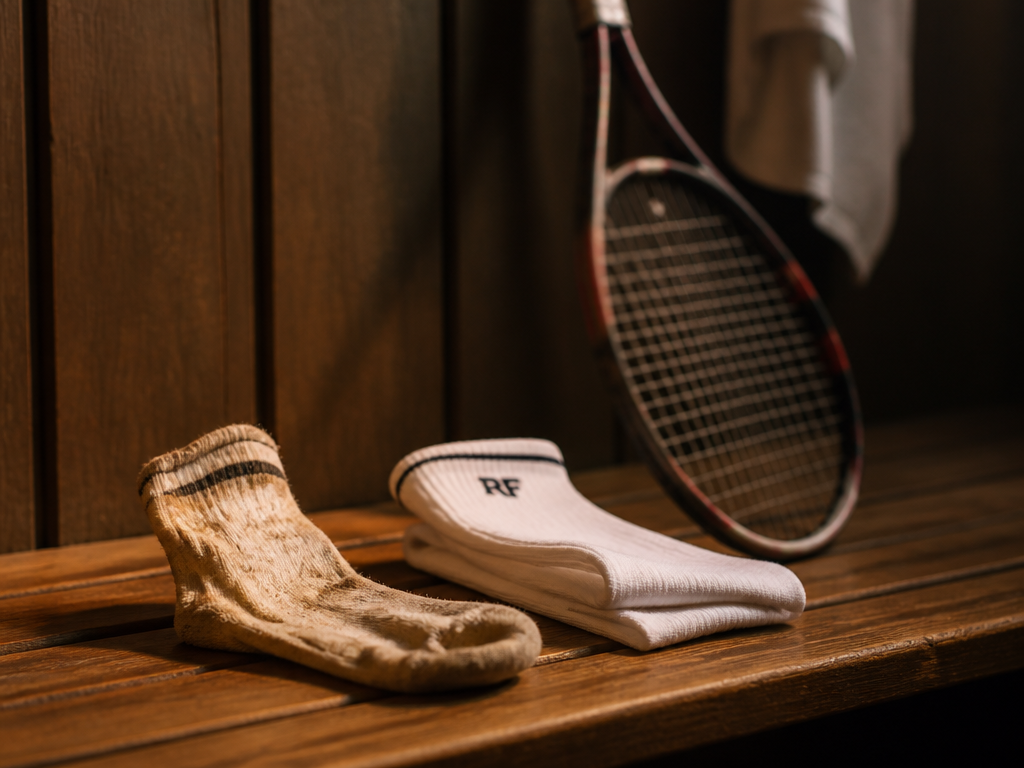
The honest answer, before the protocol and the table: a proper pair of tennis socks is worth the money for two narrow reasons — they keep your feet drier and they blister you less over a long match — and almost none of the broader claims printed on the packaging matter to a recreational player. If you currently play in everyday cotton socks and your feet are fine, you are not committing a crime. But we ran the test, and the gap between cotton and a decent synthetic pair is real, measurable, and shows up exactly where you'd expect it to: at the heel and toe after the second hour.
That is the whole verdict. The rest of this is how we got there, and a small detour into why the entire category exists in the first place — because the belief that "the right sock matters" has a source, and the source is thinner than the slogan.
Where the belief came from
Athletic socks as a distinct, marketed category are newer than most people assume. For most of the twentieth century, a sock was a sock. Tennis whites included whatever cotton crew sock matched the shoe. The shift came from two directions at once, and neither was about tennis specifically.
The first was a 1980s patent and marketing push around padded, fiber-specific athletic socks — Thorlo being the name most people remember — built on a genuinely sensible premise: cotton holds water, wet fabric abrades skin, abrasion plus friction equals blisters. That part is sound foot science and it predates the sock industry by decades. Military and podiatry literature had documented the friction-blister mechanism long before anyone sold a "tennis sock."
The second was the broader synthetic-apparel wave of the 1990s, when "moisture-wicking" became a phrase you could print on anything. Polyester does move water differently than cotton — that is a material fact, not a slogan — but the word got stretched to cover claims it can't support. Somewhere in there, the modest, defensible idea ("wet cotton causes blisters") got bundled with a much larger one ("you need sport-specific socks for performance"), and the bundle became received wisdom.
So the field believes tennis socks matter. The source of that belief is a real friction-and-moisture mechanism. What got added on top — that the sock improves your footwork, your stability, your recovery — is mostly weight the original evidence can't carry. Worth keeping that in mind as we read our own numbers.
How we tested
We are upfront that this was a small protocol, not a lab study. No foot-mounted humidity sensors, no controlled friction rig. What we had was repeatable court time and a deliberate effort to change one variable at a time.
The socks. Three categories, one representative pair each:
- Everyday cotton crew — a standard 80% cotton multipack sock, the kind most people already own.
- Budget synthetic — a polyester-nylon-elastane blend marketed as athletic but not tennis-specific, roughly the price of a sandwich.
- Premium tennis-specific — a cushioned crew with zoned padding at heel and forefoot, an arch band, and a published blend in the neighborhood of 60% polyester, 30% nylon, plus elastane and a small cotton fraction.
The players. Two testers, one male and one female, both recreational-to-intermediate (NTRP roughly 3.5), feet of average shape, no chronic blistering history. We note this because foot shape is the single biggest confounder in sock testing and we couldn't control it across the population — only within each tester.
The sessions. Twelve sessions total over three weeks, four per sock category, split evenly between the two testers. Each session was a minimum of 90 minutes of live play, hard court, daytime temperatures between 22°C and 31°C. Same shoe throughout for each tester — we did not change shoes, because a new shoe would have wrecked the comparison.
What we measured.
- Moisture, subjectively — each tester rated sock dampness 1–5 immediately after play, plus we noted whether the sock felt wet to the touch at the heel.
- Blistering and hot spots — recorded as a yes/no plus location after each session, and we inspected feet rather than relying on memory.
- Slippage — whether the sock crept down or bunched, rated as none / minor / disruptive.
- Heat — perceived warmth of the foot during the back third of the session, 1–5.
We rotated sock order so that the same sock wasn't always worn on the freshest or most fatigued legs. We can't claim statistical power off twelve sessions and two feet. We can claim that the pattern was consistent enough that both testers independently reported the same thing without comparing notes first.
What we found
Here is the aggregate. Scores are averaged across both testers and all four sessions per category. Moisture and heat are 1–5 where higher means wetter and warmer respectively.

| Criterion | Cotton crew | Budget synthetic | Premium tennis |
|---|---|---|---|
| Moisture after play (1–5, lower better) | 4.4 | 2.5 | 2.1 |
| Hot spots or blisters (sessions out of 4) | 3 of 4 | 1 of 4 | 0 of 4 |
| Slippage | Minor–disruptive | None | None |
| Perceived heat, late session (1–5) | 4.0 | 3.1 | 3.4 |
A few things jump out, and a few things that don't show up in the table matter just as much.
The moisture gap is the headline. Cotton came off the court visibly and audibly wet — you could wring the heel. Both synthetics were merely damp. This is the one place the material science is unambiguous: cotton absorbs and holds water against the skin, polyester moves it toward the surface where it can evaporate. That isn't a marketing flourish, it's how the fibers behave. The premium pair edged out the budget pair on moisture, but the meaningful jump was cotton-to-synthetic, not synthetic-to-premium.
Blisters tracked moisture, exactly as the old science predicts. Cotton produced hot spots or a genuine blister in three of four sessions, always at the heel or the side of the big toe, always in the back half of play once the sock was soaked. The budget synthetic blistered once — on a session that ran past two hours. The premium pair, with its zoned padding, came through all four clean. We want to be careful here: zero blisters across four sessions on two non-blister-prone feet is encouraging, not conclusive. A player with a known hot spot is a different test we didn't run.
Slippage was the cotton sock's other quiet failure. As the cotton crew absorbed sweat it lost structure and crept down the ankle, and on two occasions bunched under the arch — which is itself a blister risk. Both synthetics held position. The elastane and the knit construction, not the brand, are doing that work.
Heat was the one place cotton wasn't dead last in spirit. The premium cushioned crew, with more fabric at the heel and forefoot, ran slightly warmer than the thin budget synthetic. Padding is a genuine trade-off: it protects the skin and it traps heat. On the hottest day, our female tester preferred the thinner sock outright and accepted the marginally higher blister risk. That is a legitimate personal call, not an error.
The claims that hold and the claims that don't
Now the part the packaging won't help you with.
Holds up: moisture management
"Moves moisture better than cotton" is true and you can feel it inside an hour. This is the claim that justifies the category. If you take nothing else from this piece: the upgrade that matters is cotton to synthetic, and it is the cheapest upgrade available. A budget poly blend captured most of the benefit in our test.
Holds up: targeted cushioning, for the right player
Zoned padding at heel and toe did appear to prevent hot spots in our sessions, consistent with the friction mechanism. But it's conditional. It helps most if you play long, sweat heavily, or already blister. It helps least if you play 45-minute social doubles and have never had a foot problem. And it costs you a little heat. This is a real feature with a real trade-off, not a free upgrade.
Thin and overstretched: "moisture-wicking" as a magic word
Wicking is a property of the fiber and the knit, not a brand technology you can trademark your way into. Plenty of socks print the word and deliver an average result; a few cheap polyester pairs outperform expensive ones. The word on the label tells you almost nothing. The fiber percentage on the back tells you more — look for polyester and nylon as the majority, cotton as a minority or absent.
Weak: compression for recreational performance
Compression socks are everywhere now and the marketing implies stability, faster recovery, less fatigue. The evidence for performance benefit in recreational athletes is genuinely thin. The research that exists — largely in running and endurance contexts — shows small and inconsistent effects on performance, with the clearest support being for perceived recovery and some reduction in muscle soreness, not for playing better. We did not test compression in this protocol because we couldn't measure its claimed benefits with the tools we had, and we'd rather say that than fake a result. If a graduated compression sock feels good on your calves, that's a fine reason to wear one. "It will improve your tennis" is a claim the science doesn't currently back.
Weak: anything about footwork, balance, or stability
No sock improves your split-step. The shoe and the floor do that. A sock that stays put and doesn't soak through removes a distraction, which is the most you can honestly ask of it.
Cotton vs. running socks vs. tennis-specific
A reasonable question if you already own athletic socks: do you need tennis socks specifically, or will the running socks in your drawer do?
Everyday cotton is the one to leave behind for play. Not because it's morally inferior — it's comfortable and cheap — but because in our test it was wettest, slipped most, and blistered most. It's the only category that lost on multiple criteria at once.

Running socks are closer than the marketing wants you to believe. They're synthetic, they wick, they often have arch support and cushioning. The differences from tennis socks are real but modest: tennis involves more lateral movement and abrupt stops, so tennis-specific socks tend to add cushioning on the sides of the foot and a slightly more aggressive heel lock. If you already own good running socks, you can absolutely play in them, and you'll get most of the benefit. The tennis-specific pair is an optimization, not a requirement.
Tennis-specific socks are worth the premium mainly if you've identified a specific problem — heel blisters, sweat-through, slippage on clay — and want it solved with one purchase rather than trial and error. The zoning is genuinely aimed at the sport's movement. But you are paying for the last ten percent.
Put bluntly: the jump from cotton to any decent synthetic sock is large and cheap. The jump from a generic synthetic to a tennis-specific one is small and not cheap. Spend confidently on the first jump. Treat the second as a fix for a known problem, not a default.
Who this is for, and who it isn't
Upgrade now if:
- You currently play in cotton socks and your feet are wet, hot, or blistered after matches. This is the clearest case in the piece. The fix is cheap and the effect is immediate.
- You play long sessions — singles, two-hour hits, tournament days. Moisture and friction accumulate with time, and that's exactly where cotton failed.
- You have a recurring hot spot or blister. Targeted cushioning is a legitimate tool here, and worth the premium tennis pair.
- You play on clay and sweat heavily. The combination of moisture and grit makes a dry, well-anchored sock more than a comfort question.
Don't bother, or buy at the cheap end, if:
- You play short, casual sessions and have never had a foot problem. The benefit is real but you may not feel it across 45 minutes, and cotton's failures showed up mostly in the second hour.
- You run hot and hate cushioned socks. A thin synthetic beats a thick one for you, and that's fine — thin synthetics are inexpensive.
- You're being sold on compression for performance. Buy it for comfort if you like the feel; don't buy it expecting a better game.
The honest middle path for most readers: skip the premium tier on the first purchase. Buy a budget synthetic multipack, play four or five sessions, and see whether your specific complaint goes away. If it does, you've solved it for the price of a sandwich. If a heel blister persists, then the tennis-specific cushioned pair is a targeted purchase you can make with confidence instead of hope.
Evidence grade
For the central claim — synthetic athletic socks reduce on-court moisture and blistering versus everyday cotton — we grade the evidence Strong. The fiber behavior is established material science, the friction-blister mechanism is well documented in podiatry and military literature, and our small protocol reproduced the predicted pattern consistently across two testers without prompting.
For the secondary claim — tennis-specific socks outperform generic synthetic athletic socks enough to justify the price premium — we grade it Weak to Moderate. Our premium pair did edge the budget pair, particularly on blister prevention, but the margin was small, the sample tiny, and most of the total benefit came from the cotton-to-synthetic jump rather than the synthetic-to-tennis one.
For the compression-for-performance claim, the evidence in the broader sports-science literature is Weak, and we did not generate our own data on it. We're flagging that as a limitation rather than papering over it.
The biggest hole in our own testing: foot shape. Two pairs of average, non-blister-prone feet can't tell you what happens to a player with a bony heel or a wide forefoot. If that's you, treat our results as a starting hypothesis, not a guarantee.
One drawer, after the test
The clearest evidence of what this article's logic looks like lived out is in one tester's sock drawer, which we can report on directly.
I [reviewer note] threw out exactly nothing. The cotton crews are still there — they're for errands and the walk to the courts, and they're genuinely better for that, because absorbency is a virtue when you're not generating two hours of sweat. What changed is narrower than I expected going in. I bought one six-pack of budget synthetics for ordinary hits, and exactly two pairs of the cushioned tennis-specific ones, kept aside for tournament Saturdays and the long singles sets where my left heel used to come home raw. That heel has been clean for three weeks. I did not buy compression anything. The whole reform cost less than a single restring, and it amounted to a sorting problem — right sock, right session — rather than the upgrade the packaging was selling.