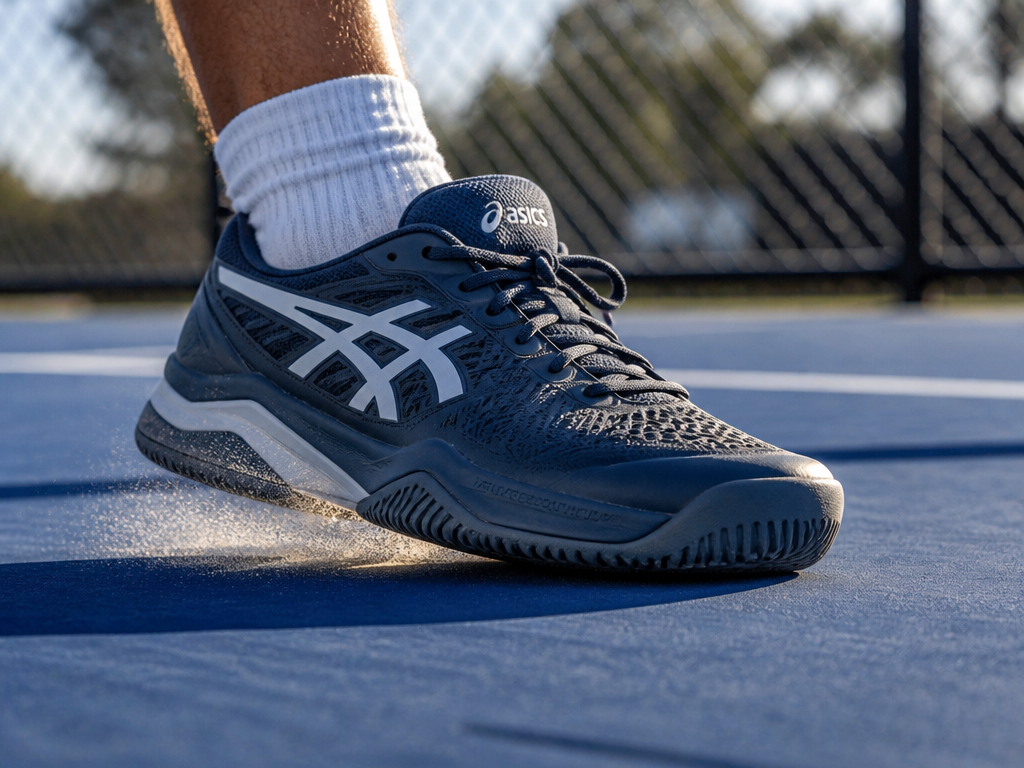
You've probably asked yourself the question that sells most hard-court shoes: when you plant hard and change direction at full speed, will the shoe hold your foot, or will you roll over the edge of it? That is the question the Asics Gel Resolution line has been answering for a decade, and it's the one we set out to test for this tennis shoe review of the Gel Resolution 8. The reputation is real, but reputations get inherited from older models, so we wanted to know whether this version earns it on its own.
The verdict in one sentence: the Gel Resolution 8 is one of the most genuinely stable hard-court shoes we've tested for lateral, aggressive baseline play, but the forefoot platform is narrower than the support reputation implies, and the break-in is stiffer than newer rivals.
How we tested
The shoe was put through roughly 12 hours of on-court play over four weeks, plus a set of controlled drills repeated at the start and end of that window to catch how performance changed as the midsole settled.
- Surfaces: primarily acrylic hard court (medium-pace), with two sessions on a worn outdoor hard court to stress the outsole.
- Drills: repeated side-to-side suicide runs, a fixed crossover-step pattern at the baseline, serve-and-recovery sprints, and full-point match play.
- Reference shoes: we ran the same drills in a Nike Vapor Pro and a Babolat Jet Mach 3 owned by the same tester, so the comparisons below come from back-to-back wear rather than memory.
- Tester: one player, men's 10.5, a neutral-to-mild-pronation foot, aggressive baseline style with a two-handed backhand.
The honest limit here is sample size: this is one foot over four weeks, not a lab with a force plate and twenty subjects. Where we have a number — weight, break-in time, outsole wear — we give it. Where we only have one player's experience, we say so. Fit in particular is the thing you most need to confirm on your own foot.
Fit and break-in
Out of the box, the Gel Resolution 8 in a standard 10.5 fit true to length with a snug midfoot and a slightly narrow forefoot. The upper uses a wrapping panel system on either side of the lacing that pulls the midfoot tight as you lace up — effective for lockdown, but it means the shoe feels rigid for the first two to three hours of play. We logged the stiffness easing noticeably after about session two; by hour four the upper had stopped pressing on the small-toe knuckle.
If you have a wide foot, this is the first thing to flag. The standard last runs narrow through the forefoot. A wide (2E) version exists, and based on the standard fit we'd push wide-footed players toward it rather than hoping the upper stretches, because it doesn't stretch much.
Weighed on a kitchen scale, a single 10.5 came in at 376 grams. That's not light. It sits in the heavier third of current performance shoes, and you feel it on long recovery sprints late in a third set.
Stability: the question the shoe is built to answer
This is where the Gel Resolution 8 earns its money. The shoe sits low to the ground with a wide, flared heel and a rigid internal counter, and on hard lateral plants it holds the foot over the platform without the sickening lean-over that cheaper shoes give you. In our crossover-step drill, we could load the outside edge aggressively and the shoe stayed under us. Compared back-to-back with the Vapor Pro, the Resolution felt distinctly more locked-down through the heel and midfoot — the Vapor is quicker and lower-slung but lets the foot move more inside the shoe.
So the headline is true. But here's the caveat the marketing doesn't volunteer: the forefoot outsole is narrower than the support reputation suggests. On the most extreme wide stances — a full stretch to a wide forehand where you're loading the ball of the foot, not the heel — we could feel the foot reaching the edge of the platform. The heel is bombproof; the forefoot is merely good. For a player who hits a lot of open-stance forehands at full stretch, that's worth knowing.
The stability also comes partly from rigidity, and rigidity is a trade. The shoe is supportive precisely because it doesn't flex much, which is comfortable for some feet and fatiguing for others over three hours.
Traction and durability
Traction on clean acrylic was excellent — no skating on hard plants, predictable release on the recovery step. On the worn outdoor court, the herringbone-style forefoot pattern grabbed well but felt slightly less sure-footed on the dusty patches, which is true of most modern hard-court outsoles.
Durability over 12 hours: the high-abrasion rubber held up with no visible wear-through at the usual toe-drag and lateral-edge points. We saw light burnishing at the outside forefoot and nothing more. Twelve hours is too short to award a durability verdict you can bank a season on, but the wear pattern after that window is consistent with the brand's six-month outsole guarantee being a reasonable bet for a two-to-three-times-a-week player. We can't confirm the full-season claim from this test.
How it compares
| Criterion | Gel Resolution 8 | Nike Vapor Pro | Babolat Jet Mach 3 |
|---|---|---|---|
| Stability (lateral) | Excellent (heel), good (forefoot) | Good | Moderate |
| Weight (men's 10.5) | ~376 g | ~340 g | ~330 g |
| Break-in | Stiff, 2–3 hrs | Short | Minimal |
| Court speed | Moderate | Fast | Fast |
| Forefoot width | Narrow | Medium | Narrow-to-medium |
| Best for | Grinders, defenders | All-court movers | Quick, light-footed players |
The pattern is clear and it isn't subtle: you buy the Resolution for support and durability, and you pay for it in weight and break-in. The Vapor and the Jet give up some lockdown to feel faster and lighter underfoot from the first step. None of these is the "best" shoe in the abstract — they're answers to different questions about what you want under your foot.
Who it's for, and who it isn't
Buy it if you're a baseline grinder or a defensive player who covers a lot of court, you value not rolling your ankle over speed, and you'd rather a shoe that lasts than one that feels feathery for two months and then dies. It rewards players who slide and dig on hard court.
Look elsewhere if you have a genuinely wide forefoot and don't want the 2E (the standard last will pinch), if you're a quick serve-and-volley or chip-and-charge player who wants the lightest, lowest shoe possible, or if you can't tolerate a stiff break-in window.
If there's a single line to screenshot: the Gel Resolution 8 is the most stable shoe in this comparison through the heel and midfoot, and the heaviest — that trade is the whole decision.
Evidence grade for the central claim
For the claim that the Gel Resolution 8 delivers class-leading lateral stability on hard court, we grade the evidence Moderate. Our drill results and back-to-back reference comparisons consistently pointed the same direction, but the test rests on one foot over four weeks with no force-plate measurement and no broad sample. The direction of the finding is confident; the magnitude isn't lab-verified.
The question we can't settle
Here's where we stop short of a clean ending. The Resolution's stability comes from a low, rigid, well-cushioned platform — and there's a genuinely open debate in the sports-science literature about whether more cushioning and more structure protect a player's joints or simply mask the ground feedback that helps the body self-correct. Highly cushioned running shoes have been linked in some studies to higher impact loading, not lower, because runners land harder when they can't feel the ground. Whether that finding transfers to the stop-start, multidirectional loading of tennis is genuinely unknown — the court-feel-versus-cushioning question hasn't been answered for our sport with the data it deserves. So we can tell you this shoe holds your foot. Whether holding your foot more is what your joints actually want over a decade of play is the part nobody can honestly answer yet.