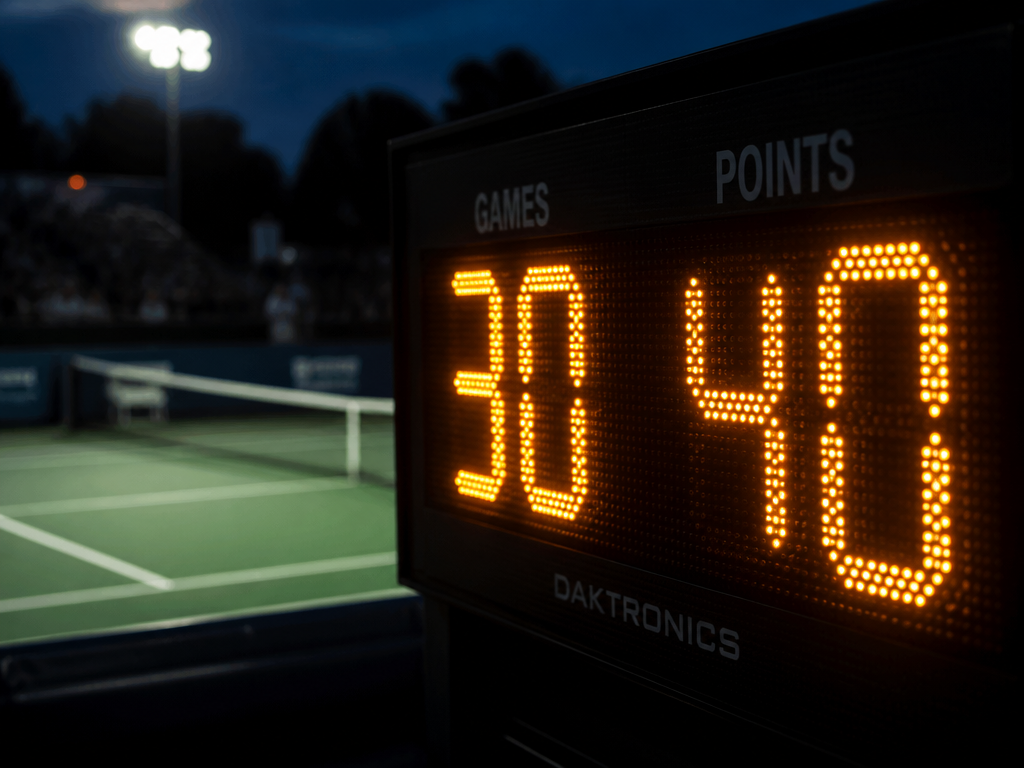
You are down 30-40 on your own serve. You toss the ball, and somewhere between the toss and the contact a small committee convenes in your head and starts arguing. One member wants you to crush a first serve and end the conversation. The other wants you to roll a safe one in and not hand over the game with a double fault. You have maybe 1.2 seconds, and you have to pick.
Here is the question this piece is actually about: on a break point, should you play aggressively or safely? We will get there. But you cannot answer it without the break point definition first, because the whole reason these points feel different is hiding inside the definition.
What a break point actually is
A break point is any point where the receiver — the player not serving — can win the game by winning the next point. That's it. The server is one point from losing a game they are statistically supposed to win, and the receiver is one point from stealing it.
Concretely: in a standard game scored 15, 30, 40, game, the server reaches break point any time they are behind by enough that the receiver's next point ends the game. The common cases are 30-40 (one break point), 15-40 (two break points, because the receiver can miss the first and still have another), and 0-40 (three break points). At 40-40 — deuce — if the receiver wins the next point, that's advantage receiver, which is also a break point. Win the point after that and the receiver has "broken serve."
Breaking serve means winning a game your opponent served. The reason that phrase carries weight, and the reason a commentator's voice changes when the score hits 30-40, is the quiet assumption underneath all of it: the server is supposed to win their service games. A break point is the moment that assumption is under threat.
Why the server is "supposed" to win, and why a break is worth so much
In professional men's tennis, holding serve is the default outcome. Across a typical ATP season, top servers hold somewhere in the range of 80 to 90 percent of their service games; in 2023, the tour leaders in service-games-won sat above 90 percent. On the women's tour, where serve is less dominant relative to return, hold percentages run lower and breaks are more frequent — which is part of why women's matches often feature more service exchanges and fewer of the long, hold-for-hold standoffs you see in the men's game.
The recreational picture is different in degree but not in direction. At the club level, the second serve is often the weakest shot in both players' arsenals, so breaks happen far more often than on tour. But the structure is the same: if everyone held serve every time, a set would go to a tiebreak every time. The only way to win a set without a tiebreak is to break serve at least once. That is the entire mechanical reason a break point matters. It is the hinge on which a set turns.
So when the receiver "converts" a break point — wins it — they don't just win a point. They move ahead in the only currency that ends sets early. That is why one point at 30-40 is worth more to the scoreboard than one point at 40-15, even though both are "one point."
Is momentum real, or just a story commentators tell
Now the harder question, because match momentum is the thing everyone feels and almost no one can pin down.
The honest answer: the existence of a measurable "hot hand" or momentum swing in tennis is genuinely contested, and the data is thinner than the confidence with which it's usually stated. Researchers have spent decades arguing about whether streaks in sports are real or whether human brains simply manufacture patterns out of noise. The original "hot hand" work — Gilovich, Vallone, and Tversky, published in Cognitive Psychology in 1985, on basketball shooting — found that the perception of streaks far outran the statistics. Later reanalyses, notably Miller and Sanjurjo (2018, Econometrica), showed that the original method had a subtle bias and that small hot-hand effects probably do exist. The fight is ongoing, and it isn't settled in tennis at all.

What we can say more confidently is narrower. There is evidence that the score itself changes player behavior. Studies of professional matches have found that players win a smaller share of points on important points than on unimportant ones — that is, the server's edge shrinks when the point matters most. The economist Romain Gauriot and others have looked at this; the broad finding across several analyses is that pressure compresses the server's advantage rather than amplifying it. Break points are slightly harder to win, for the server, than the raw serve numbers would predict.
That is a real effect and worth sitting with. It does not prove that a single converted break "shifts momentum" for the next twenty minutes. It proves something simpler and more useful: under pressure, the average player gets a little worse, and the server — who normally has the advantage — has more to lose by getting worse. "Momentum" might be nothing more than this, repeated. One player tightens up, drops a few key points, and the scoreboard moves. The story we tell afterward — that they "lost momentum" — is a description, not always an explanation.
The same point, two different problems
Here is the part most explanations skip: the server and the receiver are not facing the same situation on a break point, even though they are playing the same point.
The server's problem
The server is defending the expected outcome. Statistically, they were going to win this game; the break point is a deviation from script. This produces a specific psychological trap — loss aversion. Losing something you expected to keep feels worse than failing to gain something you never had. So the server often plays a break point as if they are protecting a lead, which tends to mean tightening up: shorter swings, a more conservative first serve, a second serve patted in at three-quarter pace to avoid the double fault.
Watch the great servers and you'll see the opposite instinct. Players like Roger Federer, Pete Sampras, and John Isner historically sat near the top of the tour's "break points saved" leaderboards, and the through-line is that they leaned on the serve when it mattered, not off it. A big server facing break point doesn't get safe — they go to their best location and trust it, because the serve is the one shot where they hold the initiative. That's not bravado. It's playing to the shot least affected by the receiver's pressure.
The receiver's problem
The receiver is in the opposite frame. They have nothing to lose — they weren't expected to win this game anyway. That should be freeing, and for confident returners it is. The danger for the receiver is different: it's overreaching. Knowing a break is "worth so much" can tempt a player to try to win the point outright off the return, going for a winner on a serve they should simply have neutralized.
The receiver's actual job on most break points is more boring than that: get the return deep and in play, and make the server hit one more ball under pressure. Remember the research — the server's edge shrinks on big points. The receiver's best ally is the rally itself, because the longer the point goes, the more chances the nervous server has to make the error that's already trying to happen.
So: same scoreboard, opposite assignments. The server should commit; the receiver should extend.
So — aggressive or safe? The answer, honestly
This is the question you came with, and the honest answer is that it depends — but it depends on things you can actually identify in the moment, so "it depends" isn't a cop-out here. It's a short checklist.
It depends, first, on which side of the point you're on. We just covered this. As server, the mistake is shrinking; as receiver, the mistake is reaching.
It depends, second, on what your reliable shot is. Aggression and recklessness are not the same thing. Going for your most trusted pattern at slightly above your safe margin is aggression. Going for a shot you make three times in ten is gambling. On a break point you want to raise your commitment, not your risk. Those feel similar in the body and are completely different on the scoreboard. The server who pounds their best serve into the corner is being aggressive at low risk because it's a shot they own. The same server attempting a flat ace down a line they never hit is being reckless.
It depends, third, on the second serve. This is where most club break points are actually decided. If you're the server and your second serve is shaky, the pressure is real and a double fault hands over the break for free. The fix is not to pat the ball in — a sitter second serve invites the receiver to attack and is its own kind of risk. The fix is a second serve with shape and net clearance that you can hit at full commitment. If you don't have one, that's the off-court project; in the moment, hit the spinniest serve you trust and accept that you may get attacked.

It depends, fourth, on what you know about your opponent. If they've been double-faulting all day, the receiver's "safe" play — just get the return in and make them serve twice — is the aggressive play, because it puts the burden on their weakest shot. If they have a huge forehand, you don't want to feed it a comfortable ball, safe or not. Tactics aren't universal; they're answers to a specific person across the net.
Put together, the resolution to the aggressive-or-safe argument is this: commit to a shot you trust, aimed at your opponent's problem, and stop trying to win the point with one swing. That sentence is doing more work than "play aggressively" or "just get it in," because both of those are advice about your nerves. This is advice about the ball.
What the pressure does to your body, in order
It's worth knowing the actual sequence, because the symptoms arrive in a predictable order and you can intercept them.
First, the threat registers — your brain flags the point as important, and the sympathetic nervous system releases adrenaline. This is fast and largely involuntary.
Second, your heart rate climbs and your fine motor control degrades slightly. This is why the toss feels different and the grip feels tight. Adrenaline is great for sprinting and terrible for the small, precise muscle work a serve requires.
Third — and this is the one you can actually fight — your tempo speeds up. Anxious players rush. The time between points shrinks, the ball bounces before the serve get fewer, the swing gets quicker and shorter. The shortened swing is usually what causes the miss, not the pressure itself.
Fourth, attention narrows. Under stress, peripheral awareness drops and players fixate — often on the thing they're afraid of, which is precisely why "don't double fault" tends to produce a double fault. The brain is bad at processing the negation; it mostly hears "double fault."
The intercept point is the third stage. You can't will your adrenaline down mid-game, but you can slow your routine deliberately — take the full time between points, breathe out before you serve, bounce the ball the same number of times you always do. The routine is not superstition. It's a way of reinstalling tempo and swing length when the body is trying to take them away. Players from Rafael Nadal to Novak Djokovic run rigid between-point routines for exactly this reason: the routine is the thing that doesn't change when everything else wants to.
A small table for the moment of decision
| You are the... | Default mistake | Better instinct |
|---|---|---|
| Server, strong first serve | Backing off, patting it in | Go to your best location and commit |
| Server, weak second serve | Pushing a sitter, or doubling | Full-commitment spin serve, accept the attack |
| Receiver, confident | Going for a return winner | Deep, neutral return — extend the point |
| Receiver, defensive | Floating it short | Block it deep, make them hit one more |
None of these are guarantees. They are the lower-variance choice in each box — the play that's wrong least often.
Where the honest gaps are
We've been careful in two places, and it's worth flagging them.
We don't actually know how much of "momentum" is causal. The evidence that pressure shrinks the server's edge is reasonably solid; the evidence that one converted break psychologically dictates the next several games is much softer and mostly anecdotal. Treat the first as a working fact and the second as a plausible story.
And the psychology section leans on observed player behavior and the broad strokes of stress physiology, not on controlled tennis-specific trials. The adrenaline-to-tempo sequence is well-established in general; "doing your between-point routine fixes it" is sensible and widely practiced but is a heuristic, not a measured result. We'd rather tell you that than dress it up.
The rule of thumb
Tonight, on every break point you reach: pick the one shot you'd bet on at 4-4 in practice, aim it at your opponent's weaker side, and swing through it at full length — because the point you lose by committing teaches you more than the point you lose by shrinking.