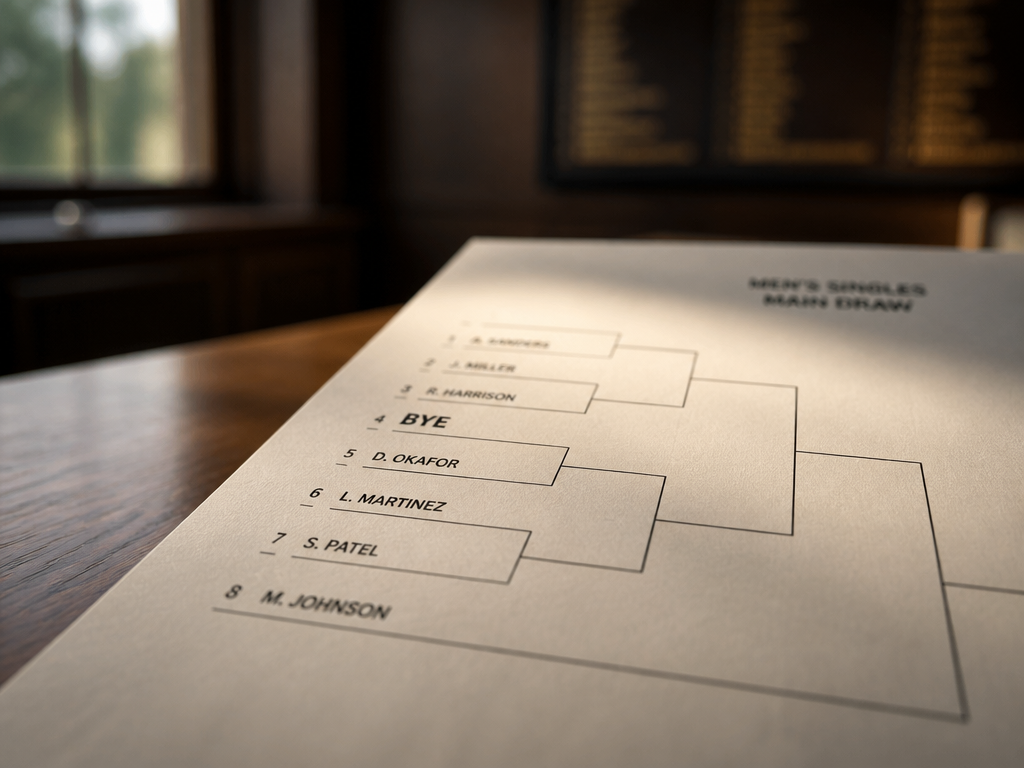
On a tournament entry sheet, the word bye sits next to a player's name like a small gift. No opponent. No first match. Straight into round two while everyone else sweats through an opener. It reads like a reward, and that is the first thing most people get wrong.
It is not a reward. It is arithmetic.
A bye is one of the most misread items in tennis terminology, partly because the broadcast graphic shows a top seed "advancing" without playing, and partly because the term sits near two others — walkover and default — that look similar and mean something completely different. We want to untangle all three, then show where the practice came from, because the belief that byes are an earned perk turns out to rest on thinner ground than the confidence with which people state it.
What is a bye in tennis, in plain language
A bye means a player is entered in the draw but has no opponent in a given round, so they advance to the next round without hitting a ball. In practice it almost always happens in round one, and it almost always goes to the highest seeds.
That is the whole definition. The reason it exists has nothing to do with merit and everything to do with the shape of a bracket.
A single-elimination draw only works cleanly when the number of players is a power of two: 2, 4, 8, 16, 32, 64, 128. Those numbers pair off perfectly round after round until one player is left. Wimbledon's main singles draw is 128 for exactly this reason — seven rounds, each halving the field, no leftovers.
But entries rarely arrive in tidy powers of two. A club event might draw 48 players. A sectional might pull 50, or 96, or 113. You cannot run a 50-player single-elimination bracket without somebody, somewhere, sitting out a round. The bye is how the math gets absorbed.
Bye, walkover, default: three words people blur together
These get conflated constantly, so it is worth being precise.
A bye happens before play, when the draw is made. There is no opponent because none was ever assigned to that line. The player advances by structure.
A walkover (often written "w/o") happens when an opponent was assigned but cannot play — illness, injury, a missed flight, withdrawal before the match starts. The remaining player advances, and the result is recorded, but no match was contested.
A default is a disqualification or a retirement enforced by an official — a code violation, a no-show after the clock runs out, conduct. Someone loses the right to continue.
The distinction matters because each one is recorded differently and, on the pro tours, paid and ranked differently. A bye is invisible on a player's match log. A walkover registers as a win with no score. The reader who calls a bye a walkover is not being pedantic-corrected for no reason; the two describe different events at different moments in the tournament's life.
A short history of why the field believes byes are a prize
Here is where the common story and the actual source diverge.
The word bye did not start in tennis. It comes from cricket and older bracket sports, where "bye" meant a run scored, or more usefully a competitor who passed to the next round because the field could not be paired evenly. The structural problem — odd numbers in a knockout — is older than lawn tennis itself. Tennis inherited the word along with the bracket.
When ranking-based seeding became formalized in the twentieth century, tournaments had to decide who would absorb the unavoidable byes. The choice was practical: give them to the top seeds. The reasoning offered at the time was competitive integrity — you do not want your two best players meeting in round one, and you want the strongest names alive deep in the event for the crowd and the draw sheet. Handing byes to seeds did both. It thinned the seeds' early path while protecting the bracket's structure.
Over decades, the practical decision hardened into a moral one in the popular telling. Players and fans began to describe the bye as something seeds "earn," a small dividend on a high ranking. That framing is not in the rulebook. Read the regulations and you find the bye described as a draw-construction device, with seeds named as the recipients because they are the convenient and defensible place to put it. The belief that it is a reward has a source — the seeding-protects-the-draw logic — but the source supports something narrower than the belief. Byes are assigned to seeds. They are not given to honor seeds.
This is the kind of gap worth noticing. A reasonable operational choice gets retold often enough that it acquires a meaning it never had.
How a draw actually fills with byes, step by step
Walk through it in the order it happens, with 48 players.
First, the tournament finds the smallest power of two that holds everyone. For 48, that is 64. A 64-line bracket has room for 64 players.
Second, subtract. 64 minus 48 leaves 16 empty lines. Those 16 lines become byes.
Third, place the byes. The 16 byes go to the top 16 seeds, distributed across the bracket so they sit in different sections — never bunched in one quarter. Each seeded player with a bye is paired against an empty line in round one and advances automatically to round two.
Fourth, everyone else plays. The remaining 32 players (48 minus the 16 seeds) fill the other lines and contest 16 first-round matches. Sixteen winners emerge. They join the 16 seeded byes, and round two begins with a clean 32.
From that point the bracket is a normal power of two and runs without further byes. The whole mechanism exists to convert an awkward 48 into a tidy 32 by the second round.
The edge case where a bye is not a perk at all
There is a version of the bye that nobody brags about. When a tournament does not attract enough direct entries to fill its bracket — too few acceptances — byes can fall outside the seeds simply because there are not enough players to assign opponents. In a sparse draw, an unseeded player can land a bye purely because the line next to them stayed empty.
This is the case that quietly disproves the "byes are earned" story. The same structural device that flatters a No. 1 seed can also hand a free round to someone ranked nowhere near the top, for the unglamorous reason that the field was thin. The mechanism does not care about ranking. The seeding rule that usually directs byes toward the top is a convention layered on top of the math, not the math itself.
The fairness question that is not fully settled
Does a bye actually help? The intuition is yes — one fewer match, fresh legs into round two. But the counter-argument has merit and is harder to dismiss than people assume. A player with a bye skips a competitive rep. They enter their first match cold while their round-two opponent has already found rhythm, read the conditions, and shaken off nerves. Coaches on both sides of this argue it sincerely. We have not seen clean, large-sample evidence settling whether the rested-but-rusty seed beats the tired-but-warm opponent at a rate worth quantifying. It is plausible the advantage is smaller than the entry sheet implies. We will call that one unsettled rather than pretend otherwise.
A quick reference for draw sizes and byes
The pattern is always: round up to the next power of two, then the difference becomes byes.
| Entries | Bracket size | Byes (round one) |
|---|---|---|
| 24 | 32 | 8 |
| 40 | 64 | 24 |
| 48 | 64 | 16 |
| 56 | 64 | 8 |
| 96 | 128 | 32 |
| 113 | 128 | 15 |
Rule of thumb: if the entry count is not 2, 4, 8, 16, 32, 64, or 128, there will be byes, and the number of them is the gap to the next power of two. A full bracket — say 32 entries in a 32-draw — has none.
Something to try this week
Pull up the draw of any tournament you are following, or your own next event, and do the subtraction yourself. Count the entries, find the next power of two above it, and the difference is the number of byes you should expect to see in round one. Then check whether those byes landed on the top seeds or scattered because the field was light. You will read the rest of the bracket differently once you have done it once.
A bye is not a medal pinned to the best players — it is the seam where the bracket's arithmetic shows through.