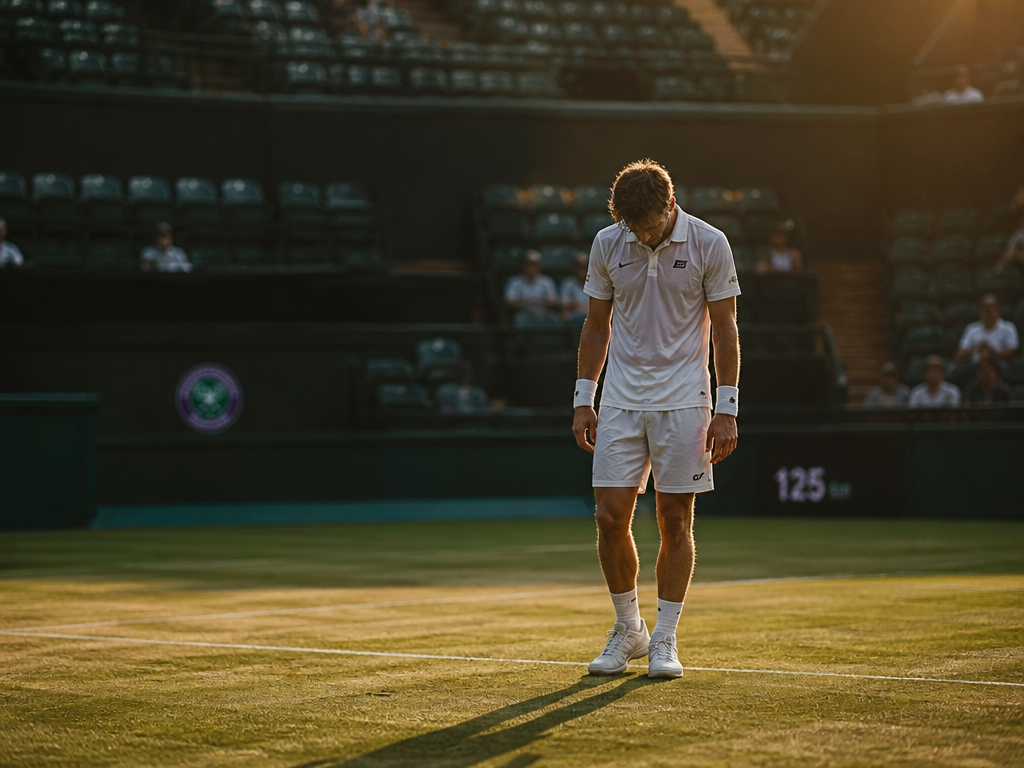
Most fans, asked to name the longest tennis match ever, reach for one fixture: John Isner versus Nicolas Mahut, Wimbledon 2010, 11 hours and 5 minutes across three days, finishing 70–68 in the fifth. That answer is correct as a stopwatch fact. But it obscures a longer story. The conditions that produced the longest tennis matches in history were not invented at Wimbledon. They were perfected, decades earlier, in Davis Cup — and they have since been deliberately legislated out of existence.
This is a piece about a belief: that marathon matches are freak weather, random and eternal. The belief has a source. The source is a specific set of format rules. And once you see the rules, the marathons stop looking like acts of God and start looking like engineering.
What is the longest tennis match ever played?
The longest tennis match ever played is Isner–Mahut, first round of Wimbledon 2010, at 11 hours and 5 minutes of play. The fifth set alone ran 8 hours and 11 minutes and ended 70–68, a score that exists only because Wimbledon at the time played the deciding set without a tiebreak. The second-longest match in singles history trails it by hours, not minutes. That gap is the tell. A record that far ahead of the field is almost never about the players. It is about the rulebook they were handed.
Before that gap can make sense, we have to go back to Davis Cup, where the same rulebook ran for nearly a century.
The competition that bred the marathon
For most of the twentieth century, Davis Cup ties were the most reliable producers of extreme length in the sport. The reasons stack neatly.
A Davis Cup rubber was best-of-five sets. So were the singles at every Grand Slam, but Davis Cup added two multipliers the Slams lacked: team stakes and, in the deciding rubbers, a deciding set with no tiebreak at all. A player was not chasing his own ranking. He was the last name his country had, and a nation's quarterfinal hung on whether he could hold serve one more time at 12–12.
The fixture most often cited is the 1982 semifinal rubber between John McEnroe and Mats Wilander in St. Louis, a singles match that ran 6 hours and 22 minutes — for years the longest singles match on record. McEnroe won it 9–7 in the fifth. He was 23. Wilander was 17. The United States needed the point to keep its tie against Sweden alive, and there was no tiebreak waiting to rescue either man. The set simply continued until someone broke serve.
That is the engine. It is worth watching it turn over in the order it actually happens.
How a marathon gets built, step by step
First, the format removes the exit. A standard set ends at 6 games with a two-game cushion, but a tiebreak caps the cushion at 7–6 if both players reach 6–6. Remove the tiebreak from the deciding set and you remove the cap. Now 6–6 becomes 7–7, then 12–12, then — if both men serve well — a number with no ceiling.
Second, the serve dominates at the top of the men's game. A strong server on a fast surface holds the large majority of his service games. When both players hold at that rate, breaks of serve become rare events, and the set length is governed by how long you have to wait for a rare event. The wait can be very long.
Third, fatigue arrives but does not break the stalemate symmetrically. Both players tire. Both serve a little worse. But if they decline at roughly the same rate, the hold-percentage gap that decides the set barely moves. The match gets harder without getting closer to ending.
Fourth — and this is the part unique to Davis Cup — the stakes refuse to let either man tank. In a tour event a player down two sets and exhausted might quietly fold. Representing a country in front of a home or away crowd, with the tie score on the line, the incentive structure changes. People dig in. The rubber lasts.

Run those four together and you do not get a freak. You get a machine for manufacturing length, and Davis Cup ran that machine more often than any single tournament because it staged these conditions several times a year across dozens of nations.
The record migrated, then the rules came for it
By 2010 the singles-length crown had moved from Davis Cup to Wimbledon, because Wimbledon's grass was the fastest serving surface left and it, too, still played a no-tiebreak final set. Isner and Mahut were not lucky. They were two big servers placed inside the last venue on earth that still left the fifth set uncapped on the biggest stage. The format did the rest.
Then the sport changed its mind. The marathons had become a scheduling and broadcast problem — and arguably a player-welfare one — and one by one the no-tiebreak rules disappeared.
- The US Open had used a final-set tiebreak at 6–6 since 1970, the longtime outlier.
- The Australian Open introduced a first-to-10 super-tiebreak in the deciding set in 2019.
- Wimbledon adopted a final-set tiebreak at 12–12 in 2019, then aligned with the others at a 6–6 super-tiebreak in 2022.
- The French Open, the last holdout, added a deciding-set super-tiebreak for the 2022 tournament.
Davis Cup itself had already moved. The competition shortened singles rubbers to best-of-three sets for most ties as part of broader reforms, and the 2019 overhaul led by the Kosmos group replaced the old home-and-away, best-of-five structure with a week-long finals event of best-of-three matches. The format that bred the marathon was not patched. It was retired.
The practical consequence: the all-time length records are now sealed. Not because players got weaker, but because every deciding set in elite tennis now has a ceiling. The number 70–68 cannot recur, because no major tournament will let a set climb past a tiebreak again.
Where match length actually lives now
If you want to know where to look for a genuinely long match today, the honest map is short.
| Setting | Deciding-set rule | Marathon potential |
|---|---|---|
| Grand Slam singles | Super-tiebreak at 6–6 | Capped — long, not historic |
| Davis Cup (current) | Best-of-three, tiebreaks throughout | Low |
| ATP/WTA tour events | Best-of-three, final-set tiebreak | Low |
| Pre-2019 Davis Cup deciding rubbers | No final-set tiebreak | The lost engine |
The honest rule of thumb: when you see a five-set, fast-surface match between two dominant servers played before 2022, that is where the genuine length records sit — and they are now historical artifacts, not live targets.
The verdict on the belief
The belief that marathons are random is folk wisdom that doesn't survive contact with the rulebook. The mechanism — uncapped deciding set, plus serve dominance, plus symmetric fatigue, plus stakes that prevent surrender — is well documented across the actual record-holding matches. Davis Cup's role as the historical breeding ground is well-established, visible in fixtures like McEnroe–Wilander 1982. What remains genuinely uncertain is the counterfactual: how many record-length matches the no-tiebreak era prevented in lower-profile ties that nobody timed carefully, and how much the super-tiebreak has truly shortened average match time rather than just truncating the rare extreme. That data is thinner than the confidence with which the reform was sold.
What this piece did not answer
We did not establish a reliable women's comparison. Women's tennis at the majors is best-of-three, so it never had the structural runway for an 11-hour singles match, which makes a direct length comparison a category error rather than a fair contest — and the documentation of long women's matches in older Federation Cup and Billie Jean King Cup ties is patchier than the men's record.
We also did not settle whether the super-tiebreak actually improved player welfare or simply moved the drama, because the post-2022 sample is still small and confounded by surface speed changes and ball specifications shifting in the same window.
The next place to look is the ITF and tournament timing archives for the deciding rubbers played between 1981 and 2018 — the years the engine ran hottest and the records were quietly accumulating. The longest matches we will ever see have already been played; the open question is how many we failed to write down.