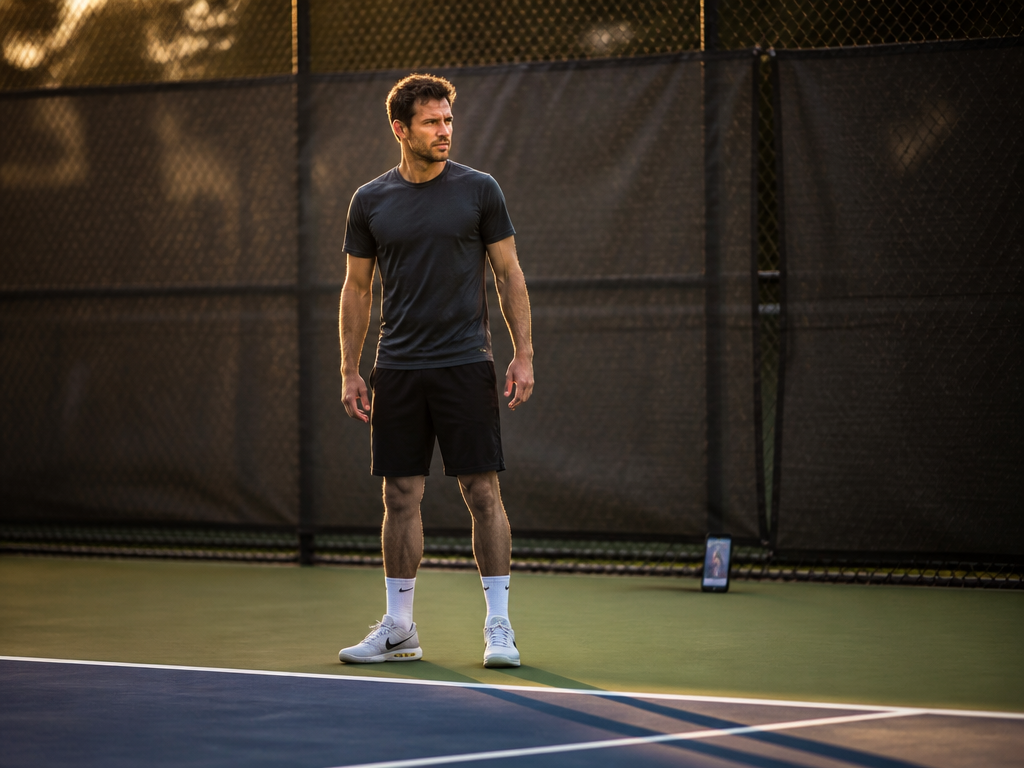
You have asked yourself this question, probably after a bad practice session: can you actually fix your game from a screen? You found a swing in a slump, watched forty minutes of tennis instruction on a phone propped against the fence, copied the cue, and either it clicked for one glorious basket of balls or it evaporated by Saturday. The question underneath is the real one. Does watching someone explain a forehand do anything durable to your forehand, or are you just entertaining yourself between losses.
We want to answer that honestly, including the parts where the answer is "it depends," because it does depend, and on things you can name.
Can you really improve your tennis from online videos?
Yes, but only for a specific category of problem, and the category is narrower than the marketplace of tennis content implies. Online instruction is good at giving you a model — what the motion should look like, what the intention behind it is, what the common error is. It is bad at telling you whether you, right now, are doing the thing or only feel like you are. That gap is the whole story. Most stuck players are not short on information. They are short on accurate feedback about their own movement, and a video cannot see you.
So the rule is roughly this: video transmits the target well, and transmits your error correction not at all. Where your problem is "I don't know what good looks like," it helps a lot. Where your problem is "I think I'm doing it and I'm not," it can quietly make things worse, because you reinforce a wrong copy with great enthusiasm.
The feedback loop is the thing that's broken
Motor learning is not mysterious, but it is specific. Skill acquisition runs on a loop: you attempt a movement, you get information about how it went, you adjust the next attempt. The information part has a name in the literature — augmented feedback — and it splits into knowledge of results (did the ball go in) and knowledge of performance (was your racquet face open at contact). A coach standing next to you supplies the second kind constantly and instantly. A video supplies neither. It supplies the target and then leaves the room.
This matters because the brain calibrates against feedback, not against intention. You can intend a flatter racquet face all day. If nothing tells you that your face is still 15 degrees open at contact, your nervous system has no reason to change, and it won't.
How a technical change actually sticks, in order
Walk through what happens when a change consolidates, because the order tells you where online learning drops out.
First, you understand the target — racquet face square, contact out front, hips rotating before the arm. Video does this fine. Second, you attempt it slowly, often comically slowly, and it feels wrong, because the correct motion feels wrong when the old one is grooved. Third — and this is the load-bearing step — something tells you whether the attempt matched the target. A coach's eye, a wall you can hear, a phone filming you and not the pro. Fourth, you repeat with that correction folded in, enough times and spaced out enough that it survives a night's sleep. Fifth, you stop thinking about it and it holds under a little pressure.
Online instruction owns step one. It is silent for steps three through five unless you build the feedback yourself.
The three failure modes
When a copied cue fails, it usually fails for one of three reasons, and they are worth separating because they have different fixes.
No error signal. The most common. You watched, you tried, nobody told you that your tried-version and the model-version diverged at contact. This is fixable with your own phone — film yourself from the side, freeze the contact frame, compare. Crude, but it closes the loop the video left open.
Model mismatch. The pro in the video is 6'2", has a continental grip habit baked in since age six, and a service motion you physically cannot reproduce next month. A lot of online instruction teaches the elite version of a stroke that even good club players approximate rather than replicate. Copying the visible shape of a Tsitsipas one-hander when your timing isn't there yet produces a worse backhand than a plain, ugly, reliable two-hander would.
Dose. This is the quiet killer. You watched once and practiced twice. Motor consolidation needs repetition distributed over days, not crammed into one bucket. One enthusiastic session does almost nothing that lasts.
What the practice research actually supports
A few findings are sturdy enough to lean on.
Distributed practice beats massed practice for retention — this is one of the most replicated results in all of skill learning, going back to work summarized in reviews like Schmidt and Lee's motor learning text and confirmed across decades of lab studies. Three twenty-minute sessions on three days outperform one sixty-minute session for what you still have a week later.
Feedback that is too frequent can hurt. The "guidance hypothesis," associated with Salmoni, Schmidt, and Walter (1984, Psychological Bulletin), found that constant feedback improves performance during practice but degrades it once the feedback is removed — learners lean on the crutch instead of building their own error detection. Faded or summary feedback retained better. The practical translation: a coach correcting every single ball can make you look good Tuesday and lost Friday. Self-filmed checks every few attempts may serve learning better than a voice in your ear nonstop.
Blocked versus random practice — hitting fifty forehands in a row versus mixing forehands, backhands, and volleys — shows the contextual interference effect: the messy, randomized version feels worse and produces more transferable skill. This has been replicated many times, though mostly in lab tasks rather than full tennis matches, so we'll call it well-supported in principle and plausible-but-thinner for your specific Sunday hit.
None of this is on the back of the average instructional video. The videos optimize for the watch — clear, confident, single-cue. The learning science says clear and confident is the easy part.
The place video genuinely earns its keep
Here is the turn. For the mental and tactical side, online instruction is often better than a live lesson, and we don't say that lightly.
A coach can't easily show you the geometry of where to recover after a wide ball, or walk you frame by frame through why you tighten up at 4-5. Tactical patterns, court positioning, shot selection, the logic of constructing a point against a pusher — these are knowledge problems, not feedback problems, and video transmits knowledge well. The pusher who beats you isn't beating your forehand technique. He's beating your decisions, and decisions are learnable from a screen because the error signal there is the scoreboard, not your racquet face.
The same goes for understanding your own tilt. Watching a calm explanation of why you double-fault under pressure — the rushed toss, the shortened motion, the held breath — gives you something to catch yourself doing in real time. That self-monitoring is a feedback loop you can run alone.
An honest rule of thumb
If you take one operating principle from this, take this: use video to learn the target and the tactics, use your own camera to learn your error.
In practice that means: watch the instruction once, not five times. Pick one cue, not four. Then turn the phone around, film yourself from the side at the baseline, and freeze the contact frame. Compare your frame to the model's frame. That comparison — not the original video — is where change comes from. Spread the work over several short days rather than one long one, and mix your strokes up instead of grooving one in a comfortable block.
That is the whole machine. The video is the map. The film of you is the compass. You need both, and most stuck players are carrying only the map and wondering why they're lost.
We won't pretend this closes every gap. Subtle timing faults sometimes need an eye that knows what to look for, and there is no app that fully replaces that yet. But the distance you can cover alone, with a phone and some patience, is larger than the discouragement usually allows.
The myth is that good online tennis instruction can fix your strokes because it explains them clearly. The more accurate version is that clear explanation fixes nothing on its own — what fixes your strokes is the feedback loop you build around it, and that part has always been your job.