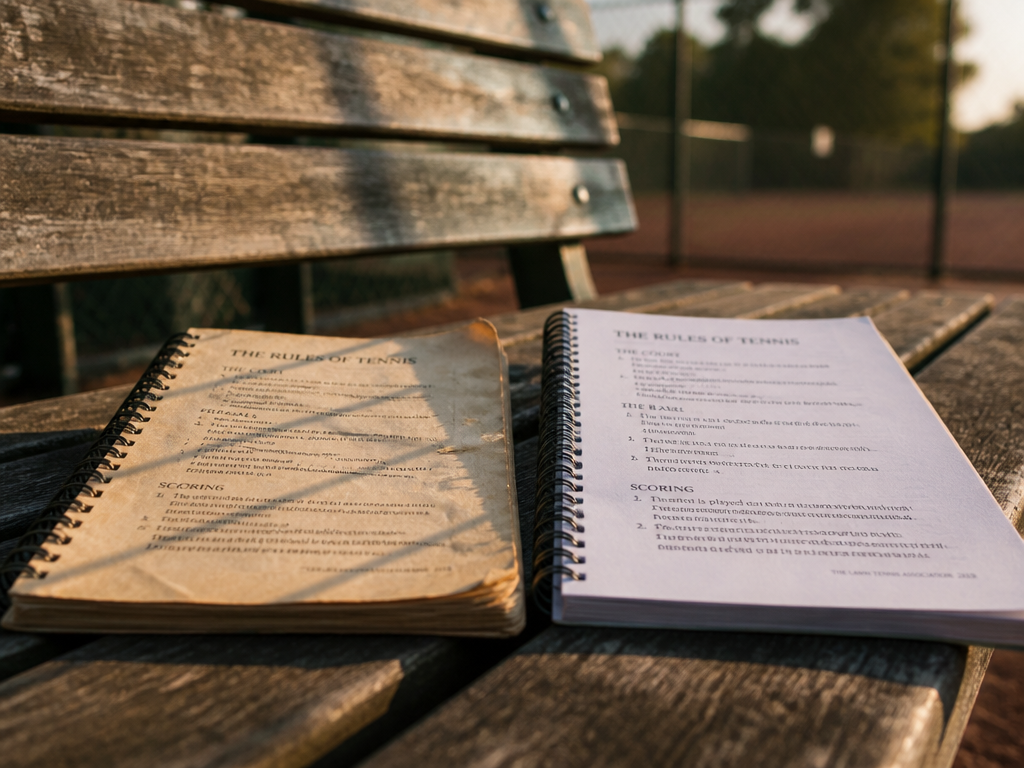
We keep rulebooks the way other people keep receipts, and last week two of them ended up open on the same screen: the current edition of the USTA's Friend at Court, which carries The Code, and an edition from roughly a quarter-century earlier. The errand was a two-minute lookup. It turned into the clearest case we have found of tennis rules changing their mind — not about a mechanic, but about what fairness is supposed to mean in a match nobody is officiating.
The item at issue governs one specific, common, miserable moment. You call a ball out. A half-second later you know it was in.
In the older edition, the remedy depends on the shot. In substance: if your bad call robbed your opponent of a ball they were clearly going to win the point with, you lose the point; if it did not, the point is replayed. In the current edition, the remedy depends on nothing. You lose the point. Every time. Whether the ball you wrongly killed was a sitter you would have buried or a screaming pass you were never reaching.
That is a sentence of difference in a document most club players have never opened. It is also a total replacement of the reasoning underneath it.
The verdict
The change from a shot-dependent remedy to a flat, single-outcome penalty is not a tidying-up. It is a different theory of fairness — and for a game with no umpire it is the better one, at a cost the current text never admits to.
Everything after this is us showing our work.
How we evaluated
We did not run a study and we were not on a court. This is a reading, and the reading is the whole authority claim, so here is exactly what went into it.
Primary sources. Two editions of Friend at Court, the USTA's handbook of the rules and their application, which the association publishes free at usta.com. The Code sits inside it as a set of numbered items governing unofficiated matches. We read the erroneous-call item in both editions and compared the operative sentences.
Framing sources. The ITF's Rules of Tennis, published at itftennis.com, which is worth keeping distinct in your head: The Code is not the Rules of Tennis. The Rules govern the game. The Code governs what players do when no official is present to apply the Rules. That distinction turns out to matter enormously here.
Supporting evidence. Published work on line-call perception, principally Mather (2008) in Proceedings of the Royal Society B, and the professional game's move to electronic adjudication. We used these to test one specific claim — that near-line calls are genuinely hard rather than merely contested — not to argue anything about The Code's authors' intentions.
What we weighted heaviest. The rule text itself. Everything else is context.
Two honest caveats before we go further. First, we are paraphrasing both editions rather than quoting them, because we would rather give you the substance accurately than a quotation we cannot guarantee is character-exact. Open the current PDF and check us. Second, the item numbers in The Code have moved across editions as items were added, split, and merged. If you go looking for "Principle 12" by number in an edition other than the one on our screen, you may land somewhere else entirely. Identify this rule by what it does — the remedy for an out call you correct yourself — not by its number.
A remedy versus a rule
Set the two versions next to each other and the difference is not severity. It is category.
The older text writes a remedy. It asks a question about the specific incident — what did your error actually cost your opponent? — and it fits the consequence to the answer. That is the logic of a small claims court. Damages should track harm. If your mistake cost your opponent a certain point, they get the point. If it cost them a rally they might have lost anyway, they get the rally back. Nobody is over-punished, nobody is under-compensated, and the outcome is calibrated to the facts.
The current text writes a rule. It asks no question about the incident at all. Bad call, corrected, point gone. The facts of the rally are formally irrelevant.
Read in isolation, the older version looks more sophisticated and the newer one looks blunt. Read as governance design for an unofficiated match, the polarity flips — and the reason is that the older version has a hidden dependency. It requires somebody to answer the question would that have been a winner? And in an unofficiated match, the only people available to answer it are the two people with a direct stake in the answer.

That is the flaw. Not that the proportional remedy is unfair — it is beautifully fair in principle. It is that it cannot be applied by the parties it governs without becoming a negotiation, and it hands the strongest negotiating position to whoever is most comfortable arguing. The player who made the bad call now has a live incentive to characterize their opponent's shot as a routine ball rather than a putaway. The player who was wronged has the mirror incentive. A rule designed to produce fairness produces an argument, and the argument is won by temperament rather than by fact.
The current version deletes the question. There is nothing left to characterize, because the characterization no longer changes the outcome. The dispute has no surface to grow on.
The evidence that nobody can see the line
The case for bright lines gets stronger once you take seriously how hard the underlying perceptual task is.
Mather (2008), analyzing challenge data from the professional tour, argued that the pattern of line-judge errors was consistent with ordinary perceptual uncertainty rather than incompetence or bias — that misjudgements cluster in a narrow band around the line, exactly where a well-calibrated observer with human temporal and spatial resolution would be expected to make them. The broader flash-lag literature in vision science supplies a plausible mechanism: the visual system's estimate of where a fast-moving object is at the instant of a brief event is systematically displaced, which is a structurally unhelpful property for judging a ball bounce against a painted stripe.
We want to be careful with this. Mather's work is about trained line judges seated on-axis at professional events. Our reading is that a recreational player standing off-axis, mid-recovery, twenty feet from the bounce, is in a strictly worse epistemic position than the people in that dataset — but that inference is ours, not Mather's, and we have not seen it tested.
On the frequency of overturned calls, we will hedge rather than give you a clean number. The figure commonly reported for successful player challenges lives somewhere in the region of a quarter to a third, varying by surface, event and season, and we could not tie a single canonical published tally to a source we would stake the piece on. Treat it as a magnitude, not a measurement: a meaningful minority of confident professional calls, made by specialists, were wrong.
The governing bodies drew their own conclusion. The All England Club announced in October 2024 that Wimbledon would replace line judges with electronic line calling from the 2025 Championships, ending a practice that had run since the tournament's founding, and the ATP moved to electronic line calling across its tour-level events on a similar timeline. The professional game's answer to the epistemics of the baseline is: stop asking humans.
Recreational tennis cannot buy that answer. It has to solve the same problem with nothing but text — and the text is what The Code is. Once you accept that the underlying judgement is genuinely uncertain, a rule that makes the consequence certain starts looking less like bluntness and more like the only remaining lever.
Four ways to govern a bad call
| Design | Who decides the outcome | Cost of a wrong call | Characteristic failure |
|---|---|---|---|
| Proportional remedy (older Code) | The two players, jointly | Varies with the shot | Becomes a negotiation; loudest player wins |
| Flat forfeit (current Code) | The text, in advance | Always the point | Over-punishes trivial errors |
| Roving official | A third party | Official's discretion | Requires staffing most matches never get |
| Electronic line calling | The system | The correct call, immediately | Capital cost; unavailable below the top tier |
Read down the second column and the pattern is plain. The current Code is the only design that removes the decision from the people in the dispute without requiring a person or a machine to be present. That is not a small achievement. It is the same move electronic line calling makes, executed with nothing but a sentence.
What the change costs
A review that finds no downside has not looked. Here is the strongest case against the current version, and we think it is a real one.
It prices honesty. Under the older text, confessing a bad call sometimes cost you nothing — a replayed point. Under the current text, confessing always costs you the point. The Code is asking players to volunteer a self-incrimination that now carries a guaranteed, non-negotiable penalty, in a setting where the only person who knows you were wrong is you. Deterrence and disclosure pull in opposite directions here, and the text picks deterrence.
We should be careful about how far to push this. It is an argument from incentives, not an observation of behavior. We have seen no data on whether self-corrected calls became rarer after the change, and we doubt such data exists — the event is unobservable by design. Anyone who tells you the change reduced honest corrections is speculating. So are we, in the other direction, if we say it did not.

It discards genuinely relevant information. Sometimes the wrongly-called ball really was floating and really was going to be crushed, and sometimes it really was unreachable. The older rule saw that difference. The current one is deliberately blind to it, and blindness is the price of consistency, not a bonus feature.
It is silent about its own trade-off. This is the criticism we would put to the drafters if we could. The current text presents itself as a simple statement of consequence. It does not explain that it chose predictability over proportionality, or why. A player who reads it comes away knowing the mechanic and knowing nothing about the reasoning — which is precisely the complaint we hear most from people who read The Code seriously. The document tells you what to do beautifully. It almost never tells you why, and the why is where the design lives.
Where the evidence is thin
We can show you what changed. We cannot show you why, and we will not pretend otherwise.
The USTA does not publish a legislative history for The Code in the way a statute would carry committee reports. What we have is two texts and a gap. The account above — that a case-by-case remedy was replaced because it could not survive being applied by the disputants — is an inference from the structure of the rules, and it is the most economical explanation we can construct. It is not testimony. Anyone who claims to know the drafters' minds without a citation to a published rationale is filling the gap with a story.
The perception evidence is solid for what it covers and does not cover what we most want. Mather (2008) is peer-reviewed and specific. Its subjects are professionals. The extension to a 4.0 player on a public court is reasonable and unverified.
And the numbering problem is worse than a footnote. Anyone building an argument about "Principle 12" across editions is, unavoidably, tracking a moving target — which is a decent argument for citing Code items by heading and edition year rather than by number.
Who this is for
This matters to you if you play unofficiated competitive matches — leagues, flex ladders, sectional draws, anything without a chair — and you have ever stood at the baseline unsure what you were obligated to do after correcting yourself. It also matters if you captain, organize, or referee, because the shift from remedy to rule changes what you should say when two players call you over. Under the current design the answer is short, and its shortness is the feature.
This matters less to you if you play social tennis where every disputed point gets replayed by mutual agreement anyway. The Code has never had the force of the Rules of Tennis; it is a code of conduct with a rulebook's diction, and a friendly match that ignores it is not breaking anything.
It is not for you at all if what you want is a ruling to win an argument you already had. The current text will give you one, and using it that way is closer to what the older text failed to prevent than to anything either edition was trying to build.
Evidence grade
Central claim — that the current item replaced a proportional remedy with a flat penalty, and that this constitutes a change of principle rather than of wording: Strong. It rests on two published editions of a primary source that anyone can open and check.
Supporting claim — that near-line judgement is perceptually unreliable enough to justify bright-line consequences: Moderate. Mather (2008) and the professional game's move to electronic line calling both point this way; neither addresses recreational play directly.
Interpretive claim — that the change was driven by the unenforceability of the older remedy, and that it prices honest self-correction: Weak. Coherent, economical, and unsourced. Hold it loosely. A note from the desk, in the singular. I have been reading The Code straight through, item by item, for long enough to have developed opinions about a document that is mostly trying not to have any. Most weeks the changes between editions are housekeeping — a clarified antecedent, a merged pair of items, a heading that reads better. This one stopped me, and it took a second read to work out why. It was not that the rule got harsher. It was that the rule stopped caring about the answer to a question the older version thought was essential. Two documents, same sport, same page of the same handbook, and one of them thinks fairness is a measurement while the other thinks fairness is a line drawn in advance.
Both of them are trying to get to the same place. Only one of them can get there with two players and no umpire.
A rule you have to argue about isn't a rule. It's a negotiation with a scoreboard attached.