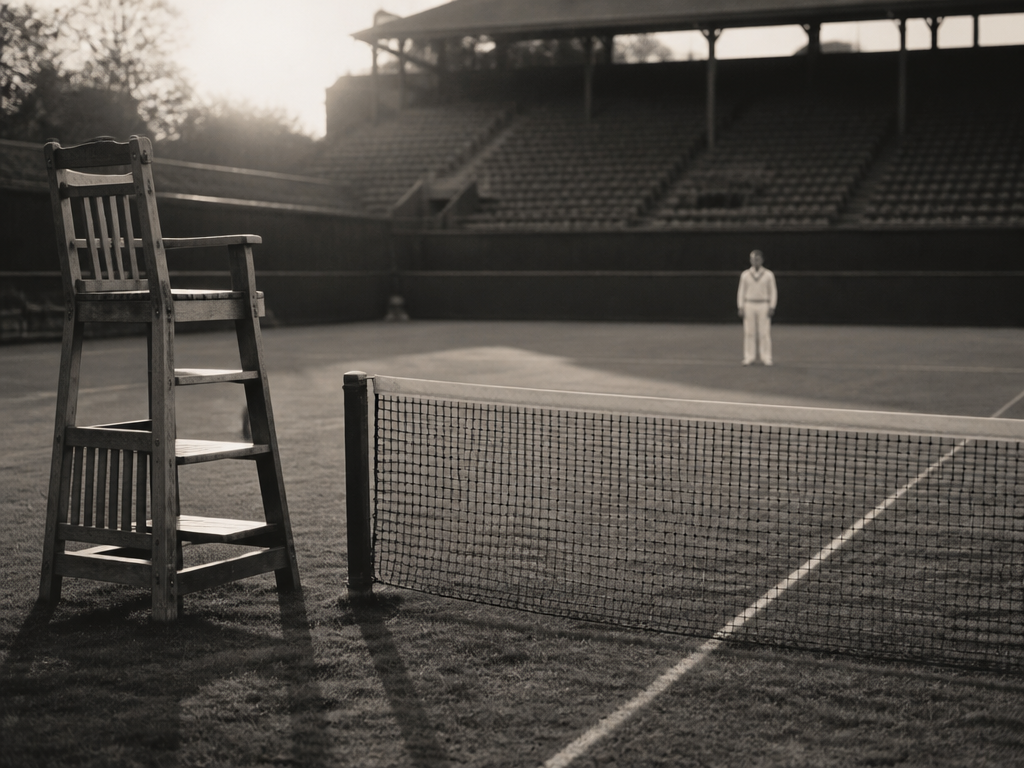
When a commentator says a player holds an "Open Era record," they are quietly excluding roughly the first ninety years of competitive tennis history. The phrase is not decoration. It marks a hard regulatory line drawn in 1968, the year the four Grand Slam tournaments first admitted professionals and amateurs to the same draw. Everything before that line lived under a different set of rules, and the records from that period are not directly comparable to what came after.
This is a history piece, not a product test, but the desk's habit holds: state the conclusion early. The Open Era distinction exists because, before 1968, the best players in the world were structurally forbidden from playing each other at the sport's biggest events. Once that ban collapsed, the record book effectively restarted. Understanding why requires looking at what the split actually was.
What most people do
Most fans treat "Open Era" as a polite way of saying "modern" — as if 1968 were just an arbitrary cutoff, like ignoring black-and-white film. The assumption is that the tennis before it was the same game, only slower and in longer trousers, and that the records are old simply because the players were.
That reading misses the mechanism. The pre-1968 record book is incomplete not because of time but because of exclusion. A large share of the era's strongest competitors were ineligible for the tournaments that generate the records everyone cites. So when a fan compares a modern Grand Slam tally against a pre-Open figure and treats them as the same currency, they are comparing a count taken from the full field against one taken from a deliberately thinned field. The numbers look like the same unit. They are not.
The second common move is to assume the split was about money in the crude sense — pros chasing cash, amateurs preserving honor. The reality was more bureaucratic and, in hindsight, more absurd.
What the evidence suggests
For most of the twentieth century, tennis ran on a two-tier system enforced by the sport's amateur governing bodies. The Grand Slams — Wimbledon, the U.S. National Championships, the French Championships (Roland Garros), and the Australian Championships — were amateur events. To enter, you had to be an amateur. The moment a player turned professional, signing with a promoter to be paid openly, they forfeited their eligibility for those tournaments.
The catch was that amateurs were rarely amateur in any meaningful sense. Many top players received under-the-table payments — appearance fees and expenses dressed up as something else — a practice common enough that the players were nicknamed "shamateurs." The system therefore policed a distinction it could not honestly maintain.
Meanwhile, a separate professional circuit operated in parallel. Promoters such as Jack Kramer ran barnstorming pro tours through the 1950s and 1960s, recruiting the reigning amateur champions one by one. Players including Kramer himself, Pancho Gonzales, Rod Laver, Lew Hoad, and Ken Rosewall turned professional and disappeared from the Grand Slam draws entirely. Laver won the amateur calendar Grand Slam in 1962, turned pro, and was then barred from the very events he had just swept — until the rules changed, after which he won the calendar Slam again in 1969.
The consequence is the heart of it: at the sport's peak in the early 1960s, the four major titles were being contested by the second tier, because the first tier had cashed out and been locked out. The amateur champion and the professional champion could not meet on the biggest stages. A record book built under those conditions records who won among the eligible, not who was best.
The break came in 1968. The British Lawn Tennis Association, frustrated with policing a fiction, voted to admit professionals to Wimbledon and abolish the amateur-only requirement; the international federation, after resistance, accepted "open" tournaments. The first open major was the 1968 French Championships, won by Rosewall. Open Wimbledon followed that summer, won by Laver. From that point the full field competed for every major.
The new openness created a new problem: prize money, scheduling, and player welfare now needed organizing across a unified professional field. Players built their own institutions in response — the Association of Tennis Professionals (ATP) in 1972, and on the women's side the WTA in 1973, founded by Billie Jean King and others partly in protest at pay disparity. The gap was not subtle. At some early Open events the women's champion earned a fraction of the men's purse, a disparity that took the U.S. Open until 1973 to formally close with equal prize money, and other majors decades longer.
| Criterion | Pre-1968 | Open Era (1968–) |
|---|---|---|
| Who could enter the majors | Amateurs only | Amateurs and professionals |
| Where the top players were | Split across amateur draws and pro tours | One unified field |
| Pay structure | Official amateurism, unofficial "shamateur" payments | Open prize money |
| Player governance | Amateur national/international bodies | ATP (1972), WTA (1973) |
| Comparability of titles | Field deliberately incomplete | Field complete |
The 1968 pivot, read this way, was not a fresh start imposed from above. It was the collapse of a rule the sport could no longer enforce, followed by players assembling the structures the old system had never given them.
What I actually do
On this desk, when we file a historical claim, we tag every Grand Slam count with its boundary before we publish it. A pre-1968 figure gets the qualifier and a one-line note on the split; an Open Era figure gets the qualifier too, because the qualifier is the honest unit, not the exception. We do not let "most majors ever" stand in a draft without one of us asking which book it came from.
The practical version is smaller than that sounds. When a reader emails to ask why a player's total "doesn't count" something from the 1950s, the reply we keep saved is one sentence: the events that produced those numbers excluded the people who would have changed them. That is the whole reason the word "Open" is still load-bearing fifty-odd years later — and the reason we type it out every time rather than trusting the count to speak for itself.
Evidence grade for the central claim — that 1968 marks a genuine break in comparability, not a cosmetic one: Strong. The tournament eligibility rules, the named professional defections, and the founding dates of the ATP and WTA are all well documented. The specific early prize-money figures are illustrative and vary by event and year; treat them as direction, not decimals.