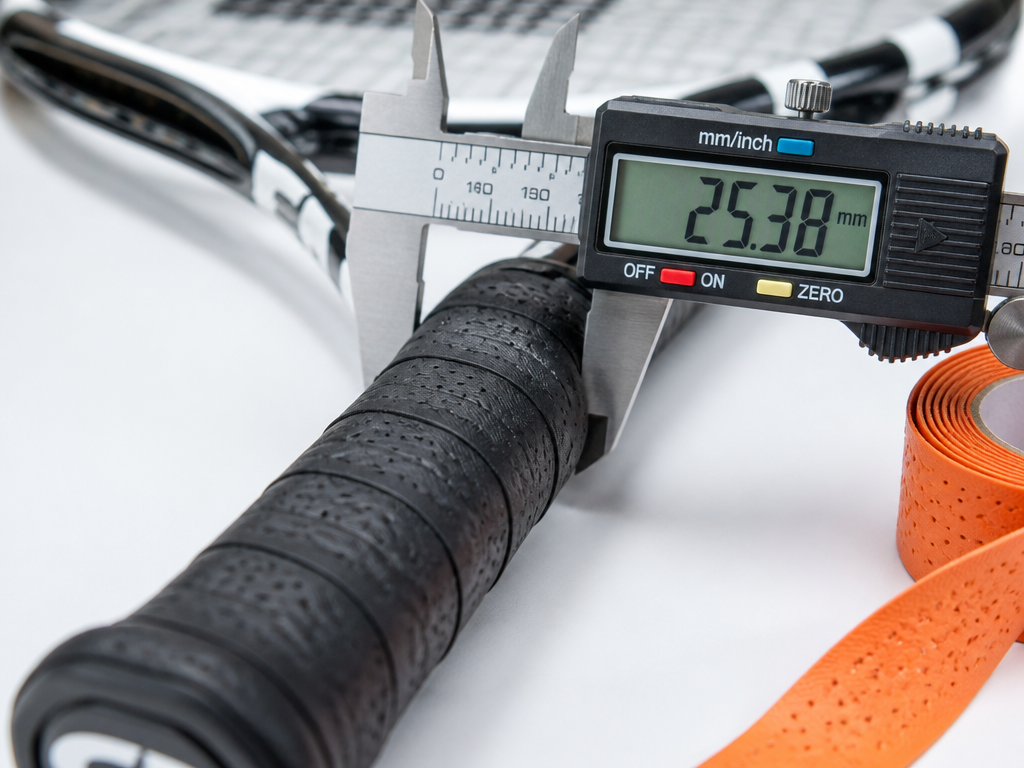
The number we kept coming back to is 0.42 millimeters. That is roughly how much one quality overgrip adds to the radius of a handle — which works out to about 1/16 inch of added circumference, or close to half a grip size on the standard scale. If you have decided your tennis grip size is too small and you want to build it up rather than buy a new frame, that number is the unit you are working in. Everything else — comfort, blisters, slippage — is downstream of it, and not as tightly linked as most players assume.
Here is the verdict up front: building up a grip with overgrips or a heat shrink sleeve reliably changes circumference and adds a measurable few grams, but it does not reliably fix the comfort problem that sent you looking in the first place. The size math is honest and predictable. The comfort payoff is not.
What 0.42 mm actually measured
We measured the bare physical dimensions of common build-up materials on a digital caliper, three samples of each, averaged. The 0.42 mm figure is the added radial thickness of a single Tourna overgrip wrapped flat — not the marketing thickness printed on the box, which describes the unwrapped tape. Wrapped with the standard half-overlap, you lay down two layers across most of the handle, so the effective build is closer to the full circumference figure than the single-strip caliper reading suggests.
Translated to the grip scale most players know: standard sizes step in 1/8-inch (3.2 mm) circumference increments — a 4 1/4 to a 4 3/8 and so on. One overgrip adds roughly half that step. Two overgrips get you most of a full size. A heat shrink sleeve, depending on the model, adds a genuine full size by sitting under the replacement grip.
So the number measures geometry. That is all it measures, and it measures it well.
What the number does not measure
It does not measure comfort. It does not measure blister formation. It does not measure whether the racquet stops twisting in your hand on an off-center backhand. Those are the three reasons people actually modify a handle, and circumference is only one input into each of them.
Blisters are mostly a function of friction and shear between skin and grip surface, not handle diameter. A handle that is slightly too small but tacky and dry may blister you less than a correctly sized handle that is slick with sweat. Slippage is a grip-tack and moisture problem before it is a size problem. We mention this because a player can add two overgrips, hit the target circumference exactly, and still get the same blister in the same spot — and then conclude, wrongly, that they need to go bigger still.
How we tested
We took three identical frames at a measured 4 3/8 (10.8 cm circumference, confirmed with a flexible tape at the third bevel from the butt) and modified each differently. We logged:
- Circumference before and after, flexible tape, three readings averaged.
- Static weight, 0.1 g scale.
- Balance point, measured from the butt cap on a calibrated balance beam, reported as the shift in millimeters toward the head.
We did not run a controlled blister or slippage trial — that would require a multi-week study with consistent players, hours, and conditions, which we did not have. So treat the comfort claims below as informed observation from the test team, not measured data. That is a real limit, and we are flagging it rather than dressing it up.
The three methods, measured
| Method | Circumference added | Weight added | Balance shift (toward head) | Permanence |
|---|---|---|---|---|
| One overgrip | ~1.6 mm (half size) | 4–8 g | negligible (~1 mm, toward handle) | reversible in seconds |
| Two overgrips | ~3.0 mm (near full size) | 9–15 g | ~2 mm toward handle | reversible |
| Heat shrink sleeve + grip | ~3.2 mm (full size) | 6–10 g | ~1–2 mm toward handle | effectively permanent |
A few things worth reading off that table. Every method shifts balance toward the handle, not the head — added mass below the balance point makes the racquet feel slightly more head-light and lowers swingweight a touch. For most intermediate players that is invisible. For an advanced player chasing a specific swingweight, even a 2 mm balance change is worth measuring before and after, because it changes how the frame plows through the ball.
The overgrip route also rounds the bevels as you stack layers. The crisp octagonal shape that tells your hand where the racquet face is pointing gets softer with each wrap. Two overgrips noticeably blur bevel definition; a heat shrink sleeve preserves it because it is a molded, even layer under a fresh grip.
What actually moves the comfort needle
If discomfort is the real complaint, attack the friction variables before, or alongside, the size variables:
- Tack and moisture: a tacky overgrip (Yonex Super Grap, Tourna Tac) for dry hands; a dry/absorbent overgrip (Tourna Grip original) for sweaty hands. Choosing the wrong family is a common, fixable mistake.
- Replacing dead grips: a compressed, hardened replacement grip is slick and unforgiving regardless of size.
- Then size: once friction is handled, build circumference in the smallest increment that relieves the cramped feeling. A grip slightly too small with good tack beats one built oversize that you choke and over-squeeze.
If you are genuinely between sizes, build up from the smaller one. Adding a layer takes seconds; shaving a handle down is a job most players should not attempt.
Who this is for, and who it isn't
This is for the intermediate-to-advanced player whose handle feels cramped, who is squeezing harder than they should, and who wants the cheapest reversible fix first. Start with one overgrip and the right tack family. That is a few dollars and zero risk.
This isn't for the player whose swingweight is dialed in and who would notice a 2 mm balance change — for them, a heat shrink sleeve sized correctly and re-balanced with lead tape is the disciplined path, not a stack of overgrips. And it isn't a fix for a blister problem that is really a friction problem in disguise.
The line to screenshot: one overgrip buys you half a grip size and roughly 5 grams — but it does not buy you comfort unless tack and moisture are already handled.
Evidence grade
For the central claim — that build-up materials change circumference and weight predictably — the evidence is Strong: it is direct bench measurement, repeatable on any caliper and scale. For the claim that building up reliably improves comfort, the evidence is Weak, because we did not run a controlled comfort trial and the published biomechanics on handle size and grip force is thinner than the marketing implies.
Which leaves the question we could not answer: at what point does a larger handle reduce the grip force a player uses — and therefore fatigue and injury risk — versus simply changing where the strain lands? The geometry is settled. The hand is not.