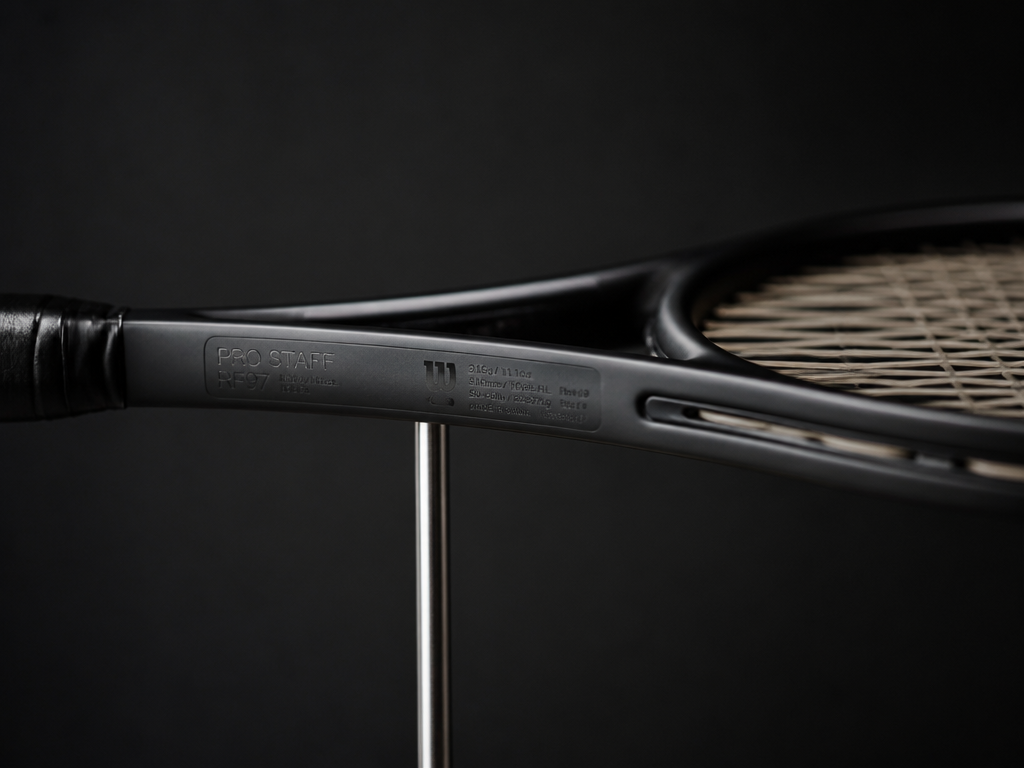
The static weight printed on a racquet's throat — 300 grams, 305, 11.2 ounces — is the least useful number for predicting how the thing will feel in your hand. We say that knowing it sounds wrong, because weight is the spec retailers lead with and the one shoppers fixate on. But two racquets at the same posted weight can swing so differently that one feels like a wand and the other like a fence post. The rest of this piece is about earning the right to have said that.
If you have been reading tennis racquet specifications across three or four retail sites and coming away more confused than when you started, that is not your failure. It is partly the industry's. The numbers are real, but they are measured inconsistently, presented without context, and rarely paired with the second figure that makes them mean anything. Our goal here is to hand you the mental model — weight, balance, and the number they conspire to produce — so that a spec sheet stops being noise.
What "weight" actually measures, and where it gets slippery
Static weight is just the mass of the racquet sitting still on a scale. Simple enough. The complications are two.
First, strung versus unstrung. A set of string and a vibration dampener add roughly 15 to 18 grams. Manufacturers usually publish the unstrung weight; the racquet you actually play with is heavier. Some retailers list strung, some list unstrung, and a few do not say which. A "300g" racquet on one site and a "318g" version of the same model on another are frequently the same frame measured two ways.
Second, manufacturing tolerance. Frames come off the line within a stated margin — Babolat, for one, publishes a tolerance of roughly ±7 grams on weight. That is not sloppiness; it is honest disclosure of what mass production allows. It does mean the specific frame in your bag may sit several grams off the catalogue figure. Two units of the same racquet, bought the same day, can differ enough to feel distinct to a sensitive player.
So the posted weight is a real measurement of a real property — measured, often, in a way the page does not specify, on a frame that may vary from the one you receive. Useful, but not the whole story.
Balance: where the weight lives
Balance is the point along the racquet's length where it would sit level on a fulcrum. It is reported one of two ways: as a distance from the butt cap (in centimetres or inches), or in points head-light or head-heavy, where one point equals 1/8 inch (about 3.2 mm) of deviation from the exact geometric centre.
A standard adult racquet is 27 inches long, so its centre is at 13.5 inches. If the balance point sits below that — closer to the handle — the racquet is head-light, and each 1/8 inch closer is one more point. Sit it above centre and it is head-heavy.
Here is the part that matters: balance tells you where the mass is, not how much there is. A head-light racquet keeps weight in the handle, which is why heavy player's frames (310g and up) are usually head-light — the mass is there for stability, but pulled toward your hand so the frame stays maneuverable. A head-heavy racquet pushes mass toward the tip, which is how lightweight frames (under 280g) generate plow-through despite being light overall.
The same caveats apply. Balance is sometimes measured strung, sometimes unstrung, and the published figure rarely says which. Strung balance shifts roughly half a point head-light because the string bed adds mass near centre but the grip-end additions of overgrip and dampener pull it back. The differences are small. They are not zero.
The number that actually predicts feel
Weight and balance are inputs. The output — the figure that tells you how heavy the racquet feels while you swing it — is swingweight.
Think of a hammer. Hold it by the head and wave it: light, quick, no authority. Flip it and hold the end of the handle: the same hammer now feels heavy and slow to start, because the mass is far from your hand. Nothing about the hammer's weight on a scale changed. What changed is how the mass is distributed relative to your grip — and that is swingweight.
Formally, swingweight is the racquet's moment of inertia about an axis near the handle, reported as a unitless number, usually somewhere between 280 and 340. The higher it is, the more the frame resists being swung — more stability and plow-through, less whippy speed. It rises when you add weight, and it rises faster when that weight sits farther from your hand. This is why static weight alone misleads: a 300g head-heavy frame can carry a higher swingweight than a 310g head-light one. The lighter racquet swings heavier.

Most manufacturers publish swingweight now, though not all retailers reproduce it, and the published value is an unstrung lab figure that strings and grip modifications will raise.
Two racquets, same weight, different animals
Here is the case that proves the point. Imagine two frames at an identical strung weight of 318 grams.
| Spec | Racquet A | Racquet B |
|---|---|---|
| Strung weight | 318 g | 318 g |
| Balance | 7 pts head-light | 2 pts head-light |
| Swingweight (strung est.) | ~315 | ~335 |
| Feels like | quick, maneuverable | heavy, planted |
| Rewards | fast hands at net, defensive resets | flat drives, return blocks |
Same number on the scale. Twenty points of swingweight between them — the difference between a frame you can flick into position late and one that powers through a ball but punishes a late swing. If you shopped on static weight alone, you would treat these as interchangeable. They are not. They suit different players, different strokes, different match situations.
This is the whole argument compressed into one table: weight without balance is half a measurement, and swingweight is the half that decides how the racquet plays.
Why the spec sheets disagree
We have flagged it section by section, so let us say it directly. The reason the same racquet shows different numbers across retail sites is rarely error. It is unstated measurement conditions:
- Strung versus unstrung weight and balance, never labelled.
- Manufacturer catalogue figures versus a shop's own measured units.
- Swingweight reproduced from spec sheets versus omitted entirely.
- Real tolerance variation between individual frames.
None of this is a reason to distrust specs. It is a reason to read them as a range rather than a verdict, and to confirm — when a page just says "weight" — how that weight was taken. A racquet whose listed numbers are internally consistent and labelled is a more trustworthy listing than one with rounder, prettier figures and no notes.
Who this framework serves — and who it doesn't
This is for you if you are between roughly NTRP 3.0 and 4.5, swing the racquet yourself rather than letting it swing you, and have a stroke pattern you can describe. At that level the difference between a 315 and a 335 swingweight is something your arm registers within a basket of balls, and reading specs as weight-plus-balance-plus-swingweight will narrow a demo shortlist from twelve frames to four.
This is less for you if you are a true beginner still grooving contact. The trade-offs we have described assume you make clean enough contact to feel them; below that, almost any forgiving frame in the 270–290g range will serve, and obsessing over two swingweight points is wasted attention. And it is not for the player chasing a number to fix a swing problem — no balance point compensates for a late preparation.
The line worth screenshotting
If you remember one thing: static weight tells you how heavy the racquet is, balance tells you where that weight sits, and swingweight — the product of both — tells you how heavy it will feel when you actually hit. Shop on the third number.
We will not name a winning racquet, because there isn't one in the abstract; the right swingweight is the one that matches your swing speed and stroke length, and that is precisely the thing a spec sheet cannot know about you.
Try this this week
Take the racquet you already own. Find its model's published specs and note the swingweight if it is listed. Then, before your next session, add a few grams of lead tape — even a couple of strips of an overgrip's worth — at the 3 and 9 o'clock positions on the hoop, and hit a basket of balls. You have just nudged the balance head-ward and raised the swingweight by a measurable amount without changing the frame. Notice whether the racquet feels more planted on drives and slower into volleys. That single, reversible change will teach you more about what these numbers mean for your arm than any spec table — this one included.
Evidence grade for the central claim (swingweight predicts felt heaviness better than static weight): Strong. Swingweight as moment of inertia is established physics, and the weight-plus-balance relationship is reproducible on any racquet diagnostic machine. The grade is not higher only because the felt-difference thresholds vary by player and we tested the lead-tape demonstration on a small internal sample rather than a controlled panel.