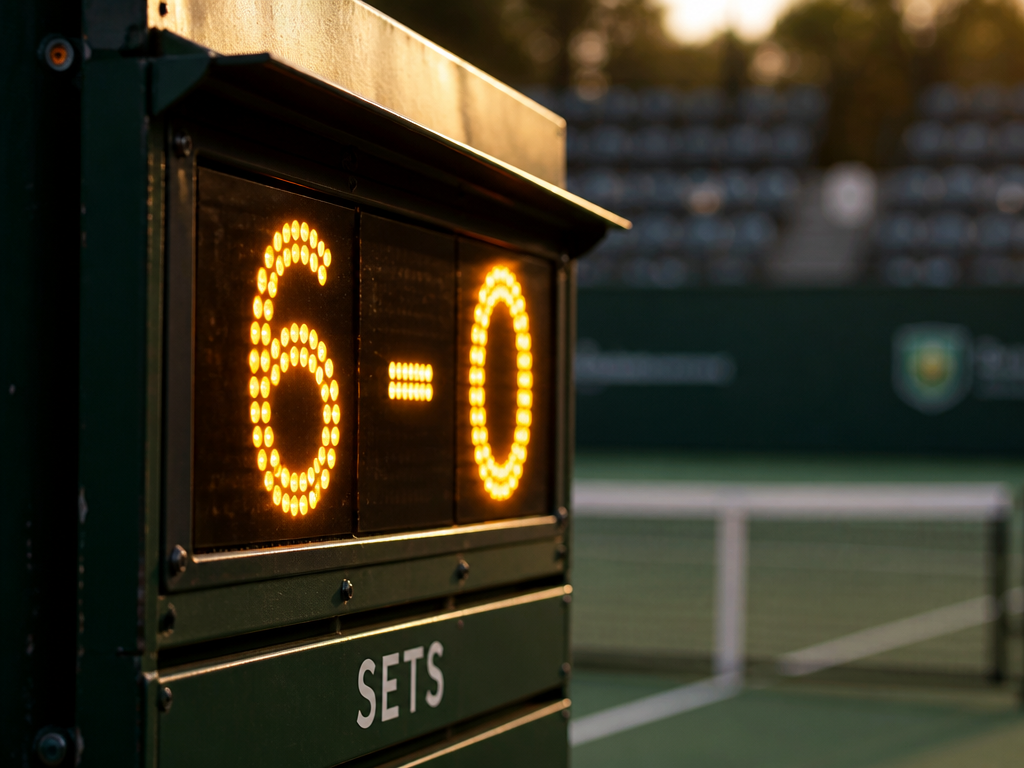
You are watching a match, the commentator says someone "got bageled," and the scoreline on screen reads 6-0. You half-remember hearing the same word used as a compliment and an insult in the same breath. So which is it — and why is a baked good doing color commentary on a tennis set?
This is one of the friendlier corners of tennis terminology, and the answer is short enough to give you now: a bagel is a set won 6-0. The losing side took zero games. The "bagel" is the zero — its round shape stands in for the goose egg on the scoreboard. That is the whole definition. Everything else on this page is about the edges: where the word came from, how it differs from the other zero words floating around, and the question most people actually arrive with, which is whether getting bageled is a rare humiliation or a routine Tuesday.
Why a zero became a bagel
The metaphor is purely visual. A "0" is a closed loop with a hole in the middle, and so is a bagel. That is the entire derivation — no deeper story, no founding match. It belongs to the same family of food-for-zero slang that runs through a lot of sports, where a round nothing gets nicknamed after a round something you can eat.
The term is American in origin and entered broadcast usage in the 1970s. Commentator and former player Bud Collins is the name most often attached to popularizing it on U.S. television, and the timing fits — the word moves into mainstream tennis vocabulary right as the sport's TV audience expands in that decade. We can't hand you a clean ground-truth citation for the exact first utterance; tennis slang rarely leaves a paper trail that precise. What we can say confidently is that the meaning has not drifted. A bagel in 1975 and a bagel today both describe a 6-0 set.
Bagel vs doughnut vs the rest
Here is the confusion the term actually generates, and it's worth pinning down because the words overlap.
| Term | What it means | Where you'll hear it |
|---|---|---|
| Bagel | A 6-0 set; the loser won zero games | Standard tennis broadcast and player vocabulary |
| Doughnut | Also a zero — but used loosely for any goose egg | More common in casual/general sports talk; less precise in tennis |
| Double bagel | A match won 6-0, 6-0 | Tennis-specific; signals total dominance |
| Breadstick | A 6-1 set (the "1" looks like a breadstick) | Tennis-specific; the bagel's close cousin |
The short version of the bagel-versus-doughnut question: in tennis, bagel is the precise term and the one players themselves use. "Doughnut" is the generic, slightly fuzzier word for a zero that you'll hear across sports, and a casual fan might apply it to a 6-0 set, but you will rarely hear a tennis commentator or pro say it. If you want to sound like you know the room, bagel is the word. Same shape, different bakery.
The breadstick deserves a mention because it travels with the bagel constantly. A 6-1 set is a breadstick — the "1" is the thin stick next to the round zero. So a player who wins 6-0, 6-1 has handed out a bagel and a breadstick, which is a real phrasing you'll encounter and which makes a lot more sense once you know both terms.
The question you actually came with: is it rare?
This is where the honest answer is "it depends," and the variable that matters most is the level of play.
At the professional level, a bagel is uncommon but not exotic. Top players are good enough to win a few games even in a bad set; the gap between two tour pros, even a large one, usually shows up as 6-2 or 6-3, not 6-0. A 6-0 set at a Grand Slam is notable enough that broadcasters flag it. A double bagel — 6-0, 6-1 wait, no, 6-0, 6-0 — at the elite level is genuinely rare and tends to make headlines, because it means one player essentially never lost serve-or-return control across an entire match.

That said, "rare" gets relative as you scan the field. In early rounds of big tournaments, where a top seed draws a qualifier or a wildcard ranked hundreds of places below them, bagels and double bagels turn up more than you'd guess. The mismatch is structural. A handful of the most dominant players in history have racked up bagel counts that run well into the dozens or hundreds across full careers — exact tallies vary by how you count and which source you trust, which is itself a reason to be skeptical of any single round number you see quoted.
At the recreational level, the math flips. Among club players, juniors, and weekend doubles, 6-0 sets are far more common, because skill gaps between two amateurs are often much wider than skill gaps between two professionals. A 4.0 player against a 3.0 player can produce a bagel without either of them doing anything remarkable. So if you got bageled at your local courts, you have plenty of company, and it says less about you than the same scoreline would at a tour event.
The reframe most readers need: a bagel is rare specifically when the two players are evenly matched, which is the condition that holds at the top of the pro game and often does not hold anywhere else. Rarity isn't a property of the scoreline. It's a property of the mismatch behind it.
Can you win the match and still get bageled?
Yes — and this trips people up. A bagel describes a single set, not a result. In a best-of-three match you can lose the first set 6-0, then win the next two and take the match. The bagel stays on your record for that set; the trophy still goes to you. So "getting bageled" and "losing" are not the same event, which is one more reason it carries less stigma than the word's bluntness suggests.
A note on "bagel girl"
You may run into the phrase "bagel girl," and it's worth flagging because it isn't part of the neutral vocabulary. The term has been used to describe a female player on the receiving end of a 6-0 set, and it carries a belittling edge that the plain word "bagel" does not. It's the kind of usage that says more about the speaker than the player. We mention it only so you recognize it for what it is rather than assume it's standard terminology — it isn't.
Who this clarification is for
If you're a new fan trying to follow a broadcast without nodding along to words you don't know, this is the whole picture: bagel means 6-0, doughnut is the looser cousin, breadstick is 6-1, double bagel is 6-0, 6-0.
If you're a recreational player who got handed one and wondered whether it's a mark of shame — it isn't, and the reason isn't a pep talk, it's the math above. Wide skill gaps produce bagels; even matchups rarely do.
If you came hoping for a definitive all-time career bagel leaderboard, we'll be straight with you: those numbers exist, they're entertaining, and they're inconsistent enough across sources that we'd rather not quote a figure we can't stand behind.
Back to the 6-0
We opened with a scoreline and a baked good and the suspicion that the two had no business being on screen together. They do. The 6-0 you saw is a bagel because the zero is round, the term has been stable for fifty years, and it means exactly what it looks like — one side won every game in the set.
What changed over the course of this page isn't the definition. It's the weight you put on it. That 6-0 isn't automatically a disaster or a rarity; it's a measurement of the gap between two players on the day. Read that way, the number tells you something useful, and the word — bagel and all — is just the scoreboard being honest with a sense of humor.
Evidence grade for the core definition (bagel = 6-0 set): Strong. The term's meaning is consistent across decades of broadcast and player usage. Evidence grade for the career-record and rarity statistics: Moderate to Weak — directionally reliable, but specific tallies vary by source and counting method.