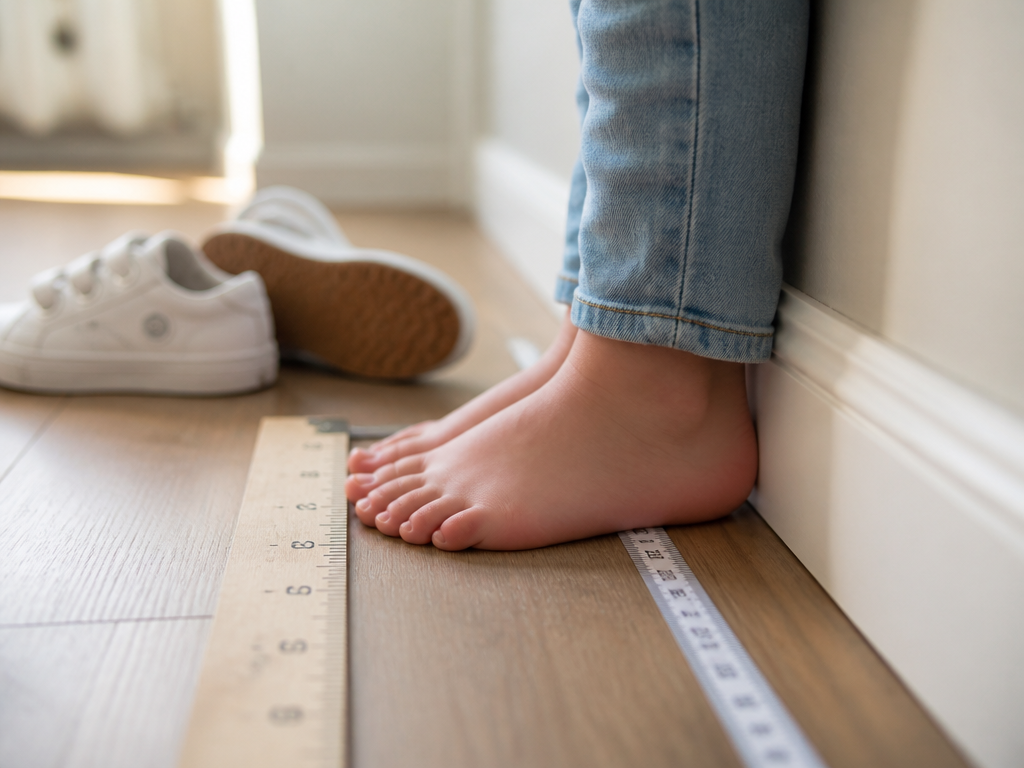
A parent does not usually walk into the kids tennis shoes problem expecting it to be hard. The expectation is that you pick a size, pick a color the child tolerates, and pay. The reality is that a size 3 in one brand is a size 2.5 in another, that a shoe built for running can roll an ankle on a hard court, and that a child's foot can outgrow the whole decision in four months. The hardest part is not spending money. It is knowing whether the shoe in your hand actually fits the foot in front of you and whether it will hold up to the way tennis is played.
So we are going to do this in the order that protects you from waste: measure first, understand what a court shoe actually is, then compare the three things most parents are genuinely choosing between. The verdict will arrive on its own.
What makes a tennis shoe different
Tennis is played sideways. A child sprints, stops, plants a foot, and changes direction — sometimes dozens of times in a single point. That lateral load is the whole design problem, and it is why a dedicated court shoe is built differently from the shoes already in the closet.
Three features carry most of the difference:
- A wider, flatter, more stable base. Court shoes sit lower and broader than running shoes so the foot is less likely to tip during a hard plant. Running shoes are built tall and cushioned for forward motion, which makes them tippier when a child cuts sideways.
- A durable, patterned outsole. Most hard-court shoes use a herringbone tread that grips and releases predictably, plus a non-marking rubber compound so the shoe does not leave scuffs on indoor or club courts. Many clubs require non-marking soles.
- Reinforced toe and lateral panels. Kids drag their toes and load the outside edge. Court shoes armor those zones; casual sneakers do not.
None of this is exotic, and you do not need to memorize it. You need to know it exists so that "they already have sneakers" is recognized as a real trade-off rather than a free pass.
Measure the foot before you shop
Brand size charts are only useful if you have an accurate number to bring to them. Measuring at home takes about three minutes per foot and removes most of the guesswork.
- Do it at the end of the day. Feet swell with use; a morning measurement can run small.
- Stand the child against a wall, heel touching the baseboard, weight evenly on both feet. Seated measurements run short because the foot lengthens under load.
- Place a flat object (a book spine works) snug against the longest toe, perpendicular to the wall. Mark where it meets the floor with tape.
- Measure heel-to-mark in millimeters. Centimeters round too coarsely for a growing foot.
- Measure both feet. They differ. Size to the larger one, always.
Then add growth and movement room. We use 8 to 12 millimeters of space beyond the longest toe — roughly a thumb's width. Less than that and a fast-growing child outgrows the shoe in weeks; more than that and the foot slides forward on stops, which is exactly when blisters and stubbed toenails happen. Write the larger foot's measurement down. That millimeter figure, not last year's size number, is what you compare against every brand chart.
A quick note on width: most children's court shoes come in a single standard width. If your child's measured foot is noticeably broad across the ball, the brand matters more than usual — some run narrow enough to be a problem, and the comparison below flags that.
The three things parents are actually choosing between
Most purchases come down to a court shoe, the running shoes the child already owns, or a general athletic sneaker. Here is how they hold up against the criteria that matter on court.
| Criteria | Dedicated court shoe | Running shoe | General athletic sneaker |
|---|---|---|---|
| Lateral stability | Strong — wide, low base | Weak — tall, tippy | Moderate, inconsistent |
| Outsole grip on hard court | Patterned, predictable | Soft, grabs unpredictably | Varies; often slick |
| Non-marking sole | Almost always | Sometimes | Rarely guaranteed |
| Toe/edge durability | Reinforced | Minimal | Minimal |
| Cushioning for running | Moderate | High | Low to moderate |
| Cost per season | Higher | Already owned | Lower |
Read down the table and the pattern is plain. The running shoe wins on cushioning and on the fact that you already paid for it, and it loses on the two things tennis demands most: sideways stability and a sole that grips and releases the same way every time. A soft running outsole can catch on a hard court during a plant and stop the shoe while the leg keeps going. That is the injury mechanism parents worry about, and it is real.
The general sneaker is a coin flip. Some skate-style shoes have flat, grippy, non-marking soles and survive a beginner's season fine. Others have slick or marking soles and offer no edge support. Without checking the specific shoe, you cannot tell, which makes it a poor default.
The dedicated court shoe gives up some plush cushioning and costs more up front. For a child playing tennis more than a few casual times, it earns that cost back in fewer rolled ankles, fewer blisters, and an outsole that lasts a season of court abrasion. For a child playing tennis regularly, the court shoe is the right call; for a child trying the sport once or twice, the sneaker you already own is a defensible bridge — but not the running shoe.
Why the size number lies, and what to do about it
Children's sizing is not standardized across brands, and the gap is large enough to ruin a fit. A measured foot of 215 mm might map to a labeled 2.5 in one maker and a 3 in another. The number on the box is a starting point, not an answer.
This is where your millimeter measurement does the work. Every major brand — Nike, adidas, Asics, New Balance, K-Swiss, Babolat, Head and others — publishes a children's size chart that lists foot length in millimeters or centimeters next to its labeled sizes. Find the chart for the specific shoe, locate your child's larger-foot measurement plus the growth allowance, and read across to the label. Do this per brand, every time. The shoe that fit last year tells you nothing about the brand you are buying this year.
Two practical guards against a bad mail-order fit:
- Buy from a retailer with free returns until you know how a given brand runs for your child.
- Have the child stand and pivot in the shoe before committing. The heel should not lift, and the toes should not jam at the front when they lean into a fake sideways step.
Who this guide is for, and who it isn't
This is for the parent buying a first or replacement pair for a child who plays tennis on a real court — lessons, a clinic, a school team, weekend hitting. The measurement step and the court-shoe case are worth the effort there.
It is less relevant if your child has only used a racquet on a driveway or in a backyard a handful of times. At that stage, a flat-soled, non-marking sneaker that fits is fine, and you can save the dedicated purchase for when interest proves itself. It is also not a guide for clay-court or grass specialists; those surfaces use different outsoles, and if your club plays on clay, ask them which sole pattern they require before you buy.
What we could not do here is test every brand's chart against a ruler for you — sizing drifts between models and production runs, so the only reliable measurement is the one you take and the chart for the exact shoe in front of you.
Evidence grade for the central claim — that a dedicated court shoe outperforms running and casual shoes for lateral stability and sole behavior: Strong, based on consistent footwear design consensus, though the size of the safety benefit for a given child remains unmeasured here.
The rule to use tonight: measure the bigger foot at the end of the day, add a thumb's width, and buy nothing until that millimeter number matches the specific shoe's chart.