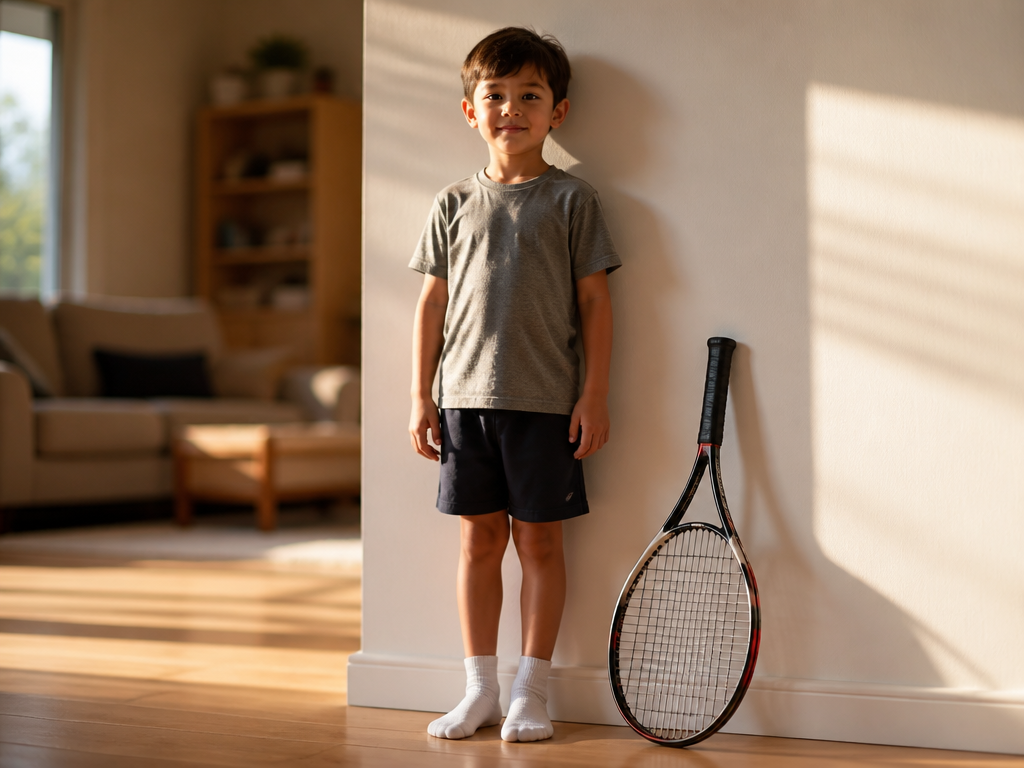
Buying a first racquet for a child is one of the few tennis purchases where the right answer is almost entirely measurable. Get the length right and most of the anxiety disappears. The verdict, stated plainly: kids tennis racquet sizing is decided by the child's standing height first, confirmed by two physical tests you can run in your living room in under three minutes — not by age, price, or frame material. Everything else parents worry about at this stage is either premature or irrelevant.
We say this having watched the failure mode up close. A parent buys a racquet a size too long because the child "will grow into it," the child can't get the frame around in time, the contact point collapses behind the body, and within a month the kid decides tennis is hard and stops asking to play. The frame wasn't bad. The fit was wrong, and fit is a sequence — each step depends on the one before it.
Why fit runs in order
Racquet fit is not a single judgment call. It's a short chain of cause and effect. A child's height sets the maximum frame length they can control. That length then determines whether the child can reach the ground comfortably with the racquet held out — the reach check. And reach only matters if the child can also lift and swing the frame without the head dropping. Run those in the wrong order and you'll talk yourself into a frame that fails one test while passing another.
So we test in causal order: measure, cross-check, reach, swing. Each step either confirms the previous one or sends you back a size.
Step 1 — Measure standing height
This is the trigger variable, so get it accurate. Have the child stand against a wall, heels flat, no shoes, looking straight ahead. Mark the top of the head with a flat edge and measure to the floor. Write the number down in inches or centimeters. Do not estimate from memory and do not use age as a substitute — two seven-year-olds can differ by a full racquet length, which is the whole reason age charts mislead parents.
Height is the input. The next three steps are all checks against it.
Step 2 — Cross-check the length band
Junior racquets come in fixed lengths, roughly 19, 21, 23, 25, and 26 inches, before a child moves to a full-size adult frame (27 inches and up). The USTA's 10-and-Under framework ties these lengths to colored court and ball stages, which is useful because it means the equipment is designed as a system rather than a guess.
Match the measured height to the band below. If the child sits on a boundary between two lengths, default to the shorter one and confirm with Steps 3 and 4.
| Child height | Racquet length | Rough age guide | What it's for |
|---|---|---|---|
| Under 40 in (102 cm) | 19 in | 2–4 | First contact, oversized soft balls |
| 40–44 in (102–112 cm) | 21 in | 4–6 | Red-stage, short court |
| 45–49 in (114–125 cm) | 23 in | 6–8 | Red/orange transition |
| 50–55 in (127–140 cm) | 25 in | 8–10 | Orange-stage, two-thirds court |
| 55–63 in (140–160 cm) | 26 in | 9–12 | Green-stage, full court |
| Over 63 in (160 cm) | 27 in (adult) | 12+ | Standard frames begin |
Treat the age column as the least trustworthy thing on this page. It's there for sanity-checking, not deciding.
Step 3 — The reach test
Now the racquet is in the child's hand. Have them hold the grip at the very bottom, arm relaxed and hanging straight down at their side, with the frame pointing at the floor. The tip of the racquet head should sit just above the floor — roughly an inch or two of clearance, not jammed into the carpet and not floating six inches up.
If the head presses into the floor and the child's arm bends to accommodate it, the frame is too long. If there's a large gap and the child has to drop their shoulder to reach down, it may be slightly short, which is far less of a problem at this stage. A frame that drags on the ground when held normally is the single clearest sign you've gone a size too big.
Step 4 — The swing check
A racquet can pass the reach test and still be too heavy or too head-light for the child to control. So the last step is movement. Ask the child to hold the racquet out in front of them, parallel to the floor, for a slow count of five. Then have them make a few easy forehand swings, ending with the frame up near the opposite shoulder.
Watch two things. Does the head droop while they hold it out — does the wrist collapse and the tip sag toward the ground? And during the swing, does the frame pull them off balance or finish low because they ran out of strength? If either happens, the frame is too heavy for now, even if the length is correct. Drop to the next size down and re-run Step 3. A child who can hold the frame steady and finish the swing high has a frame they'll actually want to pick up again.
When all four steps pass, you're done. That combination — correct length, an inch of floor clearance, steady hold, balanced swing — is a fit you can buy with confidence.
What does not matter yet
This is the permission-granting part, and we mean it. For a first frame, the following do not deserve your worry or your money:
- String type and tension. Junior frames come pre-strung. The string will be fine until the child is rallying consistently and the original string breaks or goes dead. Re-stringing a beginner is solving a problem they don't have.
- Grip size. Junior grips are small and forgiving, and small hands adapt easily. A wrap of overgrip fixes anything marginal. This becomes a real decision only at the 26-inch and adult stages.
- Frame material and "advanced" technology. Graphite-composite marketing language on a 21-inch racquet is aimed at the parent's wallet, not the child's results. Aluminum and basic composite frames perform identically for a beginner.
- Weight, beyond the swing check. You've already tested weight directly in Step 4. You don't need the spec sheet's gram figure on top of that.
Knowing what to ignore is most of what expertise buys you here.
The oversize temptation
The strongest pull is to buy one size up so the racquet lasts two seasons. We'd push back specifically. An overlong frame moves the balance point away from the hand, which means the child swings late and makes contact behind their body — the exact habit that's hardest to unlearn later. It also loads the wrist and forearm during the swing-through, and repetitive strain on a developing joint is not a trade worth a year of extra use. Junior racquets are cheap relative to a re-fit at the next size; the savings are real but small, and the cost lands on technique.
Who this protocol is for — and who should skip it
This is for the parent buying online or in a general sporting-goods store, where no one is going to run a fit test for you. Four steps, one tape measure, done.
Two cases warrant a coach instead. If your child is already in lessons and competing, ask the instructor — they've seen the kid swing and can weigh in on the borderline length-versus-control call better than any chart. And if your child has a notable strength or coordination difference that makes the swing check ambiguous, a pro's hands-on read is worth more than our table.
What this piece didn't answer
We've solved the fit problem, not the longer arc. This protocol tells you which frame to buy today; it doesn't tell you when to move up — the re-test cadence as a child grows is its own question, and the honest answer is "re-run Step 3 every few months and move up when the head starts dragging." We also didn't cover the transition to a full-size adult frame around 12–13, where grip size, weight, and string suddenly do start to matter and the easy clarity of the junior bands runs out.
For those, the place to look next is the green-to-yellow-ball transition and the first proper adult-frame demo — a stage where, for the first time, you'll want a frame in hand on a court rather than a tape measure on a wall.
Evidence grade for the central claim — that height-led fit testing beats age-based or feature-based selection: Strong. The mechanism is direct and observable, the USTA 10-and-Under length system is a published, court-tied framework, and the failure modes of oversizing are mechanically straightforward. What remains Moderate is the exact height-to-length boundaries, which vary by manufacturer and by individual build — which is precisely why the physical tests, not the table alone, make the call.