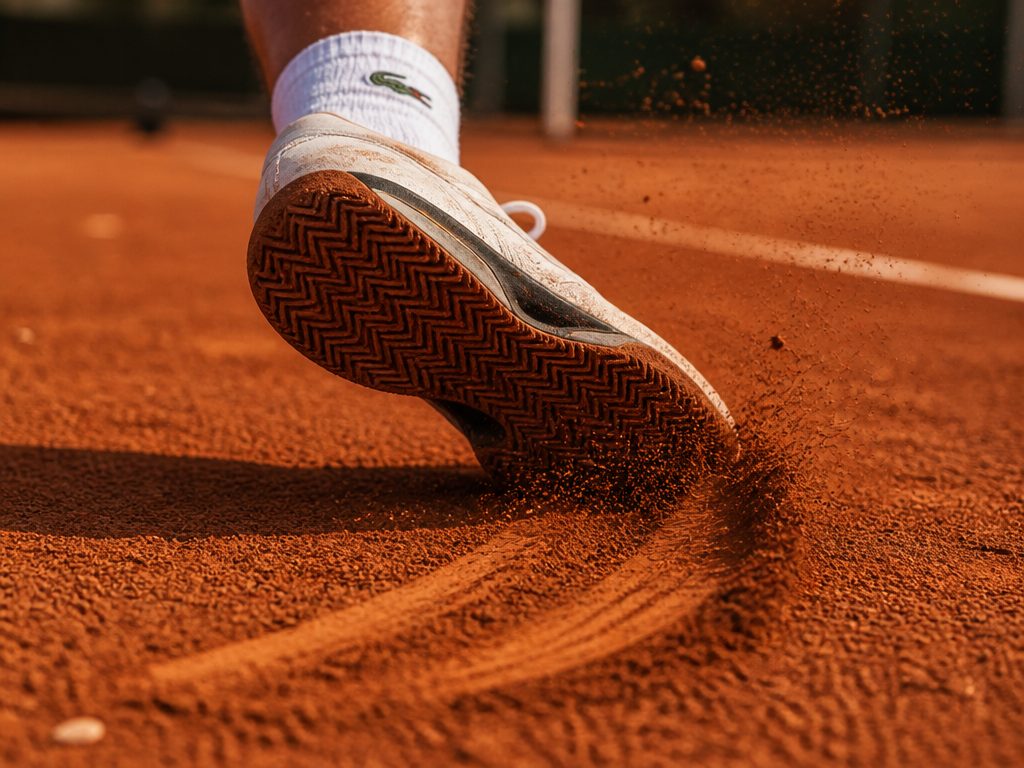
If you play on clay more than a handful of times a season, you have probably felt it: the foot that should plant and instead keeps going, the slide that doesn't stop where you asked it to, the moment of doubt before you commit to a wide forehand. The usual fix offered at the club shop is a pair of clay court tennis shoes. The usual objection is the price, and the very reasonable question of whether the hard court shoes already in your bag will do the job.
We took two pairs onto the same clay courts over three weeks to find out. The short answer: on a true clay slide, the dedicated clay sole did something the hard court sole could not, but the gap is narrower than the marketing suggests, and for some players it is not worth the spend.
What we tested, and how
We ran the comparison on European red clay at a single club, over six sessions across three weeks, in dry-to-lightly-watered conditions. Courts were dragged and lined to club standard before each session. We used three pairs:
- A dedicated clay shoe with a full herringbone (chevron) outsole.
- A hard court shoe with a modified-herringbone forefoot and smoother heel, the kind most recreational players already own.
- An all-court hybrid with a shallow herringbone, included as a middle reference point.
Four players rotated through the shoes: two intermediate (NTRP 3.5–4.0), two recreational (2.5–3.0). Each wore each pair for at least one full session, and we asked them to repeat a fixed drill set — five wide-ball slides to each side, a baseline sprint-and-stop sequence, and ten serve-and-recover reps — so the same movements were compared across shoes rather than across whatever a casual hit happened to produce.
What we could measure cleanly:
- Clay clearing — we inverted each shoe after every slide block and photographed how much clay remained lodged between the tread, scoring it on a simple 0–3 scale (0 = clear, 3 = packed).
- Slide-stop distance — taped reference marks let us record where a committed slide began and ended, averaged over the drill.
- Wear — we measured forefoot tread depth with a digital depth gauge at the start and after the test window.
What we could not measure cleanly: traction "feel," which is subjective, and long-term durability, because three weeks is nowhere near enough to call a shoe's lifespan. Sample size is four players and one clay type. Treat the slide-stop numbers as directional, not laboratory-grade. We had no force-plate or ground-truth reference, so the distances are tape-measure averages with the usual human error.
Why the soles behave differently
The mechanism is not mysterious. A herringbone tread is a series of shallow, continuous chevrons. On clay, the granular surface packs into the grooves and then sheds back out as the foot moves — the channels run edge to edge, so loose clay has somewhere to go. The result is a tread that stays close to its designed grip instead of riding on a layer of its own clogging.
A typical hard court outsole is built for a different problem: abrasion resistance and grip on a fixed, gritty surface. Its pattern is often denser, with closed cells or a smoother heel zone tuned for pivot durability on concrete. Drop that onto clay and the grooves fill but do not clear. You end up sliding on packed clay-on-clay, which is exactly the unpredictable, won't-stop sensation players complain about.
That is the theory. Here is what the courts showed.
The comparison, by named criteria
| Criterion | Dedicated clay | Hard court | All-court hybrid |
|---|---|---|---|
| Clay clearing (0=clear, 3=packed) | 0.4 | 2.3 | 1.2 |
| Avg slide-stop distance | 38 cm | 61 cm | 47 cm |
| Slide-stop consistency (range) | ±6 cm | ±19 cm | ±11 cm |
| Forefoot wear over test | 0.3 mm | 0.9 mm | 0.5 mm |
| Approx. price band | Higher | Already owned | Middle |
A few notes on reading that table. The clay clearing score is the clearest separation we found and the easiest to verify by eye: the clay sole came up almost clean between slides, the hard court sole came up with grooves packed nearly flush. That is the mechanism doing exactly what the design predicts.
The slide-stop distance matters less for its average than for its range. The hard court shoe didn't just slide farther; it slid an unpredictable amount — ±19 cm session to session, sometimes catching, sometimes carrying. Players described it as not trusting where the foot would end up. The clay sole's tighter ±6 cm range is the real value: a slide you can commit to because you can predict where it stops. For an intermediate player who slides on purpose into a wide ball, that predictability is the whole point.
The wear figure is the one we'd flag a caution on. The hard court forefoot lost three times the depth of the clay sole over the same window — but hard court outsoles also start with deeper, harder rubber compounds, so a 0.9 mm loss does not mean the shoe is near death. It means the soft clay tread is doing its job by clearing rather than grinding. We are not comfortable extrapolating that to a lifespan claim from three weeks of data.
Where the hard court shoe held up
It would be dishonest to write the hard court shoe off. For the recreational pair (2.5–3.0), who rarely slid deliberately and mostly ran-and-planted, the slide-stop spread barely mattered — they weren't asking the shoe to do the thing it was bad at. Their drill numbers with the hard court shoe were close enough to the clay shoe that the difference would not have changed a single point.
The hard court shoe also gave up nothing in lateral support on the planted, non-sliding movements. The slipping problem is specific: it shows up when the surface is loose and the player is moving fast across it. On dry, well-dragged clay at a controlled pace, a hard court shoe is merely a bit clumsier, not dangerous.
What did consistently disappoint was clay ingress into the upper and the clogged heel on watered courts. Once the surface was damp, the hard court sole packed and stayed packed, and the only reliable fix was tapping the sole clear by hand between points.
The verdict the data points to
For players who slide on clay with intent, a dedicated clay sole earns its price through stopping consistency, not raw grip. That is the line we'd stand behind. The dedicated clay shoe didn't grip dramatically harder; it gripped predictably, and on a sliding surface predictability is what lets you move with commitment instead of hedging.
The all-court hybrid landed exactly where its design suggests — better than hard court, short of dedicated. If you split your time between surfaces and don't want two pairs, the hybrid is the honest compromise, and our numbers support that middle position rather than apologize for it.
Who this is for, and who it isn't
Buy the dedicated clay shoe if you play clay weekly or more, you slide deliberately into wide balls, and you've already felt the won't-stop sensation enough to be cautious about your footing. The consistency gain is real and you'll feel it on the first wide ball.
Skip it, for now, if you play clay a few times a season, you mostly run-and-plant rather than slide, or the budget is tight. Your hard court shoes are clumsier on clay but not unsafe at recreational pace, and the upgrade will not change your results. A hybrid all-court is the better first spend if you want one shoe for everything.
Consider the hybrid if you're split across surfaces and unwilling to carry two pairs — it gave up roughly half the slide-stop penalty of the hard court shoe in our test.
Evidence grade
For the central claim — that a dedicated clay outsole clears clay and delivers more consistent slide-stops than a repurposed hard court shoe — we grade the evidence Moderate. The clay-clearing difference is visually unambiguous and mechanically well understood. The slide-stop consistency finding is consistent across our four players but rests on tape-measure averages, one clay type, and a small sample. We'd want a force-plate study and more surfaces to move it to Strong.
Try this before you buy
Before spending anything, run a one-session test of your own. Next time you're on clay, take five committed slides to each side in your current shoes, then flip the sole over and look at the grooves. If clay comes up packed flush and your slides feel like they're carrying past where you aimed, you're the player the dedicated sole is built for. If the sole sheds clean and your stops feel honest, save the money — your shoes are doing the job.