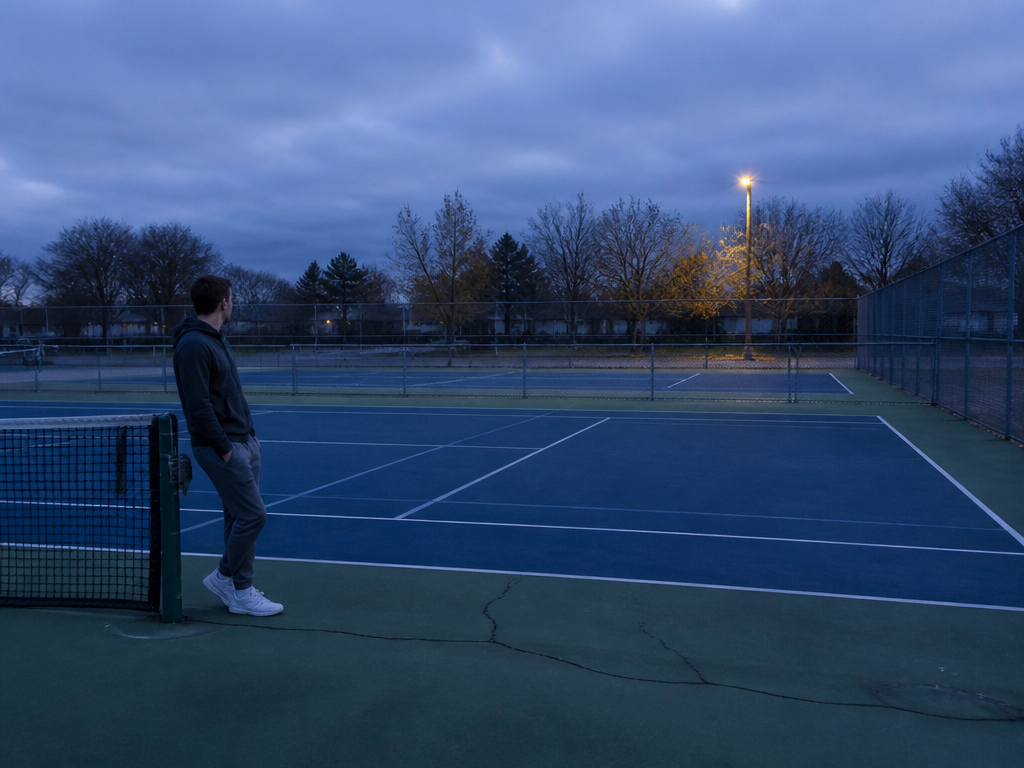
The advice is everywhere, and it is not wrong: if you want to play more tennis, go to the public courts and you will find people. The courts are free or close to it, they are open most daylight hours, and other players are standing right there. Finding hitting partners, the thinking goes, is just a matter of leaving the house.
We spent a stretch of weeks watching how this actually plays out at municipal and park courts, and the short version is this: the advice is roughly right for about a third of players and quietly false for the rest, and the difference is almost entirely about density, timing, and one awkward thirty-second conversation most people never have. What follows is where the standard counsel holds, where it breaks down, and a more honest rule to replace it.
How we looked at this
This is not a lab result. We do not have a controlled study and we would distrust anyone who claimed one for a question this social and this local. What we have is structured observation across roughly a dozen public sites — town park courts, a regional rec-center complex, two high-school courts open to the public after hours, and a busy four-court cluster near a college — over weekday evenings and weekend mornings.
At each, we tracked a few plain things: how many courts were occupied, how often a solo player was present, whether any drop-in or open-play structure existed, and whether a stranger arriving alone with a racquet could plausibly leave with a name and a next time. We were not measuring stroke quality. We were measuring whether the social infrastructure exists, because that is the part the standard advice assumes and rarely checks.
We will say up front what we could not measure: long-term follow-through. We saw exchanges of numbers; we could not follow every one to see whether a second hit happened. Treat the conversion claims here as directional.
Where the advice holds
At a genuinely busy court — four or more courts, most occupied, a steady churn of arrivals — public courts deliver exactly what the advice promises. You are visible. You are within earshot. And critically, there is almost always someone in your situation: arrived alone, hitting against a wall or feeding themselves out of a basket, waiting on a partner who flaked.
Three things made these sites work:
- A wall or backboard. It gives a solo player a reason to stay on site rather than leave after ten minutes. The longer people linger, the more overlap accumulates.
- A waiting culture. When courts are full, players queue, and a queue is a conversation that has already started. "You two only need a fourth?" is a complete sentence.
- Repeat faces. Busy courts have regulars who arrive on a rhythm — the Tuesday-Thursday 6 p.m. crowd. Show up on that rhythm twice and you stop being a stranger.
At sites like these, the standard advice needs no correction. The density does the work.
Where it breaks down
The trouble is that most public courts in suburban and regional areas are not busy. They are two courts behind a soccer field, used in scattered bursts, empty as often as not. Here the advice quietly fails, and it fails in four specific ways.
Density. You cannot meet people who are not there. We logged weekday-evening visits to smaller sites where the average occupancy was under one court. The math is unforgiving: if you show up three times and the courts are empty twice, you have effectively cut your odds by two-thirds before any social skill enters the picture.
Timing. The people are there — just not when you are. The retiree contingent hits at 9 a.m. The after-work crowd arrives at 6. If your free window is Sunday afternoon and that is when the courts are dead, no amount of showing up helps. Matching your schedule to the court's actual rhythm matters more than total visits.
The skill-match problem. This is the one nobody warns you about. You can meet someone, exchange numbers, and play exactly once because the levels are mismatched and neither of you enjoyed it. A 3.0 and a strong 4.0 will not produce a repeat hit, however friendly the exchange. Public courts hand you proximity, not compatibility. There is no rating gate at the fence, no NTRP or UTR sorting — which is freeing and also why so many first hits never become a second.
The conversation stall. The most common failure we watched was not rejection. It was nothing happening at all. Two solo players, twenty feet apart, each hitting against the wall, each assuming the other was waiting for someone. They both left. The advice says "you'll meet people" as if the meeting is automatic. It is not. Someone has to say the sentence, and most people don't.

Court types, ranked by realistic odds
We grouped the sites into rough categories and estimated, from what we observed, how likely a solo arrival was to leave with a usable next-time contact.
| Court type | Typical occupancy | Drop-in / open play | Odds of a repeat partner |
|---|---|---|---|
| Busy multi-court cluster | High, with queue | Often informal | Good |
| Rec-center complex | Moderate, scheduled | Frequently organized | Good to moderate |
| Town park, 2 courts | Low to moderate | Rare | Moderate to poor |
| School courts, after hours | Variable, clumped | None | Poor without timing |
The pattern is not subtle. The more courts and the more structure, the better the standard advice performs. Strip those away and you are relying on luck and your willingness to talk first.
Turning a hit into a habit
Suppose the density and timing are on your side and you actually get on court with someone. The work is not over — it is just different. A single enjoyable hit is not a partner; it is a candidate.
A few mechanics consistently separated the people who built something from the people who had one nice afternoon and never repeated it:
- Name the level honestly, early. "I'm a steady 3.5, mostly rallying, not much match play yet." This single sentence does the sorting the courts won't. It saves both of you a mismatched second hit and makes a matched one far likelier.
- Propose a specific next time before you leave. "Same court, Thursday around six?" beats "we should do this again." Vague plans die at the parking lot.
- Lower the stakes of the ask. You are not proposing a standing weekly commitment. You are proposing one more hit. People say yes to small things.
- Use the rec center's noticeboard if there is one. A legible card — level, availability window, contact — sitting on a bulletin board does work while you are asleep. It is unglamorous and it functions.
None of this requires charisma. It requires saying the obvious thing out loud, which is precisely the step the standard advice skips.
Who this works for, and who it doesn't
It works for you if you live near a genuinely busy court cluster or a rec center with any organized drop-in, you have schedule flexibility to match the court's natural rhythm, and you are willing to speak first. For this player, "go to the public courts" is sound and sufficient.
It works poorly for you if your only access is a quiet two-court park, your free time falls in the dead hours, or you are firmly between common levels — too advanced for the casual crowd, not advanced enough for the regulars. For this player, the courts alone will produce false starts and long droughts, and the honest move is to pair them with something else: a group clinic, a local app, a single lesson with a pro who knows other players. Public courts are one input, not the whole system.
The honest version of the rule
"Go to the public courts and you'll find someone" should read: go to a busy court, at the hour it is actually busy, willing to say one sentence to a stranger of roughly your level — and treat the empty quiet courts as a place to practice, not to meet people. That version survives contact with the parking lot.
The original advice isn't a lie. It is a half-truth that quietly assumes the conditions that make it true. Once you can see those conditions, you can either find them or stop blaming yourself when a sleepy park bench of a court fails to deliver a tennis partner.
One thing to try this week
Pick the busiest public court within fifteen minutes of you and go once at the hour you suspect it is busiest — for most sites, that is a weekday around 6 p.m. or a weekend around 9 a.m. Bring something to do alone for thirty minutes, a wall to hit against or a basket to feed yourself, so you have a plain reason to stay. Then say one sentence to one other solo player: your level and your usual free window. That's the whole experiment. If it works, you have a candidate. If it doesn't, you've learned the court's rhythm for free, and you'll arrive smarter next time. Evidence grade for the central claim (public courts reliably produce hitting partners): Moderate where density and structure exist, Weak otherwise. Our observation was structured but small, local, and unable to track long-term follow-through. The skill-match and conversation-stall failure modes were consistent enough across sites that we are confident they are real; the exact conversion rates are not something we can defend with numbers.