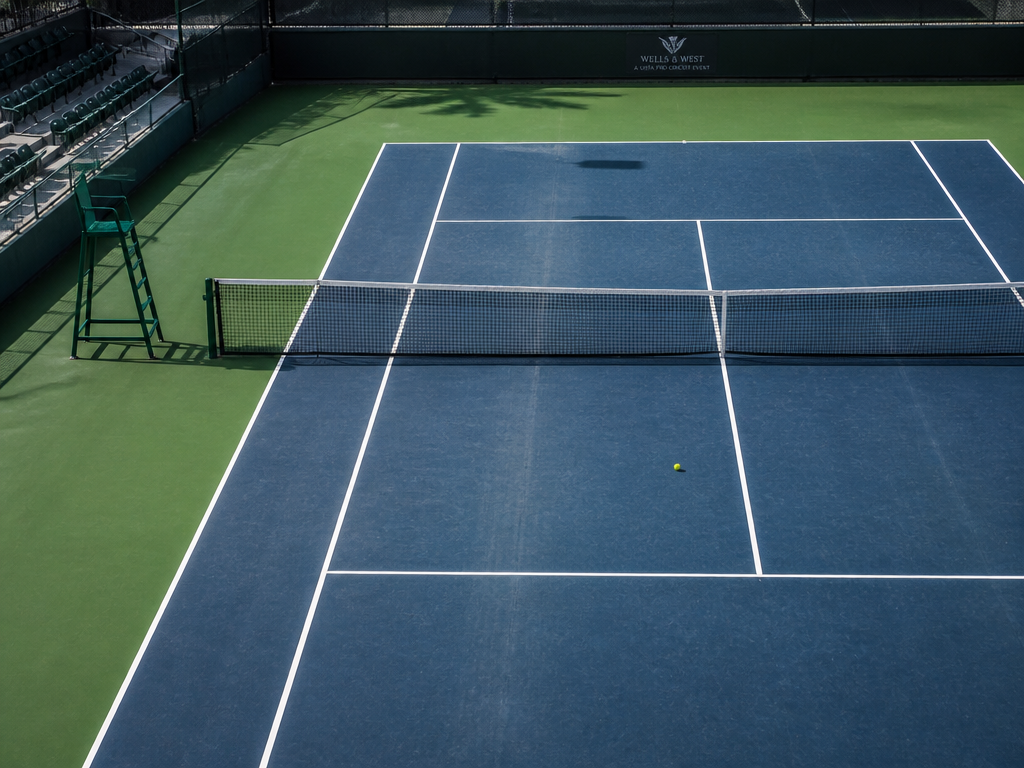
You've hit a clean ball for two sets. Then somewhere in the third — maybe at 2-2, maybe earlier — the legs go quiet. The first step to the wide ball arrives late. The forehand that was finding lines starts finding the net tape. You are not hitting worse because you forgot how to hit. You are hitting worse because the body running the strokes has changed state.
Most players who come to tennis fitness arrive through this exact door: not a desire to get ripped, but a specific, repeated, infuriating experience of fading late. The question underneath it is usually some version of "why do I fall apart in the third set when my technique is fine?" This piece is an honest attempt to answer that, including the parts where the honest answer is "it depends."
The short answer, before the long one
You fade late in a match because your body runs out of three things in roughly this order: readily available carbohydrate, blood plasma volume (from sweating), and a tolerable core temperature. Each one degrades a different part of your game. Carbohydrate depletion blunts your power and your decision-making. Fluid loss thickens your blood and raises your heart rate for the same effort. Heat, on top of both, recruits a protective braking system in the brain that simply tells your muscles to do less. None of this is a character flaw, and almost none of it is fixed by a better backhand.
The frustrating part — the part most club and competitive players never get told — is that this is the one area of your game that has almost certainly received zero coaching attention. You have probably had hundreds of hours of instruction on grip, footwork, and stroke production. You have very likely had zero hours on what to eat the morning of a match, how much you personally sweat, or what fatigue is doing to your shot selection. The gap is structural, not personal.
What's actually happening, in the order it happens
Let's walk through a long match from the inside, roughly in sequence.
The first 60 to 90 minutes: you're spending stored fuel
A best-of-three match with long rallies and hot conditions is, metabolically, an intermittent endurance event. Your muscles run primarily on glycogen — carbohydrate stored in muscle and liver. The relevant number, established across endurance physiology and summarized well in Burke et al. (2011, Journal of Sports Sciences), is that muscle glycogen stores are finite and meaningfully drawn down after roughly 60 to 90 minutes of hard, mixed-intensity work. You don't hit empty all at once. You hit a sliding scale.
What depletion feels like on court is specific and recognizable. Top-end power drops first, because the fast, explosive contractions are the most glycogen-hungry. Then the subtler thing happens: your decisions get worse. Carbohydrate is the brain's preferred fuel, and several studies on prolonged exercise have found that cognitive performance — reaction time, error rate, choice accuracy — declines alongside physical fatigue. The unforced error at 3-4 in the third is often a fueling problem wearing the costume of a mental-toughness problem.
This is why mid-match carbohydrate matters more than most recreational players believe. The well-replicated finding here is that ingesting carbohydrate during exercise lasting longer than about 60 minutes improves endurance performance. For sessions stretching past two to three hours, the much-cited work from Jeukendrup's lab on multiple transportable carbohydrates points to intake on the order of 60 grams of carbohydrate per hour, sometimes higher with mixed sugar sources. A banana between changeovers is not a snack. It is a refuel.
Somewhere in set two: you've sweated off your reserve
While you're burning fuel, you're also losing water. Sweat rates in tennis vary enormously — more on that below — but losses of 1 to 2.5 liters per hour are common in warm conditions, and elite players in heat have been measured higher. The number that matters is body-mass loss. When you've lost roughly 2 percent of your body weight in fluid, performance starts to measurably suffer. For an 80-kilogram player, that's about 1.6 kilograms — easily reached in a single hot match.

Here is the mechanism, because the mechanism is the part worth understanding. As you lose fluid, plasma volume — the liquid part of your blood — drops. Thinner blood volume means your heart has to beat faster to deliver the same oxygen to working muscle. This is cardiovascular drift: your heart rate climbs through the match even though your perceived effort is the same or your actual workload is dropping. You feel like you're working harder to do less, because you are. Sabboteur is the wrong word; the body is doing math, and the math is unfavorable.
The contested middle: cramps
Now the part where we have to be honest about what is and isn't settled. The folk explanation for cramping is dehydration and electrolyte loss, especially sodium. It's plausible and it's enormously popular. It is also genuinely contested.
The dehydration-electrolyte theory says: you sweat, you lose sodium, the altered fluid balance around your muscles makes them hyperexcitable, and they seize. The competing theory, often associated with Schwellnus and colleagues (whose work over the 2000s repeatedly questioned the electrolyte model), is altered neuromuscular control — the idea that exercise-associated muscle cramps come from fatigue-driven imbalance between the nerve signals that excite a muscle and those that inhibit it, largely independent of how dehydrated you are. Supporting this second view: cramps often strike specific muscles that are working hardest, not the whole body, which is hard to square with a system-wide salt deficit.
The current honest read is that both probably contribute, the balance differs between people, and the players who cramp most are often "salty sweaters" doing fatiguing work — which is exactly where the two theories overlap. We'll return to what that means for you.
Late: heat puts a governor on the engine
Stack heat on top of fuel and fluid loss and a third system engages. As core temperature climbs toward roughly 39 to 40 degrees Celsius, the body protects itself. The model many researchers use is central fatigue or a "central governor" — the nervous system reduces the drive it's willing to send to your muscles, regardless of how much fuel is technically left in them. This is the heavy-limbed, foggy, slightly nauseous feeling. It is not weakness. It is a thermostat with veto power over your willpower.
The nausea specifically often comes from blood being shunted away from the gut to the skin and muscles for cooling, which slows digestion — which is, cruelly, the exact moment you most need to take in carbohydrate and fluid. This is why mid-match fueling has to be trained and tolerated in practice, not attempted for the first time in a match.
Where the honest answer is "it depends"
If this piece only gave you the mechanisms, it would be lying by omission. The most important variable in all of it is individual, and most players have never measured it.
The single largest source of variation is your personal sweat rate and sweat sodium concentration. Sweat rates across athletes can differ by a factor of three or four. Sodium concentration in sweat varies even more dramatically — some people lose modest amounts, "salty sweaters" lose several times more and finish a match with visible salt rings on a dark shirt. This means generic advice ("drink a liter an hour," "take a salt tab") is right for some players, useless for others, and occasionally counterproductive. Overdrinking plain water during long efforts carries its own real risk — hyponatremia, dangerously diluted blood sodium — which is rare but documented in endurance sport.
So the genuinely honest version of the cramping answer is this: we cannot tell you from a distance whether your cramps are primarily a fatigue problem or a salt problem. We can tell you how to find out. Weigh yourself before and after a hard match in your normal kit, with no bathroom breaks, tracking what you drank. The weight you lost plus the fluid you drank, divided by playing time, is your sweat rate. Do that across a few sessions in different temperatures and you'll know more about your own physiology than most touring pros knew twenty years ago. If you're cramping despite replacing fluid well and you're a heavy, salty sweater, the sodium angle is worth testing. If you cramp early, in cool weather, well-hydrated, the fatigue-and-conditioning angle is the better bet.
That's the part of "tennis fitness" no app or article can do for you. It requires data from your own body.
The part nobody mentions: you can't do this alone

Here's the quiet reason most players never solve their third-set fade. Everything above requires consistency, measurement, and a bit of accountability — and the structure of recreational tennis provides none of those by default.
Think about how stroke improvement works. You book a coach, you have a witness, you get feedback, you come back next week and the coach remembers. Now think about how off-court conditioning works for the average club player. There is no witness. No one notices whether you did the fitness block. No one asks how the hydration experiment went. The whole domain that decides your matches happens in private, unmeasured, and therefore mostly undone.
This is where a training community stops being a nice-to-have and becomes the actual mechanism of change. Not in a motivational-poster sense — in a practical, behavioral one.
A regular hitting group does three concrete things for your conditioning. First, it manufactures the long, repeated, match-like sessions you need to even produce reliable sweat-rate data and to train your gut to tolerate mid-match fuel. You cannot simulate a third set alone against a wall. Second, it creates the comparison that surfaces problems: when four players run the same drills in the same heat and one is the only one cramping, that's a signal worth acting on, and you'd never see it training solo. Third, and least romantic but most powerful, it supplies the accountability that off-court work otherwise lacks. The fitness session you'd skip alone is the one you show up for when three people are waiting at the court at 7 a.m.
There's a knowledge effect too. Conditioning lore in tennis spreads horizontally, player to player, far more than it comes down from coaches. The teammate who figured out that a bottle of diluted sports drink plus a banana at the changeover stopped her own late cramps is a more reliable source for your situation than a generic guideline, because she shares your climate, your courts, your match length. A community is a distributed experiment running in your exact conditions. The folk wisdom is sometimes wrong — but it's testable, and a group is where you test it.
We'd put it plainly: the players who fix their fade are rarely the ones with the best information. They're the ones embedded in a group that keeps them doing the boring, repeatable things long enough to learn their own numbers.
What the evidence actually supports
Here's the honest tiering, so you know how hard to lean on each piece.
| Claim | How strong | What to do with it |
|---|---|---|
| Carbohydrate intake during efforts over ~60 min improves endurance | Well-established | Eat real carbohydrate at changeovers in long matches; train your gut for it in practice |
| ~2% body-mass fluid loss impairs performance via cardiovascular drift | Well-established | Measure your sweat rate; drink to limit losses, not to overdrink |
| Sodium-loss is the cause of cramping | Plausible but contested | Test it personally if you're a salty sweater who cramps despite good hydration |
| Cramps are largely neuromuscular fatigue | Plausible, growing support | Build conditioning so the working muscles fatigue later |
| Heat induces central (brain-mediated) fatigue | Plausible, mechanistically supported | Heat-acclimatize gradually; pre-cool when you can |
| One generic hydration number fits all players | Folk wisdom | Ignore it; your sweat rate is yours |
One honest rule of thumb
Weigh yourself naked before and after your next three hard matches, note what you drank, and do the arithmetic. Treat everything else — fuel, fluid, salt, conditioning — as an experiment you run against that number, ideally alongside people who are running it too. That single habit will teach you more about your tennis fitness than any article, including this one.
Back to the question
So: why do you fall apart in the third set when your technique is fine? Because technique was never the thing that fails late. Fuel fails, fluid fails, and heat applies the brakes — in that order, on a clock you can actually measure. The good news inside that is that all three respond to preparation, and preparation is mostly behavioral, which means it responds to company.
You don't have a stroke problem. You have an off-court problem with on-court symptoms, and it's the most fixable kind there is — but it's fixed in a group, not in private.