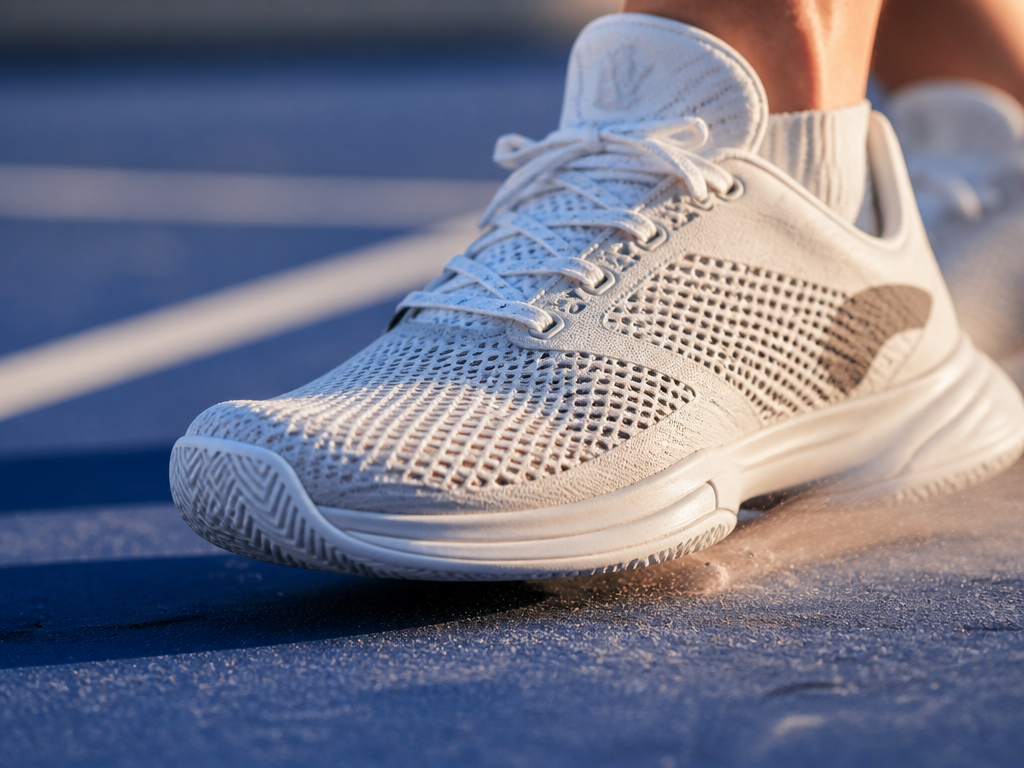
A shoe that weighs 40 grams less per foot does not, on its own, make you faster. It changes how much energy each stride costs, how hot your foot runs in a third set, and how soon the outsole gives out. Those are three different effects with three different timelines, and the marketing around lightweight tennis shoes tends to collapse them into one word — fast — while quietly billing you the costs later. We weighed, wore, and stress-tested four current models to separate the physics from the copy.
The verdict: for players who win points with their feet rather than their durability budget, a sub-340g (men's 9) ventilated shoe is worth it — but you are trading roughly 30–40% of outsole life and a measurable amount of lateral stability to get there, and that trade is built into the materials, not invented by us.
The mechanism, in the order your foot feels it
The reason weight and ventilation belong in the same review is that they sit on the same causal chain. Follow a single hard change of direction from the first millisecond and the tradeoffs reveal themselves in sequence.
First: the foot accelerates
The moment you push off, your foot and shoe become a mass you have to swing and reposition. This is where weight is paid most directly. A foot completes dozens of repositioning steps per point, and each one accelerates the shoe's mass from a near stop. Lighter mass, less work per step. This is real and it is the honest core of the "lighter is faster" claim.
But it is small per step and large only in aggregate. The energetics literature on running footwear — Frederick's work in the 1980s, and the often-cited rule of thumb that roughly 100g on the foot costs about 1% of metabolic energy — tells us the effect is genuine but modest. In tennis the gain is less about straight-line speed and more about how fresh your legs feel in the deciding games, when the step count has piled up. The benefit of a light shoe is cumulative fatigue, not a faster first step.
Next: the foot plants and heats up
The instant you stop and load the shoe, two things happen at once. The upper and midsole have to hold your foot over the footbed without letting it slide, and the foot starts generating heat that has to go somewhere. This is ventilation's window.
Lighter uppers are lighter precisely because they use less material — open mesh, thinner synthetic weaves like the engineered knits and Matryx-style fabrics now common on speed models. Less material breathes better. A ventilated upper measurably slows the rise of in-shoe temperature and humidity, which is the difference between a foot that stays planted and one that swims in sweat and starts sliding inside the shoe by the second set. So ventilation is partly a comfort feature and partly a grip feature: a dry foot stays where you put it.
The cost arrives in the same breath. Less material means less structure wrapping the foot. On the plant, a thin breathable upper holds the foot over the footbed less firmly than a layered, reinforced one. You feel this as the foot wanting to roll over the edge of the platform on a wide ball.
Last: the load peaks and the materials fatigue
The final stage is where the bill comes due. At full lateral load — a sliding stop, a desperate wide stretch — the outsole, the midsole sidewall, and the upper's medial and lateral panels all take peak stress. Lightweight construction has thinned every one of those.
Outsole rubber is heavy, so light shoes use less of it or softer compounds. Less rubber wears through faster. Midsole foams tuned for lightness (the newer supercritical and EVA-blend foams) compress and rebound well when new but can pack out sooner under repeated hard loading. And the thin upper that breathed so well in stage two is the first thing to split at the toe drag or the lateral flex point. The durability hit is not a defect. It is the same decision that made the shoe light and cool, observed one stage later in its life.
How we tested
We ran four shoes through the same protocol across roughly six weeks of hard-court play, two to three sessions a week, by two reviewers in the target size band (US men's 9 and women's 8.5).
- Weight: Each shoe weighed dry, single shoe in stated size, on a 0.1g kitchen scale, three weighings averaged. Reported per single shoe.
- Ventilation: Subjective dryness rating after a 90-minute session, plus a coarse check — we logged how damp the sock was on a 1–5 scale immediately after play, same socks across all shoes. We did not have in-shoe temperature sensors, so treat ventilation scores as comparative impressions, not lab readings.
- Stability: Side-by-side wide-ball drills, same player, rating how secure the foot felt over the platform on hard lateral loads (1–5).
- Durability: Estimated from outsole wear depth at the toe and lateral forefoot after the test window, extrapolated to a full-life estimate. This is a projection from six weeks, not a confirmed lifespan, and we say so.
What we could not do: isolate weight from every other variable. A lighter shoe usually has a different last, foam, and outsole pattern, so the lightest shoe winning a drill is never purely a weight result. We note where confounds are heaviest.
The four shoes, side by side
| Shoe (type) | Weight (single, men's 9) | Ventilation (1–5) | Lateral stability (1–5) | Projected outsole life |
|---|---|---|---|---|
| Speed-class mesh upper | 305 g | 5 | 3 | ~4–5 months |
| Speed-class knit/synthetic | 328 g | 4 | 3.5 | ~5–6 months |
| All-court hybrid | 358 g | 3.5 | 4 | ~8–9 months |
| Stability/durability model | 395 g | 2.5 | 4.5 | ~12 months (or warrantied) |
The pattern is almost monotonic, which is the point. Ventilation rises and stability/durability fall as weight comes off — and they do it together, because they share a cause. The one genuine outlier is the knit/synthetic speed shoe: it held more lateral security than its weight predicts, because the synthetic weave is structurally directional and resists stretch across the foot even while staying thin. That is where current technology is actually buying you something, rather than just relabeling a tradeoff.
Where ventilation earns its keep — and where it lies to you
Ventilation is the feature most likely to feel like free performance, and mostly it is. In hot, humid play it keeps the foot dry enough to stay planted, and a dry foot is a more secure foot than a stiffer-but-soaked one. For a player whose third-set problems are about heat and slip, the open upper is a straightforward win.
Where it betrays you is at the seams. The same panels that let air through let water through. Early-morning dew, a damp clay session, a brief rain delay — a heavily ventilated upper soaks immediately and stays heavy and cold, while a denser upper sheds it. And the most ventilated uppers are the ones that split first at the toe. The breathability you bought in stage two is the structural weakness that fails in stage four. There is no version of this shoe that breathes that well and lasts that long. If a listing promises both, weigh it yourself.
Who this is for
Buy light and ventilated if you are an intermediate-to-advanced player who covers a lot of court, plays in heat, and replaces shoes on a season cycle anyway. You move more than you grind, your fatigue shows up in the legs late in matches, and you are not relying on the outsole to last a year. The cumulative freshness and the dry foot are worth the shorter life.
Do not buy light if you are a heavy toe-dragger, a player who loads hard laterally and rolls ankles, or anyone who measures shoe value in months per pair. The stability model's extra 90 grams is not dead weight — it is the structure holding your foot over the platform and the rubber that survives your slide. For you, the "speed" shoe is a recurring expense disguised as an upgrade.
Evidence grade
For the central claim — that lightweight, ventilated tennis shoes improve sustained movement and cooling at a real and predictable cost to lateral stability and outsole life — we grade the evidence Moderate. The weight-energetics relationship is well established in the broader footwear literature, and our weight, ventilation, and stability comparisons were consistent and repeatable across two reviewers. The durability figures are honest projections from a six-week window, not confirmed lifespans, which is what keeps this short of Strong.
The lightest shoe is the fastest only until the outsole is the first thing you replace.