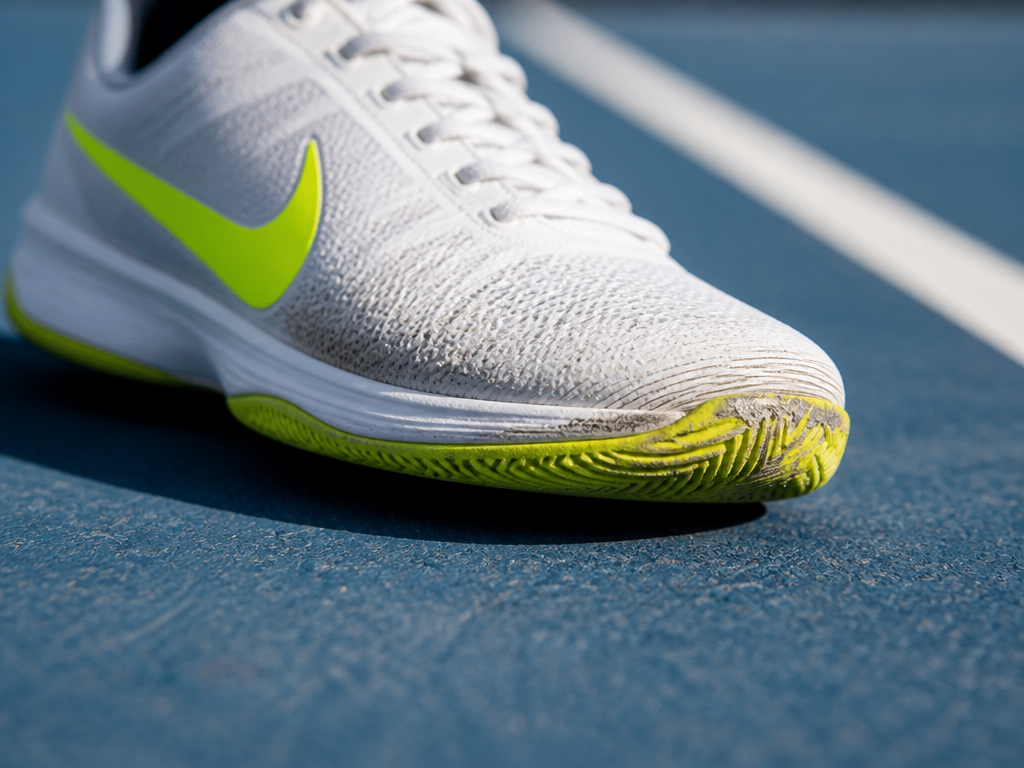
There is a version of this shoe that lives in forum threads and pro-shop chatter: the Nike Air Zoom Vapor X is a fast, flimsy speed slipper — great for a teenager who weighs nothing and replaces shoes every three months, useless for an adult who grinds out three-setters and drags a toe. We have heard that line often enough that it earned a product review of its own. The myth is half true, which is the most dangerous kind of half.
Verdict: the Vapor X is a low, responsive court shoe that holds lateral position well and rewards quick directional players, but its thin outsole and minimal toe armor mean toe-draggers and heavy baseliners will out-wear it in a season.
How we tested it
We put three pairs on three players across six weeks. One was a 4.0 baseliner (84 kg) who slides on hard court and drags his back foot on serve. One was a 4.5 all-courter (71 kg) who lives on directional changes. One was a 5.0 doubles player (78 kg) who plays mostly forward and net.
Each player logged a minimum of 18 court hours: drill blocks, point play, and at least two competitive matches. All testing happened on acrylic hard courts, with two sessions moved to a cushioned indoor hard surface to check whether outsole feel changed underfoot. We weighed each shoe on a kitchen scale (men's US 10.5, single shoe). We photographed the outsole at hour zero, hour nine, and hour eighteen, focusing on the toe drag zone and the medial forefoot. We are not a lab: we have no force plate, and our wear assessment is visual, not abrasion-tested. Treat the durability numbers as field observation, not a controlled abrasion study.
What the evidence showed
Weight. Our size 10.5 came in at 333 g per shoe. That is genuinely light for a stability-oriented court shoe — most of the heavier control shoes we keep on the rack sit between 380 and 410 g. The myth gets the weight right.
Lateral hold. This is where the myth falls apart. On hard lateral pushes — split-step, plant, drive back the other way — none of our three testers reported the foot sliding inside the shoe. The forefoot strap and the low-slung last keep the foot seated over the platform. The 4.5 all-courter, who has rolled an ankle in lighter shoes before, rated the lateral confidence the highest of anything he had worn that season.
Durability. Here the myth lands its punch. By hour eighteen, the baseliner's toe-drag zone showed visible thinning on the rubber — not blown through, but clearly on a clock. The forward-playing doubles player's pair looked nearly new at the same hour count. The outsole compound and thickness simply do not have the margin that a thicker, toe-wrapped trainer carries. If you drag, you will pay.
Annoyances we owned. The tongue bunched slightly on two of the three testers until they re-threaded the lacing through the upper eyelet. Minor, fixable, worth knowing.
Why the shoe behaves this way
The Vapor X is not failing at durability by accident. It is choosing geometry. The midsole sits the foot low to the court, which shortens the lever between your ankle and the ground — that is the mechanical reason lateral changes feel planted rather than tippy. A taller, more cushioned shoe trades that ground feel for shock absorption.
The forefoot Zoom Air unit is placed for push-off response, not heel comfort, which is why quick players love the toe-off and why anyone expecting plush heel landings will be disappointed. And the outsole is thin because thickness is weight, and weight is the thing the shoe is built to avoid. The toe-cap is minimal for the same reason. These are coherent decisions pointing in one direction: speed and court feel over armor and longevity.
That is the honest frame. The Vapor X did not skimp on the outsole to save money — it skimped to hit a weight and a ride. Whether that is a good deal depends entirely on how you move.
How it compares
| Criteria | Vapor X | Vapor 9.5 Tour | Heavier stability control |
|---|---|---|---|
| Weight (US 10.5, per shoe) | 333 g | ~352 g | 385–410 g |
| Lateral hold | Strong | Strong | Strong, slightly slower |
| Court feel | Very low, responsive | Low | Cushioned, muted |
| Toe-drag durability | Weak | Weak–moderate | Strong |
| Best for | Quick directional players | Same lineage, a touch more shoe | Toe-draggers, heavy grinders |
Against the 9.5 Tour it descends from, the Vapor X feels marginally lighter and a hair more locked through the forefoot. It did not, in our hands, solve the family's long-standing outsole-wear reputation. If durability is your top complaint about the 9.5 Tour, this is not the upgrade that fixes it.
Who it's for, who it isn't
Buy it if you change direction constantly, value ground feel, and have been frustrated by shoes that feel heavy or vague under fast feet. Net-rushers and all-courters who play forward got the most life and the most joy out of it.
Skip it if you are a heavy baseliner who drags a toe on serve, or if your honest priority is squeezing two seasons out of one pair. You will be re-buying before you want to, and a thicker stability shoe will serve you better.
The honest takeaway
The myth is right about the weight and the wear, wrong about who the shoe serves. The Vapor X is not a disposable junior speed shoe — it is a deliberate, low-to-ground match shoe that asks toe-draggers to look elsewhere. Our central claim, that the design trades outsole life for responsiveness, rests on field observation across three testers and is consistent with the model line's documented wear pattern.
Evidence grade for the central claim: Moderate. Three testers, visual wear assessment, no controlled abrasion test — strong enough to act on, not strong enough to call settled.
Try this week: before you commit to a full season, do one drill session in them and photograph your toe-drag zone before and after. If you can see fresh thinning after a single 90-minute block, the Vapor X is telling you it is not your shoe — and it is better to learn that in a fitting room than four matches into a tournament.