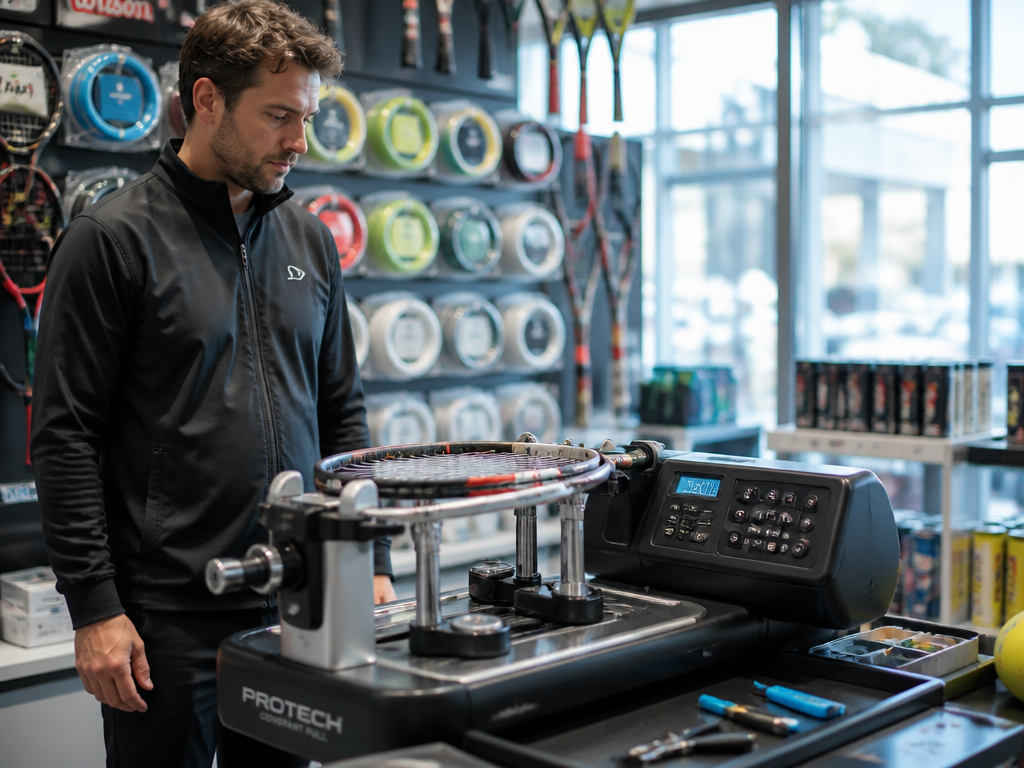
The problem that pushes most players toward a machine is not pride. It is a Thursday: you have a match Saturday, your main shifted dead a week ago, and the only shop within driving distance quotes a three-day turnaround. Stringing machines start to look less like a hobby and more like a way to take a scheduling bottleneck off the table. The catch is that the bottleneck you remove costs money up front and time forever after, and whether that trade pays depends almost entirely on how often you actually break strings.
The verdict, in one sentence: a home stringing machine is worth it once you're restringing roughly 20-plus racquets a year or you genuinely cannot tolerate shop turnaround before matches; below that, the math and the learning curve favor paying a competent stringer.
How we evaluated
We did not run a lab or restring anything ourselves. This is a synthesis. We compared published machine specifications and manufacturer list prices across the common tiers, read the consensus from independent equipment reviewers (Tennis Warehouse University's stringing-machine guides, Racquet Sports Industry trade coverage, and long-running owner threads on Talk Tennis and Reddit's r/tennis), and weighed those against typical shop labor rates. Where a number is manufacturer-stated rather than independently verified, we say so. Where owners and reviewers disagree, we flag it. Treat the cost models below as illustrative arithmetic with stated assumptions, not measurements.
First: the capital decision
The mechanism begins with one outlay that dwarfs everything after it — the machine itself. The market splits cleanly into three mechanism types, and the type determines both price and how much skill the machine demands from you.
- Drop-weight machines use a calibrated bar and gravity to set tension. Manufacturers and reviewers consistently price entry models in the rough $150–$350 band. They are self-calibrating by design, which independent reviewers cite as their main virtue, but they pull tension slowly.
- Manual crank (lockout) machines sit in the broad $300–$1,000 range. They pull faster and lock at the target tension; reviewers note that lockout heads release a fraction of tension at lock, which is consistent across the category rather than a flaw.
- Electronic constant-pull machines start around $1,000 and climb past $3,000 for shop-grade units. They hold tension actively through string relaxation, which is the feature reviewers most often credit for repeatability.
Mounting matters as much as the tension head. Reviewers repeatedly warn that two-point mounts flex the frame more than six-point mounts, and that clamp quality — fixed versus flying clamps — affects consistency more than the headline tension number. None of this is something we measured; it is the recurring consensus across reviewer guides and owner reports.
Next: the learning phase
Here is the cost almost everyone underestimates, and it does not appear on any price tag. Your first frames take time and your early jobs are uneven. Owner accounts on Talk Tennis commonly describe the first string job running well past an hour and the first several producing visibly inconsistent results — missed cross weaves, uneven tension, the occasional cut string. A practiced amateur, by the same accounts, settles into roughly 30–40 minutes per racquet. Tennis Warehouse University's instructional material treats clean, repeatable stringing as a learnable skill rather than an instant one, which matches what owners report.
The honest read: budget your first five to ten frames as tuition. If you have a tournament Saturday, the week you unbox a machine is the wrong week to learn on your match racquet.

Then: the steady state
Once you're past the learning phase, the economics flip. Your marginal cost per restring drops to the price of a set of string — call it $10–$18 for most polyester or multifilament — instead of string plus $15–$30 labor at a shop. And the bottleneck that started this whole inquiry simply disappears: you string the night before, at the tension you want, with the string you want.
This is where self-service adds something beyond price. A skilled shop stringer should already deliver consistent, accurate tension — that is their job, and the better ones do it well. What owning the machine adds is control and freshness: the freedom to try a hybrid setup on a whim, to drop two pounds before a hot week, and to play on string that was strung hours rather than weeks ago. Polyester loses tension and tension consistency steadily after stringing — a well-documented property of the material in stringing literature — so the player who strings often is genuinely playing on livelier string, not just cheaper string. That benefit is real but hard to put a dollar figure on.
Last: the payoff timeline
Put the mechanism end to end and the break-even is just division, with assumptions you should set yourself.
| Path | Up-front | Per restring | Cost at 20/yr | Notes |
|---|---|---|---|---|
| Pro service | $0 | $30–$45 (string + labor) | $600–$900 | Add fuel and turnaround time |
| Drop-weight DIY | ~$250 | $10–$18 (string only) | ~$450–$610 yr 1 | Slow pull; self-calibrating |
| Crank DIY | ~$600 | $10–$18 | ~$800–$960 yr 1 | Pays off in year 2 |
| Electronic DIY | ~$1,200 | $10–$18 | ~$1,400–$1,560 yr 1 | Long payback at this volume |
Assumptions: labor at $15–$30/job, string at $10–$18/set, 20 restrings a year. Adjust the restring count and the rest moves with it. At 40 frames a year a drop-weight machine pays for itself inside a season; at six frames a year, it may never beat the shop on money alone — the only case for buying then is turnaround and control.
Who this is for — and who it isn't
- The high-volume player or hitting junior breaking strings every week or two: the machine pays back fast and the turnaround problem vanishes. Clear buy.
- The league regular restringing every few weeks: a drop-weight or used crank machine breaks even within a year or two, and the freshness gain is a bonus. Reasonable buy.
- The occasional player restringing a few times a year: the spreadsheet says keep paying the pro. Buy a machine only if you actively enjoy the tinkering or cannot stomach shop wait times.
- The setup tinkerer at any volume: control is the real product here, not savings. Buy with eyes open about the learning weeks.
Evidence grade
Moderate. The cost arithmetic is solid and the machine-tier specs are well documented by manufacturers and independent reviewers. The freshness-and-control benefit is supported by string-relaxation behavior but is inherently harder to quantify, and the learning-curve figures come from owner reports rather than controlled measurement.
If you string fewer than ten racquets a year and the shop turnaround doesn't actually cost you matches, keep paying the pro and spend the money on string instead.