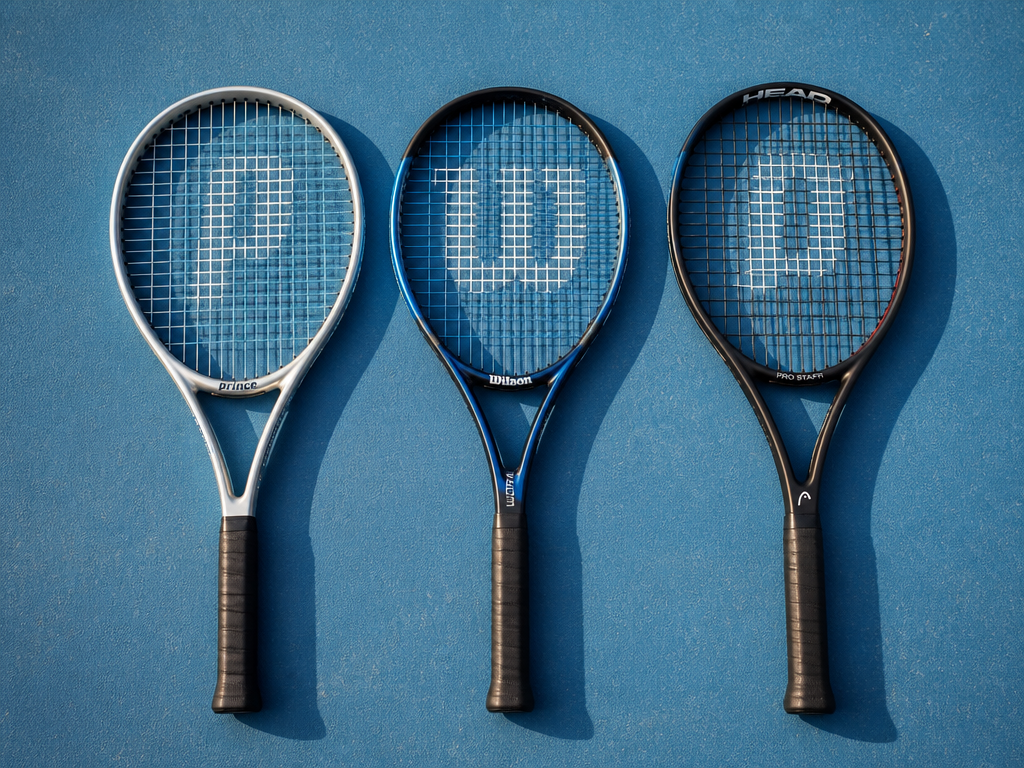
You walk into the shop, or open the tab, and there are forty frames. Half of them promise more power, the other half more control, and a few promise both, which should be your first clue that the words have stopped meaning anything. If you are an adult picking up the game or a parent buying for a kid who might quit by August, the question underneath all of it is simple: do beginner tennis racquets that cost more actually help you, or are you paying for paint?
We ran a test to answer that. The short version is below, but it earns more if you read how we got there.
What we tested
We bought three frames at three price points and hit with all of them under matched conditions:
- A budget aluminum frame, around $40 retail.
- A mid-range graphite-composite "game improvement" frame, around $90.
- A premium player's-adjacent frame, around $230.
All three were strung with the same synthetic gut at the same tension (55 lbs) on the same machine, by the same stringer, within the same hour. Same overgrip on all three. We did this so that string — which changes feel far more than most beginners realize — could not muddy the frame comparison.
Our hitting pool was four players we'd call early-stage: two genuine first-year adults, one returning player rebuilding after a decade off, and one ten-year-old who has had maybe six lessons. Each player hit a fixed feed of 40 forehands and 40 backhands per frame, blind where possible — the head was covered with a sock during the rally feeds so they reacted to the frame, not the price tag they'd been told. We logged where contact landed using a thin layer of stencil chalk on the strings, comfort on a 1–10 scale after each block, and our own observations on swing speed.
This is a small sample. Four hitters is not a study, the ten-year-old's backhand was inconsistent enough to throw out, and we had no force-plate or accelerometer to measure arm load objectively — comfort scores are subjective and we treat them that way.
The three frames
| Budget (~$40) | Mid (~$90) | Premium (~$230) | |
|---|---|---|---|
| Material | Aluminum | Graphite composite | Full graphite |
| Head size | 110 sq in | 105 sq in | 98 sq in |
| Strung weight | 9.6 oz | 10.7 oz | 11.4 oz |
| Balance | Head-heavy | Slightly head-heavy | Head-light |
| String pattern | 16x19 | 16x19 | 16x19 |
The spec sheet already tells part of the story before anyone swings. The cheap frame is light and head-heavy with a huge hoop. The premium frame is heavier, head-light, and tighter through the head. The mid frame sits between them, which is the whole reason it exists.
Criterion 1: forgiveness on a bad hit
This is the one that matters most for someone learning, and it gets the least honest attention in marketing. A beginner misses the center of the strings constantly. The question is what happens when they do.
Using the chalk maps, we measured how far off-center the average contact landed and how much the ball deviated on the worst 10% of hits. The budget frame's 110-square-inch head caught mishits the other two would have shanked — our returning player's chalk cluster was the widest of anyone, and the big aluminum hoop simply gave him more strings to miss into. On that single criterion, the cheapest frame did the best job for the rawest hitter.
The premium 98-square-inch head punished off-center contact the most. Our first-year adults felt it as a twist in the hand and a dead, jarring response. That is not a flaw — it is the frame doing exactly what a tighter head is supposed to do for a player who hits the middle. It is the wrong tool here.
Forgiveness winner for true beginners: the $40 frame. That sentence should feel uncomfortable, and it is meant to.
Criterion 2: comfort and arm load
Here the order flipped. Comfort scores after the backhand blocks, averaged across the three adults:
- Budget: 5.8
- Mid: 7.9
- Premium: 7.4
The aluminum frame, light and stiff, transmitted the most buzz into the wrist and forearm. Two of our three adults reported a stinging shock on the off-center hits — the same mishits the big head forgave directionally still rang the arm. The mid frame's graphite layup damped that noticeably, and players said so without prompting. The premium frame was comfortable too, but its extra weight made the ten-year-old fatigue inside two blocks, which is its own kind of discomfort.

There is real money visible in this gap. The jump from $40 to $90 bought measurable damping. The jump from $90 to $230 did not buy more comfort for these hitters — it bought a different feel aimed at a different player.
Criterion 3: weight and swingability
A frame you cannot swing on time is a frame that teaches you to mishit. We watched for late contact and shortened follow-throughs.
The 9.6-ounce budget frame was the easiest to whip through, which sounds good until you remember it was also the harshest and the most head-heavy, so it felt clumsy on volleys and quick resets. The 11.4-ounce premium frame produced clean, stable contact for our two more-developed adults but was plainly too much for the ten-year-old and tiring for the rawest beginner over a full session. The 10.7-ounce mid frame was the only one nobody struggled to swing on time, across all four hitters. There is a usable rule buried in this: once strung weight climbs past roughly 11.5 ounces, a developing player should hit with it before buying, not after.
The verdict that emerged
Spending more is neither smart nor wasteful — it depends entirely on which gap you are paying to close. From these tests, the money breaks down like this:
- The first $50 (from $40 to $90) buys the thing beginners actually feel: less harshness in the arm and a more swingable, balanced frame. That money is well spent.
- The next $140 (from $90 to $230) buys a frame built for a stroke you do not have yet — smaller head, more weight, more demanding. It is not a better racquet. It is a different one, and for an early-stage player it can actively make the game harder.
So the answer to "does spending more help" is: up to about the mid tier, yes, clearly. Past that, you are buying for a future player and paying to make the present one struggle. For most adult beginners and growing juniors, the mid-range graphite frame around $90 is the buy.
The three specs that beat the price tag
Before you compare any frames at all, three numbers decide more than dollars do.
- Head size. Look for 100–110 square inches. Bigger is more forgiving; the cost is a slightly less precise feel you almost certainly cannot detect yet.
- Strung weight. Stay between roughly 9.8 and 11 ounces. Light enough to swing on time, heavy enough not to rattle your arm.
- Grip size. Measure it: hold the racquet, and you should be able to slot the index finger of your other hand into the gap between your fingertips and palm. No gap means go up a size; a loose finger means go down. Most adults land at 4 1/4 or 4 3/8. This is free to get right and miserable to get wrong.
Who each frame is for
- The $40 aluminum frame is for the genuinely uncommitted — the once-a-month hitter, the kid who may not stick with it, the player who needs the most forgiving hoop and does not yet swing hard enough to feel the harshness. It is not for anyone playing weekly, because the arm load adds up.
- The $90 mid frame is for almost everyone reading this: the adult learning seriously, the junior who has had a few lessons and isn't quitting. It is not for someone who already drives the ball cleanly and wants more feedback.
- The $230 premium frame is for the player whose strokes have arrived, who hits the center reliably and wants precision. It is not for a beginner, full stop, no matter how good it looks.
Evidence grade
For the central claim — that the spend from budget to mid is justified and the spend from mid to premium is not, for early-stage players — we grade the evidence Moderate. The chalk maps, comfort scores, and swing observations all point the same direction and agree with the basic physics of head size and weight. But the sample was four hitters, comfort was self-reported, and we had no instrument to quantify arm load. The direction is trustworthy; the exact dollar thresholds are ours, not gospel.
One of us still teaches a Saturday clinic with the $90 mid frame from this test, two years and three string jobs later — not because it was the verdict, but because after the testing it was simply the racquet that asked the least of a still-imperfect swing.