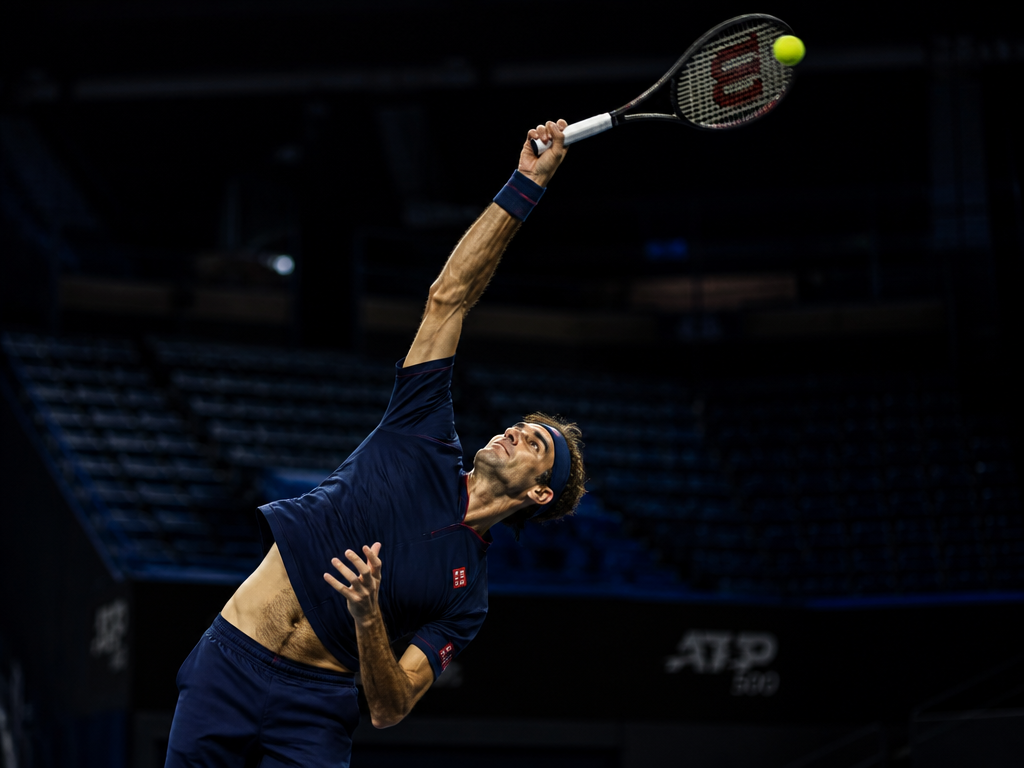
The number you have seen is 163.7 mph. Sam Groth, an Australian qualifier, hit it at a Challenger event in Busan, South Korea, in May 2012. It is the fastest tennis serve speed ever recorded in a sanctioned match, and it comes attached to an asterisk that follows it everywhere: the ATP does not officially recognize it. The tour's recognized record sits lower. The radar gun that clocked Groth was never independently verified to the standard the ATP applies to its own events.
That gap — between what was measured and what counts — is the whole story of serve speed records. So before the leaderboard, the honest part.
How fast can a tennis serve be?
The fastest serves ever recorded in men's professional tennis land between roughly 155 and 164 mph. Groth's 163.7 mph (263.4 km/h) is the outright record; the ATP's officially recognized fastest serve is John Isner's 157.2 mph (253 km/h), struck at the 2016 Davis Cup. In a typical tour match, a strong first serve from a big server runs 125 to 140 mph. So the records are outliers by 20-plus mph, and they are not all measured the same way.
Why the records don't compare cleanly
Radar guns are not neutral witnesses. Where the gun sits matters: a serve is fastest the instant it leaves the strings and bleeds speed every foot afterward, so a device positioned to catch the ball early reads higher than one placed deeper. Calibration matters. So does whether the reading was logged by the tournament's official Hawk-Eye-linked system or by a one-off gun at a smaller event.
This is why the Groth number lives in a footnote. It was real, it was filmed, but it was produced under conditions the ATP did not certify. Several other eye-catching figures — Albano Olivetti's 160-plus mph at a 2012 Challenger, for one — carry the same caveat. They are not fraudulent. They are just not measured to the same ruler as Isner's Davis Cup serve.
We mention this not to deflate the spectacle. A 160 mph serve is genuinely hard to return, and it is entertaining to watch. But a leaderboard that mixes certified and uncertified readings without saying so is selling drama as data.
The fastest recorded serves, with the caveats kept in
Here is the top tier of recorded men's serves. The asterisked entries are not ATP-recognized records, even though the readings exist on video or in event logs.
| Player | Speed (mph) | Speed (km/h) | Recognized | Notable context |
|---|---|---|---|---|
| Sam Groth | 163.7* | 263.4 | No | 2012 Busan Challenger |
| Albano Olivetti | 160.7* | 258.6 | No | 2012 Challenger |
| John Isner | 157.2 | 253.0 | Yes | 2016 Davis Cup |
| Ivo Karlović | 156.0 | 251.0 | Yes | 2011 Davis Cup |
| Milos Raonic | 155.3 | 249.9 | Yes | 2012 ATP event |
| Andy Roddick | 155.0 | 249.4 | Yes | 2004 Davis Cup |
A pattern jumps out: these are tall men. Isner is 6'10", Karlović 6'11", Groth 6'4", Olivetti 6'8". Height lengthens the lever and raises the contact point, which buys both speed and angle. But the pattern is not a law. Roddick was 6'2" and held the recognized record for years on racquet-head speed and timing, not reach. So we will note the correlation and decline to call it causation.
What "normal" looks like
The outliers only mean something against a baseline. Across the ATP tour, a first serve averages in the low-to-mid 120s mph; second serves drop into the 95–105 mph range because players trade pace for spin and margin. A 130 mph first serve is a real weapon. A 140 is rare. The 160s are a different category of event entirely, the way a 100-meter sprint world record is a different category from a fast club runner.
Federer, Nadal, Djokovic: three great serves, none of them the fastest
The names people search for are not on the leaderboard above, and that is the most useful fact in this article. Compare the three on four criteria: peak speed, placement, hold percentage, and how much each man's career leaned on the serve.
Peak speed. Roger Federer's recorded peak sits around 142 mph, Novak Djokovic's near 137, Rafael Nadal's around 135. All well short of the record tier, all comfortably above tour average.
Placement. Federer's serve was the best of the three by consensus — not for pace but for disguise and accuracy, the ability to hit a line on either side from an identical toss. Djokovic's serve, rebuilt for reliability around 2018-19, became a model of repeatable depth. Nadal's serve was the least weaponized of the three for most of his career.
Hold percentage. All three held serve at elite rates across their primes, frequently above 85 percent in strong seasons. Here is the deflationary point: their hold rates often matched or beat the biggest servers on tour. Isner held serve at extraordinary rates too — but won far fewer titles, because holding is only half the game.
Reliance. Isner and Karlović built entire careers on the serve because the rest of their games could not carry them. Federer, Djokovic, and Nadal used the serve to start points on their terms, then won with everything that came after.
The verdict writes itself. A faster serve is not a better serve, and a better serve is not a better player.
What happens in the half-second
Walk it forward in order. The toss sets the contact point — too low and the player loses the downward angle, too far forward and timing collapses. The legs load and drive up; the trunk rotates and the shoulder lags behind it, storing energy like a coiled spring. The arm whips through last, the wrist and forearm pronating at contact to snap the racquet head through the ball. Peak racquet-head speed and clean contact at the highest reachable point produce the number on the gun. Miss the timing by a few hundredths of a second and you lose 10 mph and find the net.
A benchmark for your own serve
If you want a realistic yardstick: a recreational adult man serving with sound mechanics typically lands a first serve in the 80–100 mph range, and a strong club player reaches the low 100s. Chasing a tour-level number with a stopwatch app and a phone propped against the fence will mislead you — those readings are noisy and usually flatter the server. Track placement and the percentage of first serves you make before you track speed.
Speed is the headline. It was never the spine.