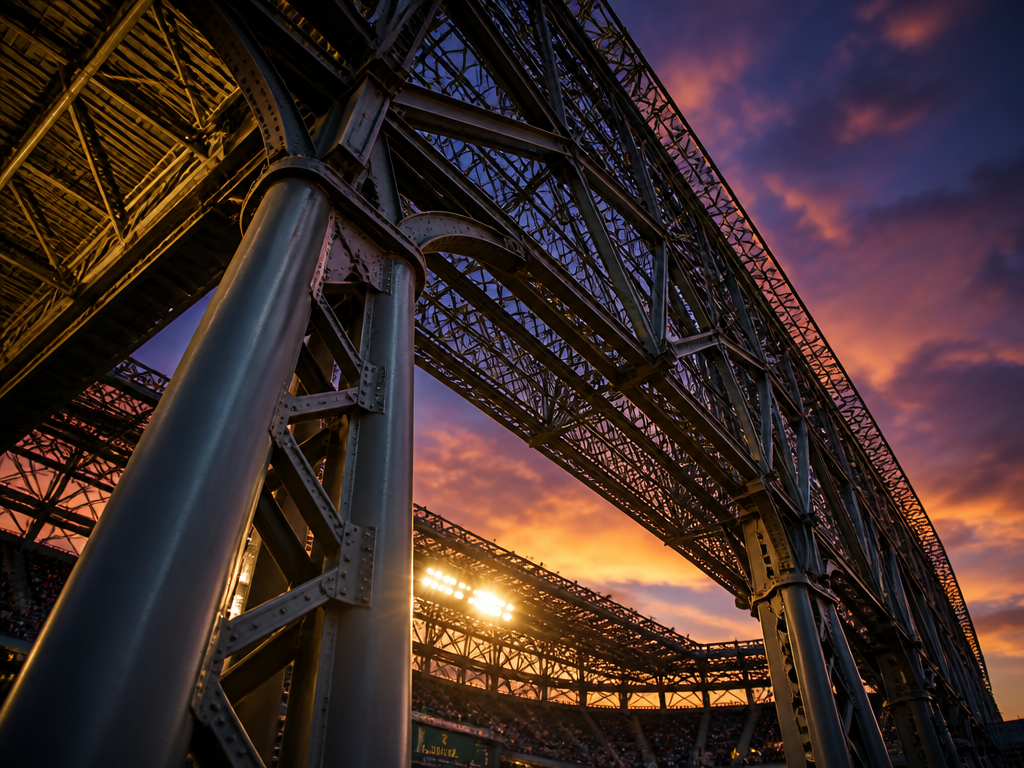
Arthur Ashe Stadium seats 23,771 people. That is the number stamped on the US Open, repeated in broadcast graphics, and cited every time someone calls it the largest of the world's tennis stadiums. It is a real figure, audited and fixed. It is also more interesting for what it leaves out than for what it tells you.
Start with the number itself. Then we can take it apart.
What 23,771 actually counts
The figure counts permanent, ticketed seats inside the bowl at Flushing Meadows in New York. It does not count standing room, suite occupancy beyond seated capacity, or the photographers and officials courtside. When the USTA reopened Ashe after its 2016 roof project, the seated capacity sat at 23,771 — slightly below the roughly 22,500–23,000-plus figures floated in earlier years, because adding the roof's support columns and reconfiguring the upper deck cost a few hundred seats.
That last detail is the whole story in miniature. The largest tennis venue on earth got its roof by giving up seats. Capacity and comfort traded places, and the trade was considered worth it.
For comparison, no other tennis-specific bowl comes close. Ashe stands alone above 20,000. Below it sit Indian Wells' Stadium 1 (about 16,100), the Australian Open's Rod Laver Arena (about 14,820), and Wimbledon's Centre Court (about 14,979 after its 2009 rebuild). Roland-Garros' Court Philippe-Chatrier holds roughly 15,000 after its own 2019 renovation. The pattern is clear: one giant, then a cluster of mid-teens arenas, then everything else.
How a tennis bowl gets that big
A tennis court is small. The playing area inside the lines is 78 feet by 36 feet for doubles, and the full run-back and side margins push the fenced enclosure to roughly 120 by 60 feet. Everything else is seating wrapped around that rectangle, and the way you reach 23,771 is mostly vertical.
Here is the sequence, in the order an architect builds it. First comes the lowest tier, the courtside rows, set as close to the lines as safety and line-of-sight allow. These are the best seats and the fewest of them. Then the bowl rises in decks, each one cantilevered or stepped back over the one below, raked steeply enough that the row behind clears the heads in front. At Ashe the upper promenade is famously distant — the back row sits more than 100 feet above the court, far enough that players look like figures on a distant table.
This is where tennis hits a ceiling that stadiums for other sports do not. A football field or a cricket oval is large enough that even a 60,000-seat ring keeps spectators within a tolerable distance of the action. A tennis court is so compact that every additional ring of seats climbs almost straight up and away. Push past the mid-teens and the top rows stop being good seats in any honest sense. Ashe is the proof of the concept and the warning about it at the same time. The venue is enormous because it can be, not because the sport asked for it.
Why the roof became the headline
For about a decade, capacity was the bragging right. After 2008, it stopped being the point. Rain, and the broadcast revenue that rain threatens, made the retractable roof the defining feature of the modern show court.
Wimbledon moved first in a serious way. Centre Court's roof, completed for the 2009 Championships, is a folding fabric structure — ten trusses spanning the court, clad in a translucent membrane that lets diffused light through. It takes roughly eight to ten minutes for the trusses to close and considerably longer, around 30 minutes or more, before play resumes, because the enclosed bowl has to be climate-controlled to manage condensation on the grass and the air.

Ashe's roof, finished in 2016, took a different route because the original 1997 building was never engineered to carry a heavy lid. The stadium sits on the ash heap that gives Flushing Meadows its name — unstable fill — so the roof's weight is carried not by the existing structure but by eight independent steel columns sunk on their own foundations outside the bowl. The two roof panels slide along tracks and meet in the middle. Closing time runs about five to seven minutes.
The order of events here matters. The roof did not make these venues bigger. It made them more reliable, and it quietly shrank a few of them. That is the trade the modern era settled on: fewer guaranteed seats, more guaranteed play.
What the number does not measure
A capacity figure tells you how many people fit. It says nothing about whether any of them can see, hear, or feel the match — and those are the things spectators actually buy.
Consider Wimbledon's Centre Court at roughly 15,000. It holds two-thirds of what Ashe holds, yet on television and in person it reads as the more intense room. The reason is geometry, not nostalgia. Centre Court's seating is pulled tight and low around the grass, the upper tier is shallow, and the acoustics of an enclosed, smaller bowl concentrate sound. A close point lands like a held breath shared by everyone at once. Ashe, by contrast, is so tall and open that energy dissipates upward; the loudest night sessions there work because of the crowd's sheer mass, not because the room focuses it.
So the honest reading of 23,771 is this: it is a record, and records are fun, but it correlates poorly with the experience that draws people to tennis in the first place. The biggest room is not the best seat, and frequently not the best room.
A practical map of the show courts
| Venue | Tournament | Approx. capacity | Roof |
|---|---|---|---|
| Arthur Ashe Stadium | US Open | 23,771 | Yes (2016) |
| Indian Wells Stadium 1 | BNP Paribas Open | 16,100 | No |
| Court Philippe-Chatrier | Roland-Garros | 15,000 | Yes (2020) |
| Wimbledon Centre Court | The Championships | 14,979 | Yes (2009) |
| Rod Laver Arena | Australian Open | 14,820 | Yes (1988) |
A rule of thumb that holds across all of them: the seat number matters less than the deck. The lowest tier of a 15,000-seat court beats the upper promenade of a 24,000-seat one for almost everything you care about — angle, sound, the readable spin on the ball. When you book a Grand Slam trip, the figure to chase is not total capacity but how many rows separate you from the court. Ask for a tier, not a stadium.
Rod Laver Arena deserves a footnote here too: it opened in 1988 as the first Grand Slam venue with a retractable roof, two decades before the others caught the idea.1
One thing to try this week
Pull up a match from this year on whichever streaming service you use, and find one wide establishing shot of the full bowl before the players walk out. Count the decks. Notice where the broadcast cameras are perched relative to the back row, and where the loudest reactions come from during a long rally. You will start reading these buildings the way the people who design them do — as a stack of compromises around a very small rectangle — and the next 23,771 you hear quoted will mean something more honest than just "the biggest."
-
The current Rod Laver roof and structure date largely to renovations completed in 2019, but the original retractable design debuted with the National Tennis Centre at Melbourne Park in 1988. ↩