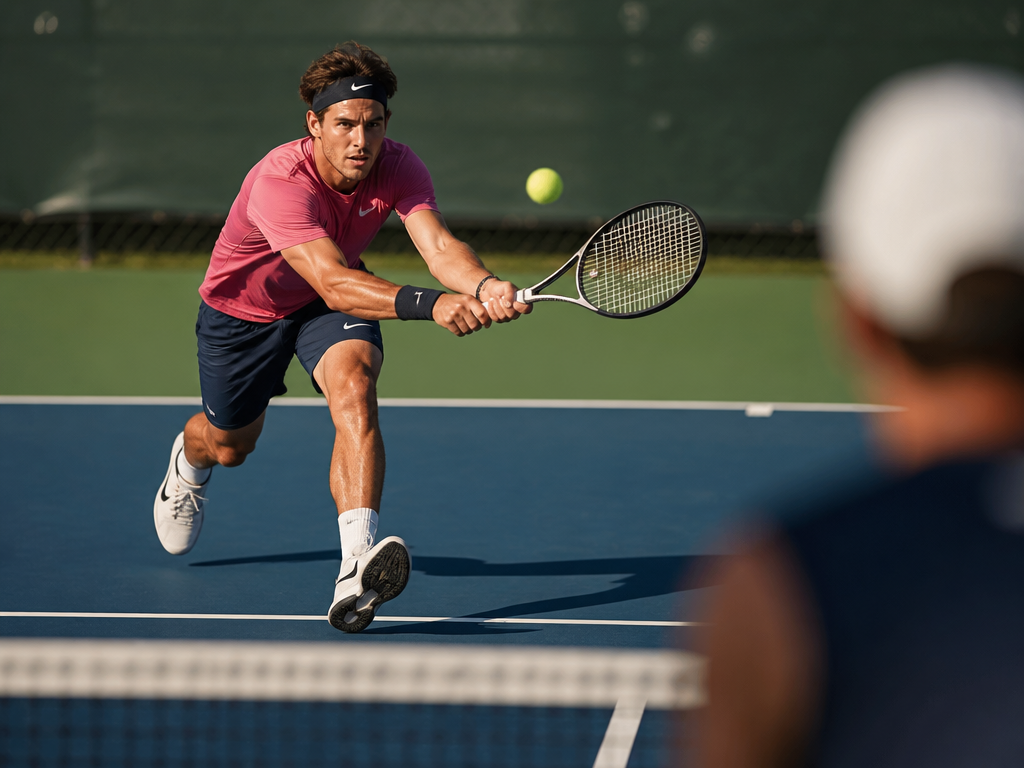
Poaching is the piece of doubles strategy that every club player has an opinion about and almost none can defend. Ask four people at a Tuesday league match why they crossed and you will get four answers — instinct, the score, the ball was there, my partner told me to — and not one of them will be a principle. That gap is strange, because the same players can talk with real precision about a continental grip or a topspin backhand. Individual technique gets treated as a subject with rules. Partnership behaviour gets treated as personality.
The verdict, stated plainly: the best-supported claim in the poaching literature is that the threat of the poach, not the interception itself, is what wins points — and the systems that work at recreational level are the ones that make that threat visible, cheap, and repeatable. The evidence for it is coaching consensus reinforced by pro-level positioning data, not a controlled study, and we will say so again at the end.
How we evaluated
We read rather than played. This piece is a synthesis of four kinds of source, weighted in roughly this order.
First, the instructional doubles literature — the small canon of books that treat doubles as its own discipline rather than a singles variation. Pat Blaskower's The Art of Doubles is the one most often handed to intermediate league players, and it is unusually direct about net-player responsibility. Second, tennis analytics writing, principally the strand associated with Craig O'Shannessy's Brain Game work, which is where most quantitative claims about court positioning in circulation actually originate. Third, observed pro-level tendency — what doubles specialists visibly do with hand signals and pre-serve movement, which is public and repeatedly described but rarely measured in a way we could cite as a figure. Fourth, player-level consensus: coaching forums, USTA league discussion, and the recurring complaints of the 3.5 player.
We weighted the analytics work highest where it addresses geometry, because geometry transfers between levels. We weighted it lowest where the underlying data is professional match play, because a 4.0 return and an ATP return are different objects. And we will flag every point where the honest answer is that nobody has measured this.
What most players do
Four behaviours turn up so consistently in coaching material and league discussion that they function as the recreational default.
They cross late. The net player waits until the return is struck, confirms it is reachable, and then moves. This is the movement that feels responsible — you never get caught out of position — and it is the one that surrenders the entire psychological payload. A cross that begins after contact is invisible to the returner. It can win the point in front of you; it cannot change the next four returns.
They poach when they are losing. The poach gets deployed as an emergency measure at 15-40, which is precisely when the returner is most settled and least likely to be rushed into an error. Down break point is the worst available moment to introduce a new variable, and it is the most common.
They poach silently. No signal, no pre-agreement, no post-point word. The server is left to discover mid-swing that the court has changed shape. Blaskower is blunt about the consequence: an unannounced poach transfers risk to a partner who did not consent to it, and the resulting resentment outlasts the point.
They treat a missed poach as a debt. The net player who guesses wrong and gets passed down the line goes quiet for three games. This is the most damaging of the four, and it is where the psychology genuinely matters. The cost of a failed poach is almost never the point; it is the two or three subsequent points the net player spends frozen, and the partner's now-lowered expectation of them.
What the evidence suggests
The threat is the product. The consistent claim across the instructional literature is that a net player who moves early and visibly changes the returner's decision even when no ball is touched. The returner who has to account for a moving target has a narrower crosscourt window, and — more importantly — has taken attention away from the incoming ball to allocate to a peripheral one. This is the central mechanism, and it is asserted far more often than it is measured. We could find no study isolating it at recreational level. It is coaching consensus, mechanistically plausible, and unquantified.
The attention-splitting argument has adjacent support, not direct support. Sports-science work on anticipation in tennis — the occlusion-paradigm tradition, where players judge shot direction from partial advance information — establishes that ball-striking decisions depend on limited, early visual information under time pressure. That literature is overwhelmingly built on singles returns, and extending it to "therefore a moving net player degrades return quality" is an inference we are making, not a finding we are citing. Treat it as a reason the mechanism is plausible, not as proof it operates.

The geometry favours the poacher more at 3.5 than at pro level. This is the strongest transferable point. The recreational returner's high-percentage shot is crosscourt over the low part of the net; the down-the-line pass past a net player is a small target over the high part of the net, usually struck off a serve they did not control. The asymmetry means the punishment for a wrong guess is bounded — you lose one point to a shot your opponent cannot reliably repeat. O'Shannessy's positioning work makes a version of this argument repeatedly. The counter-argument, which we take seriously, is that the pro-derived numbers usually quoted alongside it describe a population that returns nothing like a league player.
The binding constraint is partner trust, not court coverage. This is the point we have seen least often addressed and think matters most. The reason recreational players under-poach is not that they have miscalculated the geometry. It is that a failed poach is socially expensive in a way a failed groundstroke is not — it visibly costs the partner a point. Any system that lowers the social cost of a miss will produce more poaching than any amount of tactical instruction.
The signal exists for the server. Hand signals are usually explained as coordination. The more useful reading is that they are consent. The server who knows the poach is coming has agreed to cover the alley, which converts a unilateral gamble into a joint decision — and a joint decision that fails is not a debt.
Three systems, compared
| System | What it demands | Main failure mode | Evidence quality | Best for |
|---|---|---|---|---|
| Signaled (pre-point hand signal, server covers) | Server's serve placement must match the call; both players commit | Server misses the spot and the poacher is stranded | Strong consensus in instructional and pro practice; no recreational-level trial | Regular partnerships, 3.5+ |
| Read-and-react (freelance off the returner's setup) | Net player must read low balls and late preparation reliably | Reads are unreliable below 4.0; server never covers | Widely taught, weakest support at intermediate level | Experienced net players, mismatched partners |
| Fake-only (movement without commitment) | Willingness to move early and be seen | Returners at higher levels stop respecting it | Least discussed, most defensible for beginners | New partnerships, players rebuilding confidence |
What we actually do
On the evidence above, the recommendation we would give an intermediate league player is narrower than the standard advice, and deliberately cheaper.
Move on every point, and only cross on some of them. The fake costs nothing and delivers most of the mechanism — the returner has to see you as a live object rather than furniture. If you cross on one point in six and fake on the other five, you have bought six points of pressure for one point of risk.
Agree the system before the match, not during it. A thirty-second conversation about who covers what after a poach is worth more than any in-match adjustment, because it is what converts the miss from a fault into a shared cost.
Poach on the second serve return of the opponent with the weaker crosscourt, and poach early in the set rather than late. Establishing the threat at 1-1 pays across the remaining games; establishing it at 4-5 pays across none.
And when the poach fails, say something before the next serve. The failure mode that actually loses matches is the silence afterward.
Reviewer note: I have played league doubles where the signal system was adopted and abandoned inside two matches, and in every case the reason given was tactical and the reason underneath was that one partner had stopped forgiving the other. Nothing in the tactical literature prepares you for how quickly that happens.
Who this is for — and who it isn't
This is for the 3.0–4.0 league player who already poaches occasionally and cannot explain when or why, and for the player in a new partnership who wants a shared vocabulary before the first match rather than after the third.
It is not for anyone below about 2.5, where the returner cannot reliably hit crosscourt in the first place and the entire threat argument collapses — the ball goes wherever it goes. It is also not for players hunting a number: if you want a percentage improvement attached to a poaching system, nobody has produced one at recreational level, and anyone quoting you one has extrapolated from professional match data.
Evidence grade
Moderate for the central claim that the threat of the poach outperforms the poach itself — consistent across independent instructional sources and coherent with pro-level positioning practice, but never isolated experimentally at any level. Weak for any quantitative version of it. The honest state of the field is that doubles psychology is well-observed and badly measured.
Rule of thumb for tonight: fake on every point you don't poach, and take your one real poach early in the set — if you guess wrong, you will have guessed wrong in the direction that still teaches your opponent to look at you.