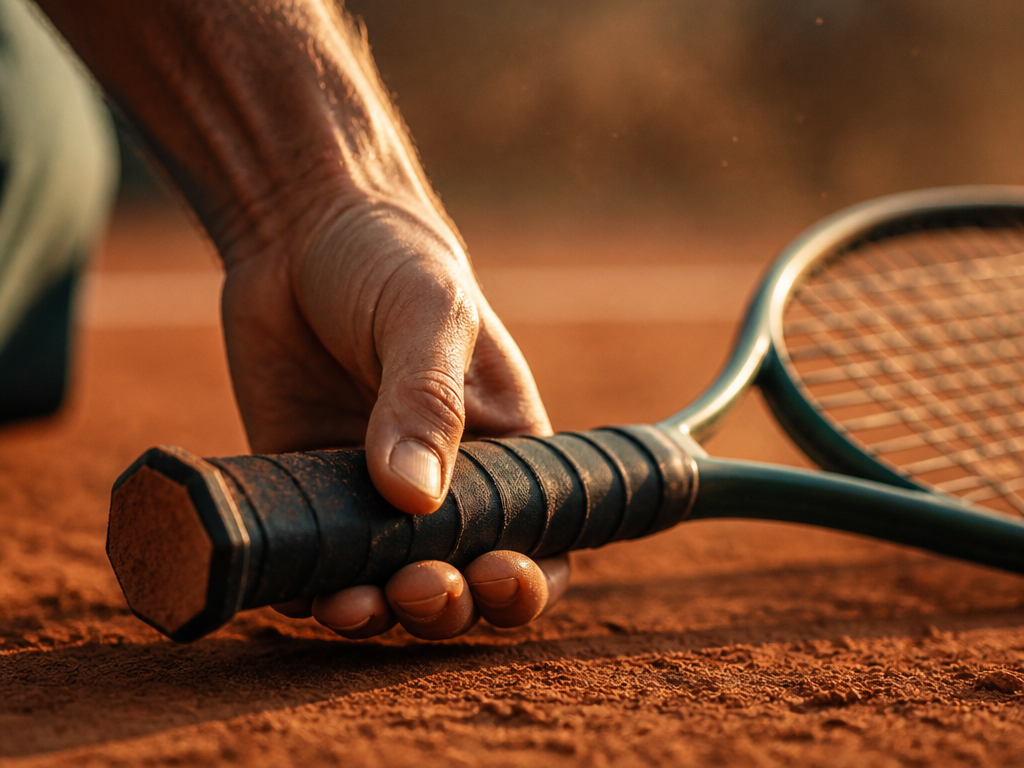
Somewhere between the slow-motion breakdown of Alcaraz's wrist and your fourth grip change of the season, a genuinely useful number got buried.
In 1997, Bruce Elliott and colleagues published a study in the Journal of Applied Biomechanics that put skilled players in a lab and compared a conventional eastern forehand grip against a western one, tracking the upper limb segment by segment to work out where racquet head speed actually comes from. The headline result was a non-result: racquet head speed at impact came out effectively the same for both grips. Not modestly different. Not different-with-caveats. Statistically indistinguishable.
That single non-difference is one of the most useful things ever published about forehand grip selection, and almost nobody repeats it, because "it barely matters" does not perform well as a thumbnail. Our verdict, stated plainly: your grip determines the shape of the ball you hit, not the speed of the racquet — which makes it a weak candidate for the reason your forehand has stalled.
How we evaluated
We did not put anyone in a lab. This is a reading of the published evidence, and it is worth being explicit about what went into it and what weight each source carried.
We drew on four kinds of material. First, peer-reviewed biomechanics — principally Elliott, Takahashi and Noffal (1997) on grip position and racquet head velocity, which is the closest thing to a direct experimental test of the question. Second, textbook synthesis: Duane Knudson's Biomechanical Principles of Tennis Technique (2006), which is where the mechanism gets explained rather than just measured. Third, the widely reproduced high-speed-video spin figures that circulate from John Yandell's Tennisplayer archive, putting elite topspin forehands somewhere in the region of 2,500 to 3,200 revolutions per minute with Nadal at the top of that band. Fourth, the consensus among teaching professionals about what happens when a club player changes grips mid-season, which is not controlled data but is the largest body of observation that exists.
We weighted them differently. For mechanism — what a grip physically does to the racquet face — the lab work and Knudson's synthesis carry the argument. For outcome in a real match, neither does, and we lean on coaching consensus while saying openly that it is consensus, not evidence. The video-derived spin numbers we treat as order-of-magnitude only; they are not peer-reviewed, the measurement conditions vary, and we have seen them quoted with a false precision they cannot support.
Where our sources disagree, we say so. Where a figure is manufacturer-stated, we label it.
What that 1997 study actually measured
The design matters more than the headline. Elliott's group was not asking "which grip is better." They were asking where the racquet's speed comes from — how much of it is generated by shoulder internal rotation, how much by the forearm, how much by the wrist — and whether changing the grip changes that distribution.
It does. The reported pattern is that the total speed arrives at the same place by different routes: the more extreme grip position shifts the segment contributions and produces a racquet path with a larger vertical component at impact, which is the mechanical signature of a ball with more topspin and a lower net-clearance-to-depth ratio. The eastern position gets there with a flatter path.
So the grip changes the recipe. It does not change the total.
Two honest limits. The sample was small — single digits of skilled male players, which is normal for lab biomechanics of that era and normal for it to be underpowered for anything subtle. And we are reporting the pattern as it has been summarised in the literature and coaching material since; we have not re-analysed the raw data, and anyone treating this as a settled universal law is overreading one study.
What the number does not measure
This is the part that gets skipped, and it is where the study stops being able to help you.
It did not measure error rate. Racquet head speed is not a score. A grip that produces identical speed and twice the unforced errors is a worse grip, and nothing in that design would detect it.
It did not measure rally conditions. Lab feeds arrive at a controlled height in a controlled place. The reason grip choice feels consequential on court is that real balls arrive at knee height and shoulder height in the same game, and a grip's comfortable window is height-dependent. The study deliberately removed the variable that makes the question interesting.
It did not measure recovery, fatigue, or movement, so it cannot speak to what happens on the ninth ball of a rally.
It did not measure transition cost — the weeks of worse tennis you buy when you change a grip you have grooved. That cost is real, it is the single most common regret teaching pros report, and no lab study of already-skilled players will ever capture it.
And it did not include anyone below the skilled tier. The players in that lab already had a repeatable contact point. If your contact point moves around by a foot depending on how late you arrive, the study is not about you.
The four grips, honestly compared
Bevel numbers below refer to the index-knuckle position for a right-handed player, counting from the top bevel clockwise — the standard convention, not a measurement. What each grip does to the racquet face is mechanism from Knudson; where each fails is coaching consensus.
| Grip | Index knuckle | Natural contact height | What the evidence supports | Where it fails |
|---|---|---|---|---|
| Continental | Bevel 2 | Low, out front, close to the body | Serves, volleys, slice — one grip for the whole net game | Closes the face on high balls; requires elite timing to hit topspin at all |
| Eastern | Bevel 3 | Waist to chest, well out front | Flatter drive, comparable racquet speed to western per Elliott et al. | Punished by high, heavy balls above shoulder height |
| Semi-western | Bevel 4 | Chest height, slightly further back | Larger vertical racquet path, more spin at similar speed; the default among current pros | Low skidding balls and short slices become genuinely awkward |
| Full western | Bevel 5 | Shoulder height and above | Highest spin potential of the four | Low balls, fast courts, and transitioning to the volley grip all get harder |
One genuine caveat on the pro-usage argument: the fact that the modern tour skews semi-western is weak evidence for what you should do. Tour players face balls arriving at heights recreational players almost never see, on rebound surfaces prepared to a standard your club court is not. Copying the population-level answer to a different question is how people end up with a grip that suits balls they will never receive.
The variable the lab controlled away
Here is the reframe the number points at. If a grip's job is to present the right face angle at a given contact height, then the useful question is not which grip is best — it is what determines your contact height. And that is not a grip decision. It is a positioning decision, made a second and a half before impact, in the last two steps.
This is why grip changes so often produce a fortnight of improvement and then nothing. You changed the tool for matching a contact height you are not reliably reaching. The evidence for this is not experimental — it is the near-unanimous report of teaching professionals, and we grade it accordingly — but it is consistent with the mechanism, and the mechanism is the part that has actually been measured.
The next question people ask: grip size
Manufacturers list adult handle sizes in a narrow band, typically 4⅛ to 4⅝ inches of circumference (L1 through L5), and retail advice attaches a lot of injury prevention to picking correctly within it. We looked for strong evidence that grip size within that range meaningfully drives elbow pain and did not find it. The claim may still be true. It is not, on what we could read, well established, and we would not change racquets over it.
Who should change grips, and who shouldn't
Change if: you are using a continental grip for topspin forehands and losing balls long — that is the one case where the mechanism predicts a real problem, because the face angle is fighting you. Or you have a full western grip on a fast, low-bouncing court, which is a genuine mismatch.
Don't change if: you are anywhere in the eastern-to-semi-western band and your complaint is inconsistency. The published evidence gives you no reason to expect a speed gain, and the coaching consensus predicts you will pay a transition cost for a lateral move.
The line worth screenshotting: anywhere between bevel 3 and bevel 4 is a correct answer, and the grip you keep will beat the better grip you are still learning.
The verdict
On the central claim — that grip choice within the common range determines ball shape rather than racquet head speed, and is therefore rarely the limiting factor for a recreational player — we grade the evidence Moderate. The mechanism is well described and the one direct experimental comparison supports it, but that study is small, dated, limited to skilled players, and has not to our knowledge been convincingly replicated. Treat it as a strong reason to stop tinkering, not a law.
Reviewer's note
I have not moved my index knuckle off bevel 4 in three racquets, and I no longer own a grip-change plan. What changed after reading this material is narrower than that: when the forehand deserts me, grip came off the list of things I check. What replaced it is whether my last step before contact was a small one, because a small final step means I got there early and a lunge means I did not. That is not a recommendation. It is just what taking the number seriously looks like when it is your own racquet.