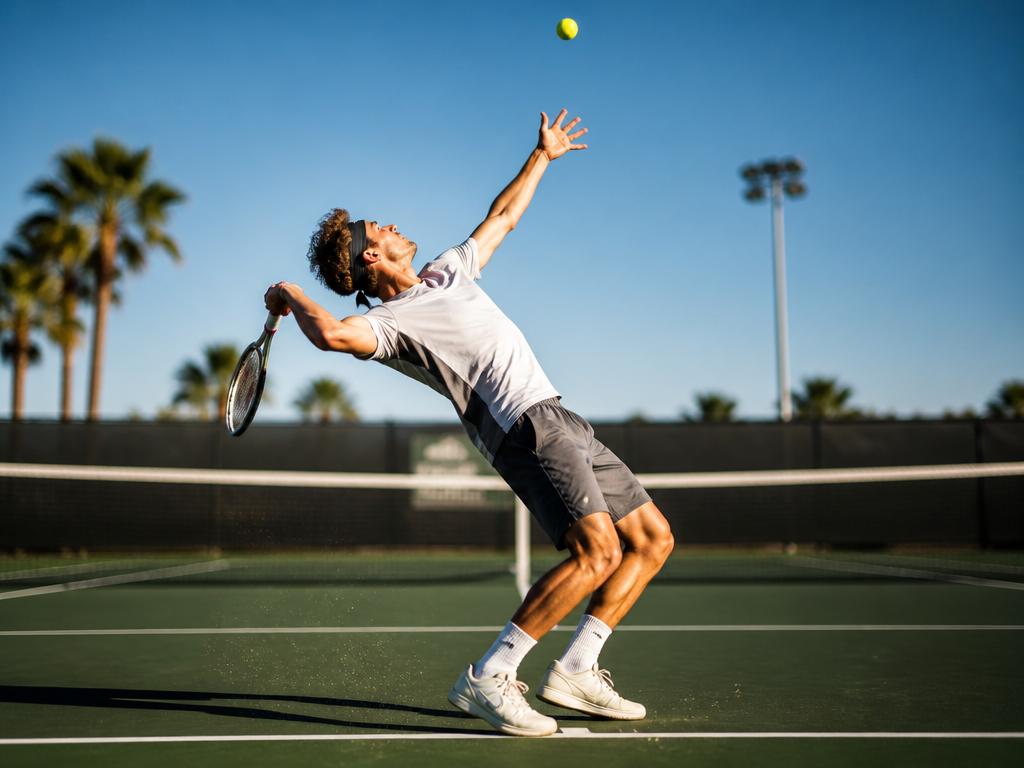
The fastest way for most 3.0–4.0 players to win more matches is not a bigger first serve. It is a second serve that lands under pressure — and for the majority of players stuck double-faulting, that reliability comes from kick serve technique, not from swinging harder or aiming safer. That claim runs against instinct. The flat bomb feels like the weapon. But the evidence points the other way, and the rest of this piece is us earning the right to have said it.
How we weighed the evidence
We are not writing from a court or a lab. What follows is a synthesis of three kinds of evidence, each with its own weight and its own limits.
First, the physics, which is settled and uncontroversial: a ball struck with heavy topspin curves and drops through what physicists call the Magnus effect, the same force that bends a soccer free kick. That is textbook fluid dynamics, not a coaching opinion.
Second, the biomechanics literature on the serve. Independent studies of the service motion — the kinetic-chain work associated with researchers like Bruce Elliott and Machar Reid, and the coaching biomechanics of Brian Gordon — converge on the same mechanics: the serve is a sequenced transfer of energy from legs to trunk to arm, finished by forearm pronation. We treat that as strong, because independent groups agree.
Third, and weakest, the reported player outcomes. Coaches across levels report that players who trade a flat second serve for a topspin one cut their double faults sharply within a season. We have seen those figures repeated widely, but they are coach-observed and self-selected, not controlled trials. We flag them as suggestive, not proven, and we have not invented a number of our own.
Where those three disagree, we say so. Where a figure is someone's estimate rather than a measurement, we label it.
Why the second serve carries the match
Here is the strategic core. Your first serve can miss and cost you nothing but a do-over. Your second serve, if it misses, hands your opponent the point outright. At the recreational level, the scoreboard is not decided by aces — it is decided by double faults and by soft, sitter second serves that get punished.
The consensus among coaches, and the reason the tour treats the second serve as the true measure of a server, is simple arithmetic: the shot you cannot afford to miss is the one worth building. A flat second serve forces a cruel trade-off — hit it hard enough to matter and you risk the net or the baseline; hit it safe and slow and you feed a put-away. A topspin serve breaks that trade-off, and that is the whole point.
What the spin actually buys you
A kick serve trades raw speed for arc and a heavy downward drop. Because topspin makes the ball dive, you can aim well above the net band — a foot or more of clearance — and still bring the ball down inside the box. More margin over the net and a steeper landing angle is exactly what a nervous second serve needs.
The bounce is the bonus. A ball loaded with topspin and side-spin kicks up and away after it lands, jumping toward a right-hander's backhand from the ad court. Against a 3.5 opponent, a serve that clears comfortably and then leaps to shoulder height is not a consolation shot. It is offense disguised as safety.
One honest caveat: the height and violence of the kick that pros produce depends on racquet-head speed most recreational players will not reach. The mechanism scales down, but the spectacle does not. A reliable, moderate kick is a realistic goal; a shoulder-high explosion off a slow swing is not.
The three fundamentals that actually move the needle
Coaches disagree about drills. They agree, remarkably, about the foundation. Three things separate a serve that spins from one that does not.
The grip. A continental grip — the edge-on "hammer" hold — is non-negotiable. It is what lets the strings brush across the back of the ball instead of pushing through it. Players who hold a forehand-style grip can flatten a first serve, but they physically cannot generate real topspin. If you change one thing, change this.
The toss. For a kick serve the toss sits slightly behind your head and a touch toward your tossing shoulder, not out in front. That placement is what lets the racquet travel up and across the ball from low to high. A toss thrown out front turns the motion back into a flat swing no matter what your grip is doing.
The upward brush plus the legs. The cue coaches reach for again and again is some version of make the ball climb the strings — swing up the back of the ball toward one o'clock, not straight through it. That upward path is powered from the ground: bend the knees and drive up, so the racquet is accelerating skyward at contact. Pronation — the natural rolling of the forearm — then finishes the motion. Note that pronation is a release, not a manufactured flick; forcing it is a common way to hurt yourself.
Grip, toss, path. Get those three aligned and spin appears almost on its own. Miss any one and no amount of effort compensates.
Where players stall
The recurring failure is not effort — it is the toss creeping forward under match nerves, which quietly converts the whole motion back to flat. A close second is decelerating into the ball to "guide" it in; spin requires the racquet to be speeding up at contact, and a tentative swing kills the very spin that would have made the serve safe. The third is skipping the legs entirely and arming the ball, which caps both spin and, over time, the shoulder's tolerance for the motion.
Who this is for — and who it isn't
This is for the 3.0–4.0 player, the high-schooler, and the ambitious junior who can already land a serve but bleeds points on the second one. If double faults decide your close matches, the topspin second serve is the highest-leverage thing you can build.
It is not for the true beginner still missing flat serves — get a repeatable motion into the box first. And it is not a quick fix. Every honest source describes it as weeks of ugly, netted attempts before it clicks. Anyone promising a same-day kick serve is selling something.
The verdict
If you want one line to screenshot: for recreational players, a reliable topspin second serve wins more matches than a faster first serve, and the fundamentals that produce it are grip, toss, and an upward brush driven by the legs. The strategic case rests on strong logic and settled physics; the biomechanics are well-supported; the specific improvement numbers coaches cite are suggestive but not rigorously proven.
Evidence grade: Moderate-to-Strong. The physics and the mechanics are solid. The size of the real-world payoff is where the data thins out.
Which leaves the question the science has not actually closed. The kick serve loads the shoulder and trunk differently than a flat serve, and the long-term musculoskeletal cost of teaching heavy spin early — especially to still-growing juniors serving hundreds of balls a week — is not settled in the literature. Are we handing young players a more reliable serve at a durability cost we cannot yet measure? On that, honestly, the evidence is not in.