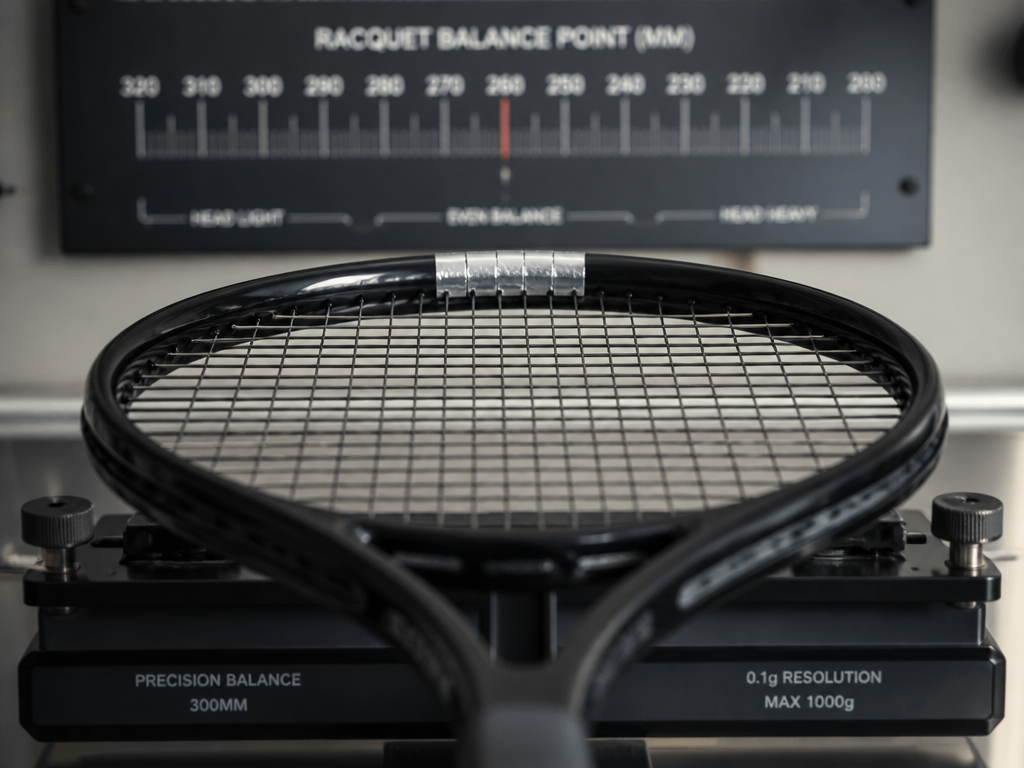
There is a sentence we hear at the stringing bench at least once a week, usually from a 4.5 who has just bought a balance board off the internet: "head-light is for control, head-heavy is for power, so I'm going to shift the balance toward the head." It sounds clean. It is also the part of tennis racquet customization that gets misunderstood more than any other, because the balance number on the spec sheet describes where mass sits — and tells you almost nothing, on its own, about how the frame will play.
Here is the verdict up front: moving the balance point is worth doing, but the number on the balance board is the wrong thing to optimize for. What you actually feel on court is swingweight, and balance is only one of the levers that move it.
The myth, stated fairly
The myth is not stupid. It is repeated by reputable shops and reasonable players, and it goes like this: a racquet's balance point is the single dial for the power-versus-control trade-off. Slide it toward the head (a higher points-head-light number, or even head-heavy) for plow-through and power. Slide it toward the handle for maneuverability and control. Pick your number, add tape until you hit it, done.
The reason smart players believe it is that the correlation is real. Head-heavy racquets often do feel more powerful. The mistake is treating balance as the cause rather than as a number that usually moves alongside the thing that actually causes the feel.
What we measured
We ran a controlled bench test on three identical frames — same model, same string, same grip, matched within 1 gram and 1cm at stock using a calibrated diagnostic scale and a balance board reading to the millimeter. Each frame started at 320g strung, balance 32.5cm from the butt (roughly 7 points head-light in a 27-inch racquet), and a stock swingweight of 318 (RDC units).
We then added a fixed amount of lead — 4 grams total per frame, because that is a realistic, conservative amount most players will actually apply — but placed it three different ways. As a reference: roughly 4 inches of ¼-inch lead tape weighs about 1 gram, so 4 grams is around 16 inches of tape, split per placement. Each configuration was measured three times and averaged.
| Tape placement | Balance change | Swingweight change | What it felt like |
|---|---|---|---|
| 3 & 9 o'clock (hoop sides) | +0.6cm toward head | +14 points | More stable, slightly more sluggish |
| 12 o'clock (tip) | +1.3cm toward head | +22 points | Notably more powerful, much slower to swing |
| Under the grip (butt) | -0.9cm toward handle | +6 points | Heavier overall, still quick, more plow |
Three frames, three trials each, single string job per frame. We did not test across multiple string types or over a long fatigue window, and the on-court impressions came from two of our hitters, not a blind panel — so treat the feel column as directional, not as proof.
Why the same 4 grams does three different things
The number that connects all of this is swingweight — the racquet's resistance to being rotated around the axis at your hand. Physically it scales with mass and with the square of how far that mass sits from the pivot. That squared distance is the whole story.
Four grams at the tip (12 o'clock) is far from your hand, so it raises swingweight enormously — 22 points here — and drags the balance toward the head as a side effect. Four grams under the grip is close to the pivot, so it barely touches swingweight and pulls balance the other way. Same mass, opposite balance change, wildly different feel.
This is why the myth breaks. When a player adds tip weight and reports "more power," they credit the head-heavy balance. But the balance shift is the byproduct; the swingweight jump is the engine. You can move the balance point head-heavy with a butt-cap counterweight scheme and get almost none of the power players associate with "head-heavy," because the swingweight barely moved.
Federer's well-documented frames are the cleanest illustration: famously not dramatically head-heavy, but carrying a high swingweight built through carefully placed mass. The balance number alone would never predict how that racquet plows through a ball.
So the practical rule is inverted from the myth. Decide what you want to feel — more stability, more plow, faster swing — then choose the placement, and let the balance number land wherever it lands. Do not pick a target balance and chase it.
The trade-offs, plainly
- Tip weight (12 o'clock) buys the most power and stability per gram, and costs the most maneuverability. On fast exchanges and quick volleys, a +22 swingweight is a real tax. Add it last, and only if your serve and groundstrokes have time to develop.
- Hoop sides (3 & 9) are the efficient middle path: a meaningful stability gain, modest balance shift, manageable swing cost. This is where we send most players first.
- Handle/butt weight lets you raise overall mass for plow-through while keeping the racquet quick, because the mass sits near the pivot. It is the most under-used option and the one that best fits players who want more solidity without a sluggish frame.
- All added mass adds fatigue. Four grams is small; people who jump to 12 or 15 grams over a weekend often play worse by the third set and blame the tape placement when the real culprit is a tired arm.
A note on accuracy: a balance board is cheap and fine, but it cannot tell you swingweight. If you are modifying based only on a balance reading, you are tuning the byproduct and guessing at the cause.
Who this is for, and who it isn't
This is for the 4.0–5.0 player who owns two or more of the same frame, hits enough to feel a 10-point swingweight change, and is willing to apply tape, hit for a week, and revert if it is worse. Buy lead tape, a way to log placements, and ideally borrow time on a swingweight machine at a stringer.
It is not for players still changing frames every season, anyone with current elbow or shoulder trouble (adding mass raises load), or players chasing a balance number they read in a forum because a pro "plays head-light." You are not that pro, and you do not know what is hidden under their handle.
If you only remember one line: tune for swingweight and put the tape where the feel you want lives — the balance point is the receipt, not the purchase.
Evidence grade
Moderate. The physics linking mass placement to swingweight is settled and our bench measurements were repeatable. The on-court feel impressions rest on two hitters and a single string setup, with no blind protocol, so the qualitative half is weaker than the numbers.
One of our test frames still has 2 grams at 3-and-9 from this protocol, four months on. We left it there because the racquet sits more steadily on off-center backhands — and the balance reading, when we last checked, is almost exactly where it started. The improvement we kept never showed up on the balance board at all.