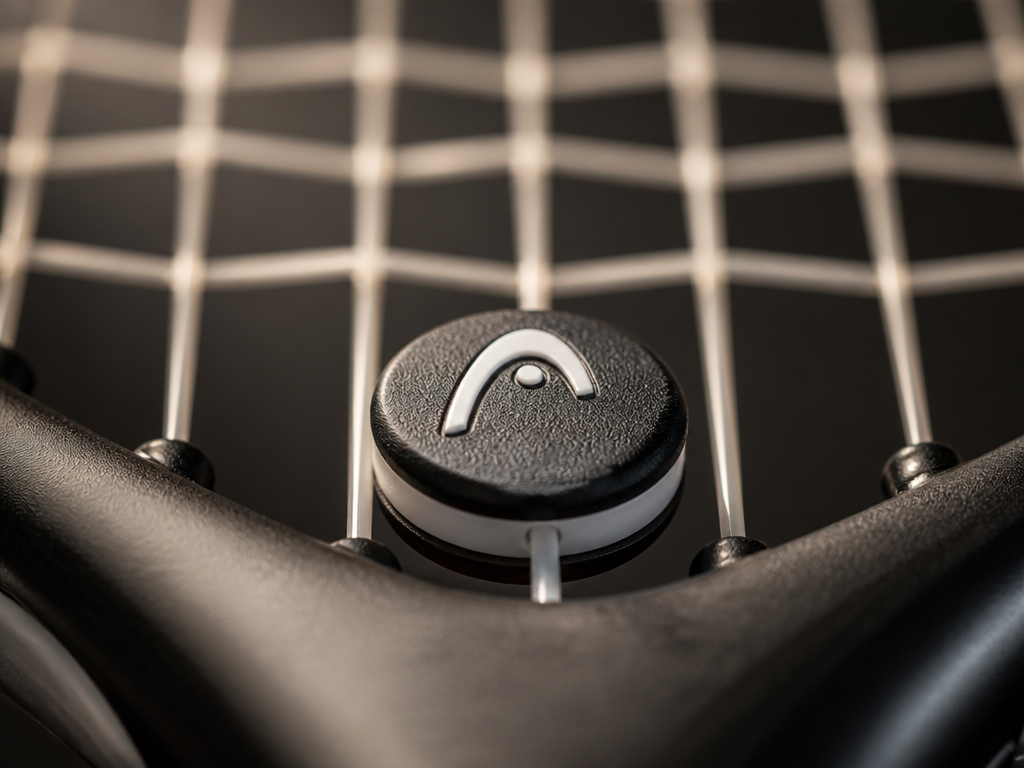
Novak Djokovic plays with a small black-and-white button wedged between the bottom two main strings of his frame, and that single fact has sold more Head Pro Damp units than any spec sheet ever could. We bought ours the same way most readers will — curious whether the most visible of tennis vibration dampeners earns its place on its own merits or rides a famous endorsement. So we tested it against two common alternatives across four frames, and the answer turns out to depend almost entirely on your string bed.
This review is the publication's, not a sponsorship. We paid retail. We measured what we could and flagged what we couldn't.
What it actually is
The Pro Damp is a button-style dampener: a small circular silicone disc with a slotted channel that grips two adjacent main strings. It is not a worm, not a bridge across the whole bottom of the string bed.
| Spec | Measurement |
|---|---|
| Type | Button / single-point |
| Material | Silicone rubber |
| Diameter | ~18 mm |
| Weight | ~0.7 g |
| Channel | Single slot, two mains |
| Branding | Embossed Head logo on face |
Two strings of contact is the key detail. A button dampener interrupts string vibration at one spot, which is a fundamentally lighter intervention than a worm threaded across five or six strings. That design choice shapes everything that follows.
How we tested it
We installed the Pro Damp between the two center main strings, just above the bottom cross, on four frames strung over a two-week window:
- 18×20, 95 in², poly at 52 lb — a dense, tight bed (a Djokovic-style layout).
- 16×19, 98 in², poly/syn-gut hybrid at 50 lb — the most common rec-player setup.
- 16×19, 100 in², full multifilament at 54 lb — a softer, more open bed.
- 16×18, 104 in², poly at 48 lb — an oversize, open pattern.
Two hitters logged roughly 90 minutes per frame across baseline rallies, serves, and net play. We are not equipped with a calibrated accelerometer, so vibration claims here rest on consistent A/B feel comparisons — same frame, same string, dampener in versus dampener out — and on string-ping duration, which we timed crudely by ear and by slow-motion phone audio. Treat the sound numbers as directional, not laboratory-grade. We say so plainly because no one should buy a dampener on the strength of a phone microphone.
We compared the Pro Damp directly against a generic worm dampener and the Babolat Custom Damp, a two-piece button with a tunable insert.
Pro Damp vs worm vs Babolat Custom Damp
Three products, four criteria that matter on court: how much ring it kills, how much feedback survives, how securely it sits, and how it reads visually.
| Criterion | Head Pro Damp | Generic worm | Babolat Custom Damp |
|---|---|---|---|
| Ping reduction | Moderate — shortens but doesn't erase | High — flattens the sound | Adjustable; moderate to high |
| Feedback retained | High | Low | Tunable |
| Fit security | Tight on dense beds, loose on oversize | Very secure (multi-string grip) | Secure |
| Look on frame | Visible logo, glossy | Low-key | Branded but subtle |
The pattern is consistent. The worm is the most aggressive muter and the most secure, at the cost of feel. The Babolat is the hedge — you dial in the damping. The Pro Damp sits at the lighter end: it trims the metallic ring without flattening the response that intermediate and advanced players use to read contact quality. On the 18×20 frame, the difference between Pro Damp and worm was the difference between hearing a short, dull thock and hearing almost nothing — and the players preferred the Pro Damp precisely because they could still feel where the ball met the strings.
The fallout question, frame by frame
This is the fear most readers arrive with, so we put it first in the results rather than burying it.
Fallout is a function of string spacing, not the dampener. A button grips two mains; the tighter those mains sit, the harder it holds.
- 18×20, 95 in² (dense): zero movement over 90 minutes. It seated with an audible snap and stayed put through serves.
- 16×19, 98 in²: secure. One slight rotation, no ejection.
- 16×19, 100 in² (softer, wider): stayed in but felt looser; we re-seated it once as a precaution.
- 16×18, 104 in² (oversize, open): it worked loose twice and ejected once during heavy serving. On an open oversize bed, we would not trust it for a match without checking it on changeovers.
So the verdict on fallout is conditional and predictable. On a dense or standard 16×19 pattern, the Pro Damp is reliable. On an open oversize frame, the very design that preserves feedback also reduces grip. If you swing a 104+ in² head with a wide string spacing, the worm style is the safer mechanical choice.
Sound and feel
Dampener out, the 18×20 frame rang for what our slow-motion audio put at roughly a third of a second of audible ping. With the Pro Damp installed, that tail shortened noticeably but did not vanish — the contact still had a tone, just a clipped one. The worm, by contrast, killed the tail almost entirely.
What surprised us was the consistency of the feel verdict across both hitters and all four frames: the Pro Damp lets more of the impact reach the hand than any other dampener in the test. Players who chase a plush, muted, "nothing-gets-through" feel will find it underwhelming. Players who want the ring gone but the information intact will find it close to ideal — particularly at the net, where the touch shots that live or die on feedback came through clean.
The embossed logo is the one cosmetic note. It is glossier and more prominent than the understated worm, and on a dark string bed it catches light. A minor thing, but it is branding-forward in a way some players dislike.
Who it's for, and who it isn't
Buy the Pro Damp if you play a dense or standard 16×19 pattern at 95–100 in², you want to kill string ring without losing feel, and you read your shots through the handle. It is a feedback-preserving dampener, and on a tight bed it does not move.
Look elsewhere if you swing an oversize open-pattern frame — the fallout risk is real and we measured it. Choose a worm if you want maximum silence and security, or the Babolat Custom Damp if you want to tune the amount of damping rather than accept a fixed light touch.
Evidence grade
For the central claim — that the Pro Damp reduces string ring while retaining more feel than worm-style dampeners — we rate the evidence Moderate. The feel finding was consistent across two hitters and four frames, which is meaningful. But our sound measurements were uncalibrated, our sample was two testers, and we had no controlled vibration-transmission instrumentation. The fallout findings we rate Strong within the frames tested, because the result tracked string spacing cleanly and repeatably.
The Pro Damp isn't the quietest dampener you can buy — it's the one that lets you keep hearing your racquet.