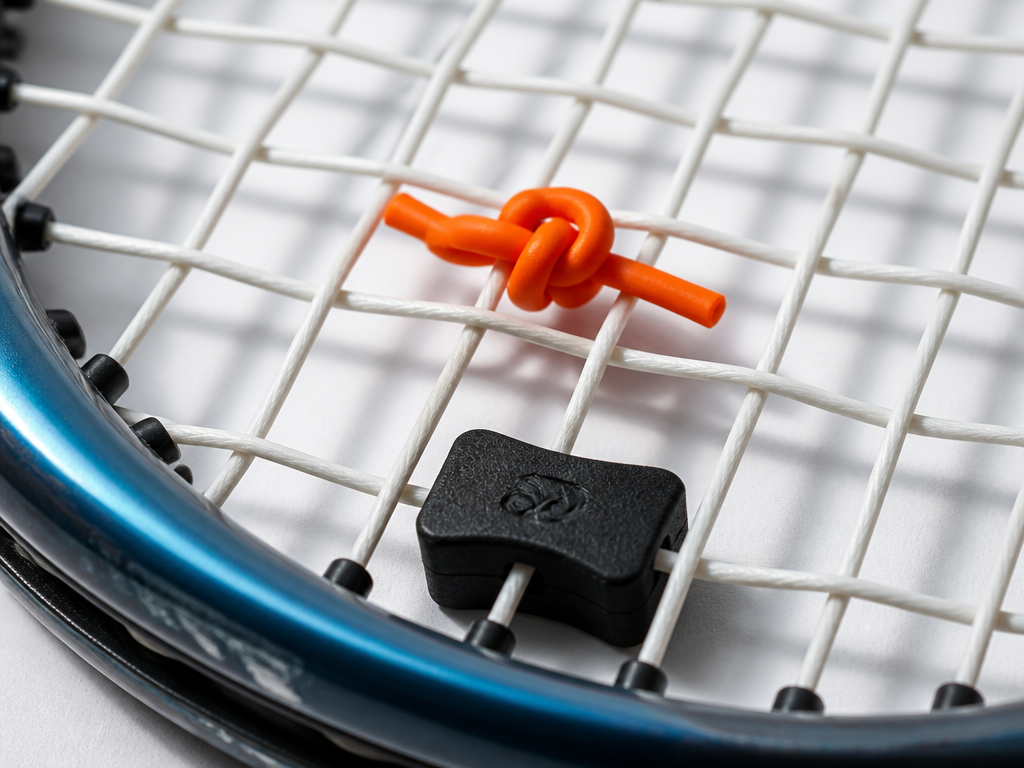
Andre Agassi knotting a rubber band through his string bed is the origin story every budget-minded player eventually hears, and it raises a fair question: are rubber bands a legitimate alternative to the vibration dampeners sold for a few dollars at every pro shop, or just a habit a famous player made look credible? We went looking at what the published physics, the manufacturer claims, and the consensus among independent testers and owners actually say — and the answer is more specific than either the believers or the skeptics tend to allow.
The short version: a rubber band, like any small dampener, reliably muffles the high-pitched string "ping" and changes almost nothing about the vibration that reaches your arm — which is also true of the foam and rubber dampeners you'd pay for, so the rubber band is mostly a free way to buy the same sound change.
How we evaluated
We did not run a lab or install bands on our own frames and report numbers as if they were measured. This is a synthesis. We weighed four kinds of evidence:
- Published physics on string-bed vibration, principally the work summarized in Rod Cross and Crawford Lindsey's Technical Tennis and Howard Brody's racquet-physics writing, on what a string dampener can and cannot affect.
- Manufacturer claims from dampener makers, read skeptically for what they promise versus what they demonstrate.
- Independent tester consensus, including the long-running view at Tennis Warehouse University and similar gear desks.
- Owner feedback on durability, feel, and whether buyers felt the thing did what they hoped.
Where these disagree, we say so. Where a figure is manufacturer-stated rather than independently verified, we flag it.
What most people do
Most recreational players in the 3.0–4.0 range buy a small foam or rubber dampener — a "worm" that weaves between two mains, or a button that snaps onto the bottom strings — and slot it near the bottom of the string bed. The stated reasons cluster into two: they don't like the sharp ping, and they believe the dampener protects their arm from the shock that aggravates tennis elbow.
The first reason is sound. The second is where the trouble starts. The belief that a string dampener reduces the impact load transmitted to the wrist and elbow is widespread, repeated in product marketing, and not supported by the physics. The rubber-band crowd inherits the same confusion in a cheaper form: people knot a Size 64 band through the center mains, hear the ping disappear, and conclude the band must be soaking up vibration on its way to the hand.
It muffles the ping. That part is real. The leap from "quieter" to "easier on my arm" is the part the evidence does not back.
What the evidence suggests
The key is that a tennis racquet has two largely separate vibrations, and a dampener only touches one of them.
The first is the string-bed vibration — a high-frequency buzz, often cited in the racquet-physics literature in the rough neighborhood of 400 to 600 Hz depending on string and tension. This is what you hear as the ping, and it dies out within milliseconds. The second is the frame's fundamental vibration — a much lower frequency, commonly cited around 100 to 200 Hz for the whole-frame mode — which travels down the handle and is what your hand and forearm actually feel after an off-center hit.
A string dampener, whether a $4 worm or a one-cent rubber band, sits on the strings. It adds a tiny inertial mass to the string bed and damps that high-frequency string mode — which is why the ping goes quiet. It does essentially nothing to the frame's lower-frequency mode, because it isn't attached to the frame in a way that would absorb that energy. Cross and Lindsey make this point directly: the dampener changes the sound, not the shock load reaching the arm. Brody's earlier work reaches the same conclusion. We did not find a controlled study showing string dampeners reduce arm-felt vibration, and the manufacturer copy that implies otherwise tends to lean on the word "vibration" without distinguishing which vibration it means.
So how does a rubber band compare to a commercial dampener on the thing they do affect — sound? The consensus among independent testers is that the difference is small. Both kill the ping. A tightly knotted band gives a slightly more muted, "deader" sound than some button dampeners; testers describe the change to playing feel as minor in either case, because the part of the feel you actually sense — the frame flex and the ball pocketing — is set by the strings, tension, and frame, not by a gram of foam or rubber near the throat.
| Criterion | Rubber band (Size 64) | Foam/rubber dampener | Nothing |
|---|---|---|---|
| String ping | Muffled | Muffled | Audible |
| Arm-felt frame vibration | No meaningful change | No meaningful change | Baseline |
| Cost | ~1 cent | ~$3–6 | $0 |
| Durability | Breaks; replace often | Months; can fly out | n/a |
| Legality | Within ITF norms when between strings | Same | n/a |
A note on rules, since it comes up: the ITF allows vibration-damping devices only outside the pattern of the crossed strings, which in practice means a band woven down the center between two mains is fine; some testers and owners report bands snapping mid-match, which is the most common complaint against them.
What I actually do
A brief reviewer note here, since the honest answer is personal preference, not a measured result.
I keep a few Size 64 bands in my bag because they are a near-free way to find out whether I even like a muffled string bed before I spend anything. If I hate the ping, a band tells me that in five minutes. If the band breaks, I'm out a cent. What I do not do is reach for one — or for any string dampener — when my elbow is sore, because the evidence says that is the wrong tool for that problem. For arm comfort I'd look at string type, lower tension, and grip size long before anything that clips to the string bed.
That is the whole honest pitch: the band does one job, does it about as well as the paid option, and pretends to do nothing it can't.
Who this is for — and who it isn't
Worth trying if: you mainly dislike the string ping, you want to test that preference for free, or you already use a dampener and resent paying for replacements that fly into the net.
Skip it if: you're shopping for arm relief — a dampener of any kind is the wrong purchase, and you'll be disappointed; if you find a frayed band aesthetically cheap and that bothers you; or if you've had bands snap mid-rally and would rather a button that stays put.
The line you can screenshot: a rubber band buys you the same sound change as a store dampener for free, and the same lack of arm protection for free.
Evidence grade and what we didn't answer
For the central claim — string dampeners, rubber band or commercial, reduce the audible string ping but not the frame vibration felt at the arm — we grade the evidence Strong. It is consistent across the racquet-physics literature and the independent tester consensus, and the manufacturer claims that conflict with it are vague rather than demonstrative.
What this synthesis did not settle: whether the small sound change has a psychological effect on timing or confidence, which the physics can't measure and which owner reports split on; and whether any string-bed device, of any design, can meaningfully alter arm load — the literature says no for the common types, but we found no broad test of every novelty product on the market. If you want to chase the arm-comfort question properly, the next place to look is the string and tension research, not the dampener aisle.