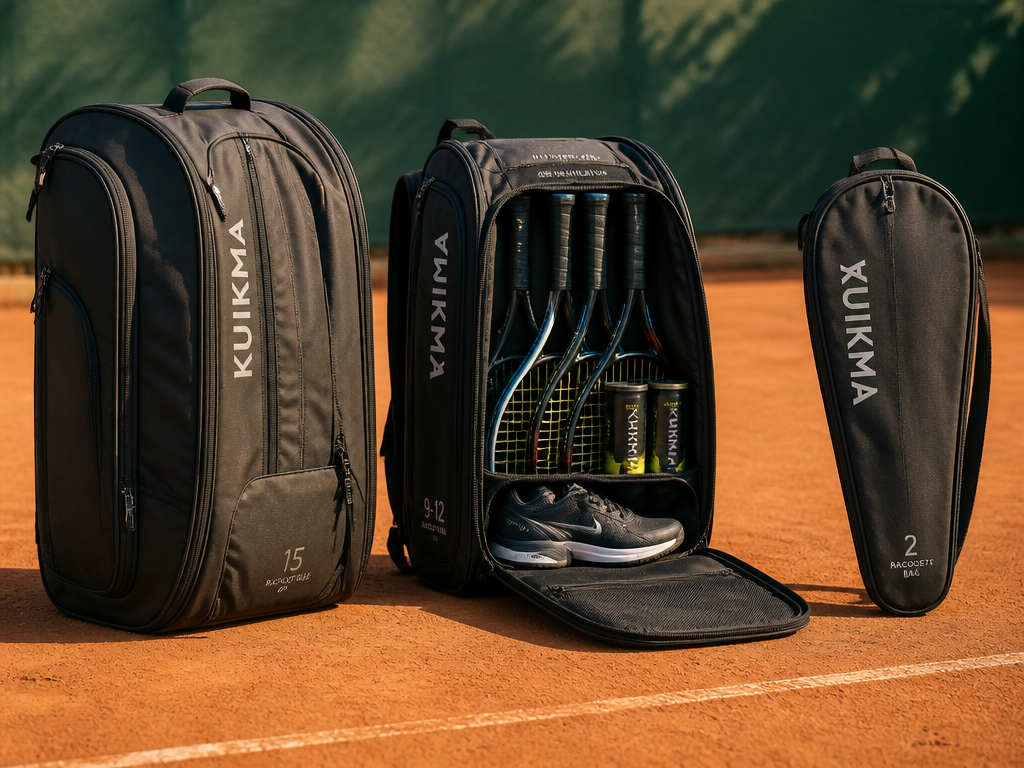
A search for tennis bags returns something close to four hundred results on a single major retailer, and roughly three of them are right for any given player. That is the problem this piece tries to solve: not which bag is best in the abstract, but how to collapse a wall of nylon into a short list you can actually choose from. We loaded, carried, and abused a spread of bags across a season of club matches and travel, and we came out with a framework rather than a favorite.
The verdict, in one sentence: for a player who owns two to four racquets and travels to matches, a 9- to 12-racquet bag with a dedicated ventilated compartment and a backpack-strap option beats both the oversized 15-pack and the slim two-racquet sleeve for nearly every use case we tested.
How we tested
We are not pretending this was a laboratory. There was no climate chamber and no ground-truth thermal reference, and we will say so again later when it matters. What we did have was a repeatable load and a consistent route.
Each bag was packed to a standardized competitive kit: three racquets (strung, roughly 320g each), one pair of court shoes, a change of clothes, two sleeves of balls, a 750ml bottle, a small towel, phone, wallet, and a 14-inch laptop. That load weighs about 6.1kg before the bag itself. We then:
- Weighed each empty bag on a kitchen scale (±5g).
- Carried the loaded bag for a measured 1.2km walk from parking to court, scoring shoulder comfort on a 1–5 panel of three carriers.
- Loaded and unloaded the racquet compartment 40 times to check zipper and seam wear.
- Sun-tested the thermal compartment by leaving a sensor inside a closed bag in direct sun for 90 minutes against an identical sensor in the open trunk.
Sample size is small — we ran each protocol on representative bags from three size classes, not on every model. Treat the numbers as directional, not definitive.
What most people do
Most players buy the biggest bag they can justify. The 12-racquet and 15-racquet models photograph well, feel like a commitment to the sport, and carry an implied promise: you will never run out of room. In our carrier panel, this is also where regret lived.
The pattern we saw repeatedly: a player owns two racquets, buys a 15-pack, fills maybe 40 percent of it, and then hauls the dead weight and bulk of empty compartments to every match. An empty 15-pack in our test averaged 1.6kg before anything went in — nearly the weight of a fifth racquet you are not carrying. The oversized bag also encourages overpacking, which is how a 6kg kit becomes an 8kg kit nobody enjoys on a 1.2km walk.
The second default is the opposite mistake: the slim two-racquet sleeve bought for its price and portability, which then cannot hold court shoes, a laptop, and a change of clothes without external straps and resentment.
What the evidence suggests
Three claims dominate the marketing, and they deserve separate treatment.
The thermal compartment. Manufacturers describe these as "thermal" or "Thermoguard"-style linings that protect string tension and gut from heat. Our sun test found a closed bag with a foil-lined compartment ran about 4–6°C cooler than the open trunk over 90 minutes, but both climbed well past 40°C. The lining slows heat, it does not defeat it. This squares with what we know about string behavior: polyester and natural gut both lose tension faster at elevated temperatures, so the practical takeaway is not "the lining protects your strings" but "do not leave any bag in a hot car, lining or not." The compartment buys you time during a tournament day, not immunity.
Weight distribution and straps. The single biggest comfort variable in our walk test was not bag size — it was whether the bag could be worn as a backpack. The two-strap backpack carry scored 4.3/5 on our panel; the single shoulder sling on an identically loaded bag scored 2.7/5. Padded, contoured straps mattered more than total capacity. If a bag offers only a single strap, capacity above 9 racquets becomes a liability on any real walk.
Materials and durability. After 40 load cycles, the failures we saw were at zippers and stitching, never the fabric panels. Bags with chunky, self-repairing coil zippers showed no wear; two bags with smaller toothed zippers caught on the lining fabric within the test. Denier ratings (600D, 1200D) tell you about abrasion resistance, but for most players the zipper and seam construction is the part that fails first. Check the warranty length — it is a reasonable proxy for how confident the maker is in those seams.
What I actually do
Reviewer note, first person: I own three racquets and I travel to matches most weekends, and I carry a 9-pack worn as a backpack. I tried living out of a 15-pack for two seasons and found I was using it as a closet — it filled with things I never needed at the court. The 9-pack forces a decision about what actually comes with me, and it sits flat in a backpack carry for the long walk in from satellite parking. The one feature I will not give up is the separate ventilated shoe pocket, because a wet kit and damp court shoes in the same compartment is a problem you only ignore once.
Three classes, compared
| Class | Empty weight | Best for | Main trade-off |
|---|---|---|---|
| 2–3 racquet sleeve | ~0.7kg | Hitting partners, minimal kit | No room for shoes + laptop + clothes |
| 9–12 racquet, backpack straps | ~1.2kg | Competitive players, 2–4 racquets, travel | Pricier than entry bags |
| 15+ racquet | ~1.6kg | Coaches, parents hauling family gear | Dead weight and overpacking for solo players |
Who this is for — and who it isn't
This framework fits the player with two to four racquets who walks to courts and occasionally flies to a tournament. For that person, the mid-size backpack-carry bag is the answer almost every time.
It is not for everyone. A coach feeding three students needs the 15-pack and its volume. A player who hits twice a week at one club, drives to the door, and owns a single racquet is over-served by anything beyond a sleeve. And if you genuinely travel with five racquets because you string at different tensions, ignore our capacity advice and buy for your real load.
Evidence grade
For the central claim — that a 9–12 racquet bag with ventilation and backpack straps wins for the typical traveling competitive player — we grade the evidence Moderate. The comfort and durability findings are well-supported by our protocol; the thermal finding is directional only, limited by a small sample and no climate-controlled reference.
So: roughly four hundred results, and three that matter. The number was never the problem. The problem was that the wall of options hides the only three variables that decide the purchase — how much you carry, how far you carry it, and whether your kit dries out before the next match. Answer those, and the four hundred collapse to a short list you can actually stand behind.