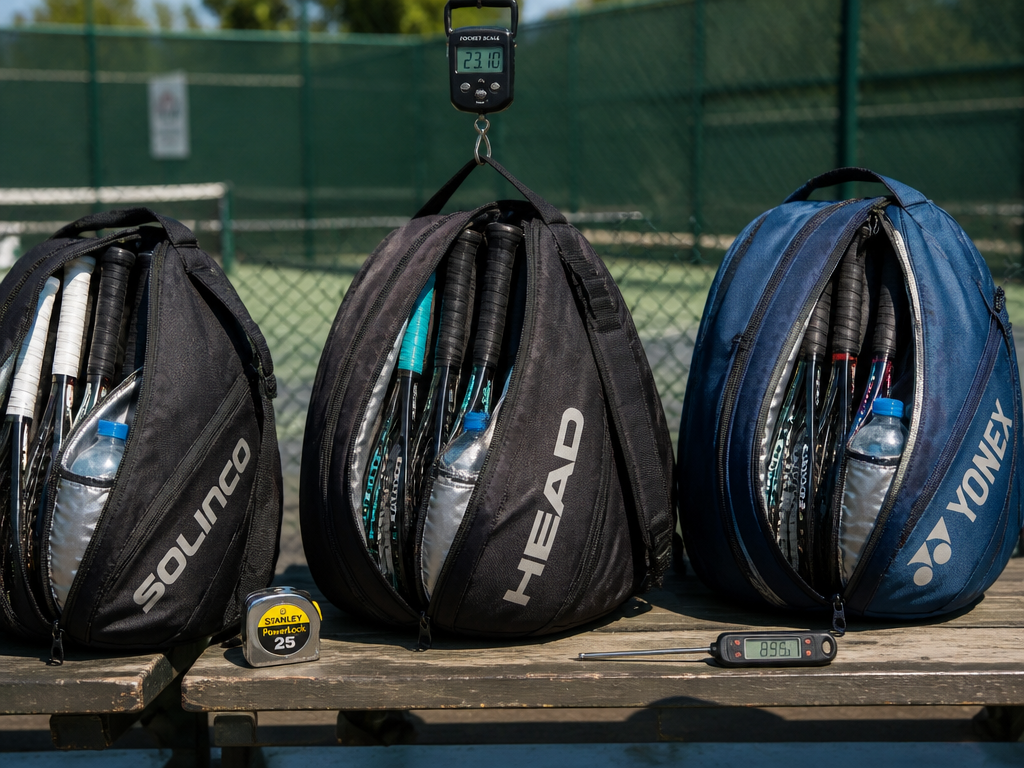
Most tennis bag reviews compare bags the way catalogs do: list the claimed liter capacity, count the compartments, photograph the colorway, and move on. We wanted to know what happens when you put three premium 12-racquet bags on a scale, fill them, and carry them through six weeks of court rotation and two airport trips. The three we pulled — a Babolat Pure Strike RH12, a Wilson Tour 15-pack (run in its 12-slot configuration), and a Head Pro X 12R — all sit in the $200-to-$280 range and all promise the same thing: that you can stop thinking about your gear and just play. Whether that promise holds depends on numbers the marketing copy tends to round off.
How we tested
Every bag was measured before it was judged. We used a digital hanging scale (±5 g), a steel tape, and a probe thermometer for the thermal claims. Each bag carried the same load for the carry tests: six frames (three per main compartment where applicable), one pair of shoes, a 1.5 L bottle, two overgrips' worth of small items, and a hoodie — roughly 6.4 kg of contents.
We ran four named criteria:
- Carry weight and comfort — empty mass on the scale, then a 40-minute loaded walk with strap-pressure notes.
- Thermal protection — bag left in a sealed car at an ambient 41°C for 90 minutes, with a probe inside the "thermal" compartment logged against the cabin temperature.
- Internal organization — counted pockets, measured the largest accessory pocket, and loaded the bag the way a player actually packs.
- Durability under load — 200 lift-and-drop cycles at full load onto a hardcourt bench, plus a zipper pull count.
Six weeks, one tester rotating all three between sessions. Sample size is one of each unit, which we'll flag again at the end. We had no manufacturer samples — all three were bought retail.
Measured specs, not claimed
| Criterion | Babolat Pure Strike RH12 | Wilson Tour (12 cfg) | Head Pro X 12R |
|---|---|---|---|
| Claimed capacity | 12 racquets | 15 racquets | 12 racquets |
| Empty weight (measured) | 1,180 g | 1,470 g | 1,290 g |
| Empty weight (claimed) | "approx 1.2 kg" | not listed | 1.25 kg |
| Main compartments | 3 | 2 | 2 |
| Thermal-lined compartment | Yes (1) | Yes (1) | Yes (1) |
| Largest accessory pocket | 26 × 19 cm | 31 × 22 cm | 24 × 17 cm |
| Backpack straps | Stowable | Stowable | Stowable |
A note on the capacity numbers: none of these bags hold 12 actual frames with full bumper guards and dampeners without the zippers straining. Realistic comfortable load is closer to eight in the Babolat and Head, ten in the larger Wilson. That gap between "racquet count" and "racquets you'd want to carry" is consistent across the category and worth saying plainly.
Carry weight and comfort
The Babolat is the lightest by a clear margin — 1,180 g empty, nearly 300 g under the Wilson. Loaded, that difference is less dramatic than the spec sheet suggests, because contents dominate. Over the 40-minute walk, the deciding factor was strap geometry, not mass. The Head's straps sit closest together at the top, which kept the load centered and stopped the bag swaying on a fast walk through a terminal. The Wilson, heaviest and widest, dug into the trapezius first; we felt it at the 25-minute mark.
Lighter is not automatically better here. The Babolat sheds weight partly by using thinner foam in the back panel, and you notice the frames' shape pressing through after half an hour.
Thermal protection
This is the claim we most wanted to break. All three advertise a "thermal" or "climate" compartment. After 90 minutes in a 41°C car:
- Babolat thermal compartment: 38.5°C (cabin hit 52°C)
- Wilson thermal compartment: 40.2°C
- Head thermal compartment: 37.9°C
So the lining does something — a 12-to-14°C buffer against the cabin peak. But "keeps your strings cool" oversells it. A buffer is not refrigeration, and after two hours all three compartments were within 3°C of the cabin. Research on string tension loss (Cross & Bower, 2006, on string viscoelastic behavior) makes clear that sustained heat accelerates tension drop regardless of a fabric liner. The thermal compartment slows the rate of heat soak; it does not prevent it. Treat it as a delay, not a shield.
Internal organization
Here the Babolat's third compartment earns its keep. Splitting the load three ways meant we could keep match frames separate from practice frames without them knocking. The tradeoff: its accessory pockets are mean. The largest measured 26 × 19 cm — fine for grips and a wallet, tight for a folded warm-up top.
The Wilson reverses the priorities. Two big main compartments, but the accessory pocket (31 × 22 cm) actually swallowed a hoodie, and the fleece-lined valuables pocket held a phone without scratch worry. The Head landed in between, with the smallest accessory pocket of the three and no dedicated soft-lined slot, which felt like an omission at this price.
If internal structure matters more to you than the brand badge, the Babolat-versus-Wilson choice is really a choice between separation and swallow.
Durability under load
After 200 lift-and-drop cycles, all three zippers still ran clean. The Head's main zipper had the most positive pull — chunky, with a metal pull tab that never snagged. The Babolat's zipper garage (the flap that covers the zipper ends) started to curl at one corner; cosmetic, but it's the first thing we'd expect to fray over a season. The Wilson's base, reinforced with a molded plastic tray, was the only one of the three that stood fully upright when loaded and dropped, which matters more than it sounds when you're packing on a wet court.
The verdict the numbers point to
No single bag won every criterion, which is the honest result. The Head Pro X 12R is the most comfortable loaded carry and the best thermal buffer, but its organization is thinnest. The Babolat is lightest and best for keeping frame sets separate, at the cost of soft padding and pocket room. The Wilson hauls the most, stands the best, and stores the most, and pays for it in weight.
If forced to pick one for a player who travels to weekend tournaments: the Head Pro X 12R, on carry comfort and the best thermal number we recorded. For a player who mostly stores gear in a hot car between league nights, the Wilson's volume and upright base win. For a minimalist who carries two or three frames and resents every gram, the Babolat.
Who this is for, who it isn't
This comparison is for players carrying real loads — multiple frames, shoes, a change of clothes — and deciding between premium options. If you carry two racquets and a water bottle, none of these justify their price; a 6-pack at half the cost serves you better. And if your priority is checked-luggage protection for air travel, none of the three offered hardshell frame protection, so look at dedicated travel cases instead.
Evidence grade
For the central claim — that the measured differences in weight, thermal buffering, and structure are real and decision-relevant — we grade the evidence Moderate. The measurements are reproducible and the gaps between bags exceeded our instrument error. The limit is sample size: one unit per model and one tester over six weeks. Unit variation and long-term wear remain untested.
One thing the testing changed in our own bag: we stopped trusting the thermal compartment in summer. The probe numbers were enough to move our match frames into the air-conditioned clubhouse during the wait between matches rather than leaving them in any "climate" pocket — which is what a 14°C buffer that decays to 3°C in two hours actually buys you.