A polyester string we pulled off the rack last month carried a printed "stability" score of 8.9 out of 10 on its packaging. No units, no reference, no description of what was held still relative to what. Just 8.9, sitting next to a spin rating and a power rating, as if all three measured the same kind of thing.
This tennis string review is built around that one number. We wanted to know what a stability rating actually captures, so we measured it ourselves on three strings across two racquets. The short version of our verdict: stability scores like that 8.9 measure one real, narrow thing — how little the strings shift sideways on contact — and they say almost nothing about whether the bed still feels stable in your third week of play.
The number, and where it comes from
Most published stability ratings, whether from a manufacturer or a retail playtest desk, are a proxy for string movement: how far the main strings slide laterally when the ball strikes off-center, and how readily they snap back into place. A high score means the mains barely move and reset fast. A low score means you straighten your strings between points.
That is a sensible thing to measure. Lateral movement changes the launch angle of the next shot, and a bed that needs constant straightening is genuinely distracting — we will not pretend otherwise. But "stability" as a single printed digit collapses several distinct mechanical behaviors into one figure, and the collapse is where the misreading starts.
How we tested
We ran each string through the same protocol so the numbers are at least comparable to one another, even where no industry ground-truth reference exists for a "correct" stability value.
- Racquets: Yonex EZONE 98 (305 g) and a Wilson Clash 100 v2, both freshly strung for each string tested.
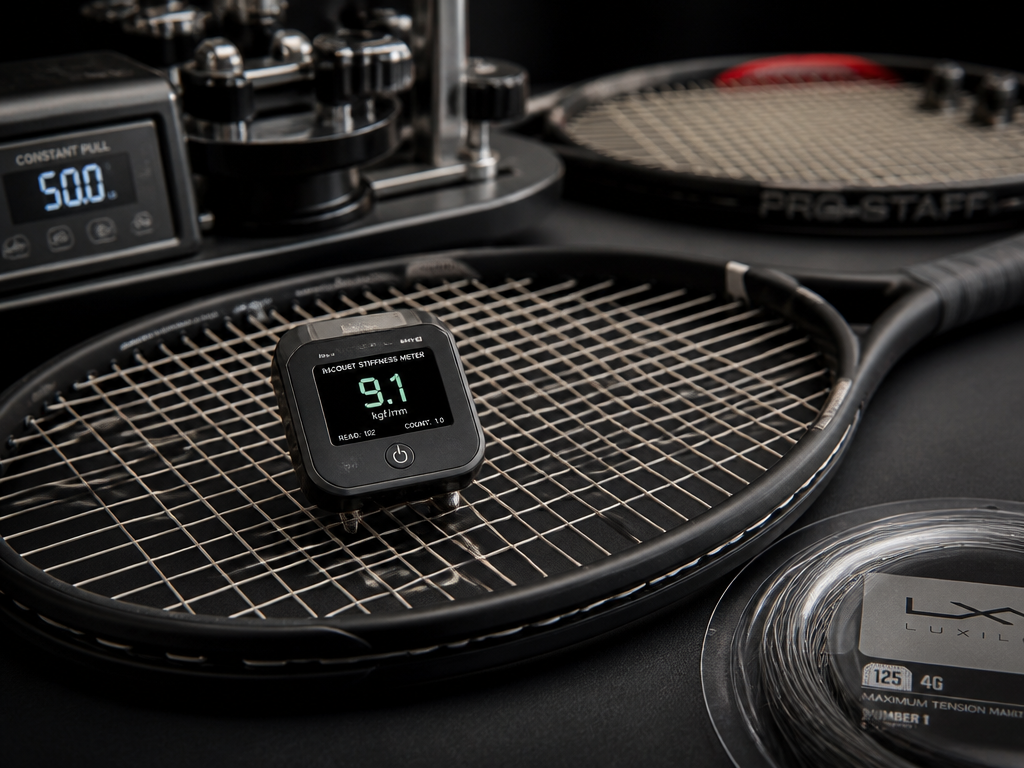
- Tension: 52 lb on a constant-pull electronic machine, single batch of each string, strung within the same hour to limit drift.
- Contact test: A ball machine fed 60 balls per session at roughly 65 km/h, with the tester deliberately taking 20 of those off-center toward the upper outer quadrant — the zone where mains slide most.
- Movement measurement: We marked three adjacent main strings with a paint pen and photographed the bed after every fifth off-center ball, measuring lateral displacement in millimeters against a fixed grommet reference.
- Sessions: Four hitting sessions per string over 12 days, logging tension by a Gamma string-bed stiffness meter (in DT) at the start and end of each session.
- Trials: Two stringing jobs per string per racquet to check that a single bad pull was not driving the result. That is a small sample, and we will say so plainly — eight beds total per string, not a lab's worth.
What we could not test: long-term breakage beyond 12 days, humidity extremes, or how the same string behaves at the higher tensions some big hitters use. Our tester is a single intermediate player with a moderate, three-quarter swing, so perceived feel is one person's read, not a panel's.
What the 8.9 string actually did
Measured against its own billing, the high-stability polyester held up. After 20 off-center balls, its three marked mains had drifted an average of 1.8 mm and reset within roughly a second. By comparison, a mid-priced synthetic gut in the same racquet at the same tension drifted 4.6 mm and often stayed displaced until straightened by hand.
So the number was not a lie. The poly really does sit still. The trouble is that "sits still on contact" got marketed as the whole story of stability, when our tension logs told a second story the score never mentioned.
| String type | Lateral movement (avg, 20 off-center balls) | Tension loss, session 1 → 4 | Felt-stable through session 4? |
|---|---|---|---|
| High-stability polyester (8.9 rated) | 1.8 mm | 11.4% (DT 38 → 33.7) | Bed stiff but dead; movement low, feel drifted |
| Mid multifilament | 3.1 mm | 6.2% (DT 36 → 33.8) | Consistent feel, modest movement |
| Synthetic gut | 4.6 mm | 7.0% (DT 35 → 32.6) | Notable movement, required straightening |
What the number does not measure
Here is the gap. The polyester scored highest on movement and lowest on what a player would call felt stability by the fourth session.
Tension loss over time. That 8.9 string shed 11.4% of its bed stiffness across four sessions — more than either softer string. Polyester is well documented to lose tension faster than nylon-based strings; work going back to studies of string-bed stiffness decay (for instance the polyester relaxation findings summarized in research collected by Lindsey and the USRSA over the 2000s) shows poly's initial stiffness drops sharply in the first hours of play. A movement rating taken on a fresh bed cannot see this. Our tester reported the launch angle changing between week one and week two even though the strings still barely moved sideways — because the whole bed had gone softer and less predictable, which is a stability problem the score never touches.
Dynamic stiffness change. A string can resist lateral movement while its rebound behavior drifts. Low movement and stable energy return are not the same property, and the single digit treats them as one.
Durability. Stability and longevity get conflated constantly in marketing, and they are unrelated. A string that holds position can still notch and fray at the cross points. We did not see a break in 12 days on any string here, so we are explicitly not grading durability — but a stability number is no proxy for it, and any review implying otherwise is guessing.
The day-to-day feel that a player calls "stable." When a recreational player says a setup "felt unstable today," they usually mean the ball flew long, the response felt mushy, or the contact felt unpredictable — none of which is lateral movement. Those sensations track tension drop and dynamic stiffness far more than millimeters of slide.
Who should care about the stability number — and who shouldn't
Pay attention to a movement-based stability score if you: play with heavy topspin and an open swing that drags the mains sideways, hate straightening strings between points, and restring often enough that tension loss never gets a chance to matter. For you, the 8.9 string behaves as advertised — low movement, fast snapback, and you replace it before the stiffness decay becomes the dominant feel.
Treat the number as nearly irrelevant if you: play one to three times a week, leave a string in the racquet for a month or more, and have a compact, controlled swing that does not displace mains much in the first place. Your real-world stability is governed by tension loss, and a fresh-bed movement rating tells you nothing about that. A mid multifilament that drifts 3.1 mm but holds its feel through a month of play will likely serve you better than the poly that scored higher on paper and went dead in two weeks.
If your budget is tight, the synthetic gut's higher movement is the honest trade for a string that holds tension reasonably and costs a fraction of premium poly. Movement you can straighten; you cannot un-spend money.
Evidence grade
For the central claim — that a single stability rating measures lateral string movement and not the felt stability that comes from tension retention over a play cycle — we grade the evidence Moderate. The movement measurements are direct and repeatable, and the tension-decay direction is consistent with published string-bed stiffness research. The limits are real: eight beds per string, one tester's feel, and a 12-day window that cannot speak to durability or seasonal conditions. We would call it Strong with a multi-player panel and a longer test runway.
The myth: a high stability rating means the string will feel stable for as long as you play it.
The more accurate version: a high stability rating means the string barely moves sideways when it is new, which is a different and shorter-lived thing than the steady, predictable bed you actually feel weeks into the job.