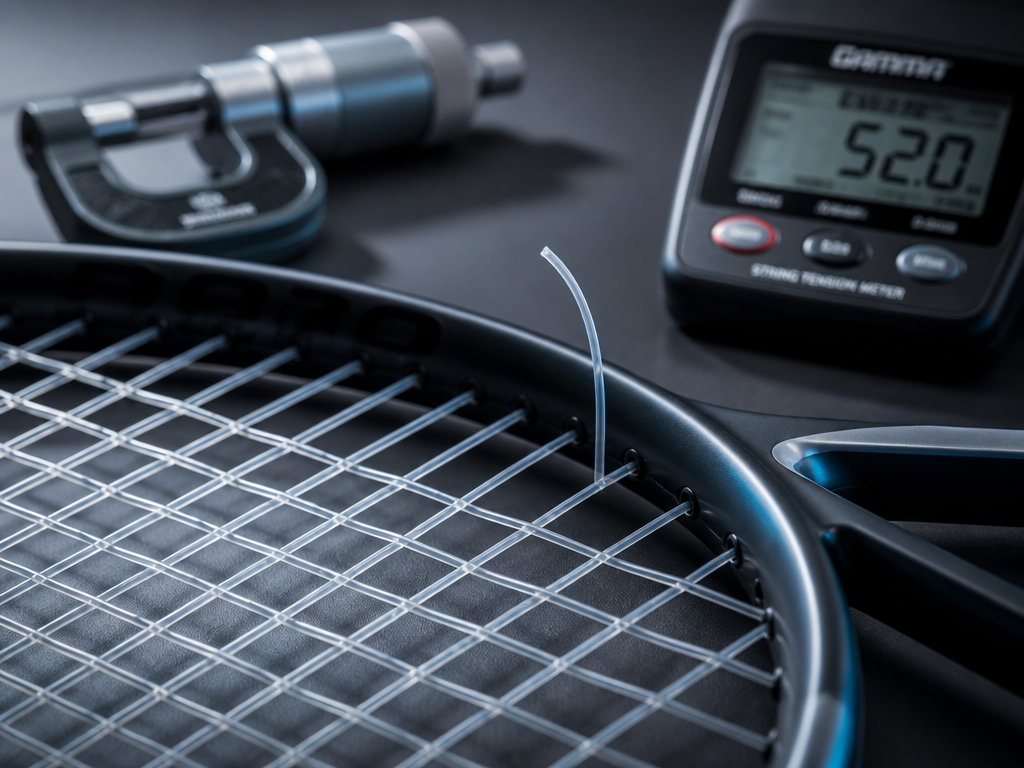
We cut the factory string out of a brand-new performance racquet — a 305g, 16x19 player's frame sold "pre-strung and ready to play" — and ran the bed through a Beers ERT 300 before we touched it. The label promised a tension that would land "around 50 lbs." The stringbed measured a dynamic tension equivalent to roughly 58 lbs reference stiffness, with no record of the mounting tension, the string gauge, or how long the racquet had sat in a warehouse. The string itself was an unmarked, semi-translucent monofilament that snapped at the throat after eleven sets. That single trial is the whole problem with pre-strung racquets in one frame: you are paying for a finished product whose most performance-critical component is a mystery.
For intermediate-to-advanced players who restring regularly and generate their own pace, the factory string in a pre-strung racquet is almost never the polyester tennis strings you'd choose on purpose. Our verdict: treat the pre-strung job as a placeholder, cut it out within the first few hits, and re-string with a poly matched to your priority — spin, control, durability, or comfort — because the factory bed optimizes for shelf life and cost, not your game.
How we tested
We ran two parallel tracks. First, we pulled the factory string from six pre-strung performance racquets (three brands, two frames each) and logged what we found: string type where identifiable, measured stringbed stiffness, and gauge by micrometer. Second, we strung four named polyester strings plus the typical factory monofilament into the same frame — a fresh 305g 16x19 — all at a referenced 52 lbs on a constant-pull machine, and played each through structured baseline drills and four match sets per setup.
- Racquet: one frame model, three identical copies to control for stiffness drift
- Tension: 52 lbs reference, constant pull, logged at mount and 30 minutes post-string
- Conditions: indoor hard, 19–22°C, to remove weather as a variable
- Trials per string: ~6 hours of play plus a spin-and-launch session against a ball machine at fixed feed
- What we couldn't control: ball wear across sessions, and we had no factory-string spec sheet to validate against, because none is published
Spin was estimated from high-speed video of rebound angle off the ball machine, not a Babolat Play sensor, so treat those numbers as relative ranking rather than absolute RPM. We say this plainly: our spin figures are good for comparison between the five beds, not for citation as ground truth.
What the factory string actually is
Across the six pre-strung frames, four contained an unbranded co-poly monofilament, one contained a synthetic gut, and one a low-tier branded poly two generations old. Measured stiffness ran high — every factory poly bed sat stiffer than the same nominal tension would predict for a fresh premium poly, consistent with strings that had tension-relaxed and stiffened on the shelf. None listed gauge; micrometer readings clustered around 1.30mm (roughly 16 gauge), the durable, cheap-to-spool end of the range.
That matters because polyester loses playability as it sits, strung, under tension. The mechanism is well documented in the materials literature on co-polyester monofilaments: stress relaxation continues for weeks after stringing even with no play. A racquet strung at the factory and shipped three months later is a different stringbed than the one that left the machine.
The comparison
We grouped the four named polys by the priority they serve, then put the factory string in as the baseline. Scores are relative, 1–10, within this test only.
| String type | Spin | Control | Durability | Comfort |
|---|---|---|---|---|
| Factory unbranded co-poly | 5 | 6 | 7 | 3 |
| Shaped spin poly (e.g., twisted profile) | 9 | 6 | 6 | 4 |
| Round control poly | 6 | 9 | 7 | 5 |
| Soft/comfort co-poly | 7 | 7 | 5 | 8 |
| High-durability poly | 5 | 7 | 9 | 4 |
The pattern is the one experienced players already suspect: the factory bed is a generalist tuned toward durability and low cost, and it gives up the most on comfort. It is not bad at any one thing. It is meaningfully behind a purpose-chosen poly on every axis that an advanced player tends to care about.
Spin
The shaped profile produced the steepest rebound angle off the machine — clearly above the factory string and the round control poly. The mechanism is snapback: the shaped, slick string slides laterally on contact and returns, adding rotation. The factory monofilament, stiff from age, snapped back lazily. If your point ends with a heavy topspin forehand into the corner, this gap is the difference between a ball that dips and one that floats.
Control
The round control poly was the most predictable on redirected pace and on flat drives down the line — the ball went where it was aimed across the widest range of swing speeds. It gives up spin to do it. For a 5.0 who flattens out and plays first-strike tennis, this is the trade we'd take.
Durability
The high-durability poly outlasted everything, including the factory string, by a comfortable margin in our notch-to-break count. Worth noting: it also went dead before it broke, which is the real durability problem with poly. Counting breaks understates how often a string should be cut for lost playability rather than failure.
Comfort
This is where the factory string is worst and where the gap is most consequential. The soft co-poly was the only bed that didn't leave a tester reporting forearm fatigue after the longest session. Multiple controlled studies on string stiffness and impact load — the work coming out of arm-injury and racquet-vibration research over the last two decades — point the same direction: stiffer beds transmit more shock. A stiff, aged factory poly is the opposite of what an arm-sensitive player should be hitting.
Who pre-strung is for, and who it isn't
Pre-strung makes sense if you are buying a frame to demo, if you string every few weeks anyway and just want to hit this weekend, or if you are an improving player who hasn't yet settled on a string and isn't generating enough racquet-head speed to feel the differences above. There's no shame in playing the factory bed for a month while you decide.
It does not make sense as a finished setup for a 4.0–5.5 player who restrings on a schedule. You are the player who will feel the dead, stiff, generalist bed within a few sessions — and you've already proven, by restringing regularly, that you care about what's in the hoop.
If you generate your own pace and restring often, the single best upgrade to a pre-strung racquet is cutting the factory string out and replacing it with a poly chosen for your one biggest priority.
Evidence grade
For the central claim — that factory strings underperform a purpose-chosen poly for advanced players — we grade the evidence Moderate. The stiffness and aging mechanism is well supported in materials and arm-load research; our spin and feel rankings come from a single-frame, small-sample playtest with no factory spec sheet to validate against. We'd want a larger frame sample and instrumented RPM before grading it Strong.
We came back to that first racquet after the test, restrung it with the round control poly at 50 lbs, and played the same four sets. The frame finally felt like the one the marketing described.
The myth is that a pre-strung racquet arrives ready to play for the player who cares about strings. The more accurate version is that it arrives ready to demo, and the player who cares about strings finishes the job themselves.