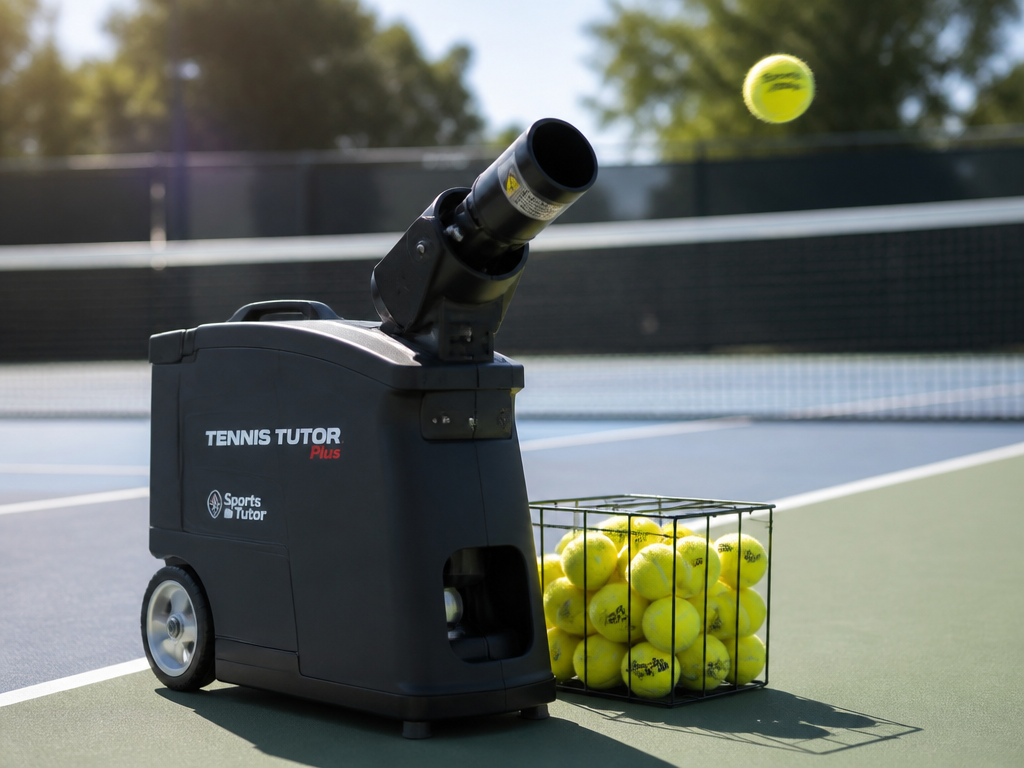
A few weeks ago we set a ball machine to feed flat forehands at roughly 55 mph, one every four seconds, to a single intermediate player — a 24-year-old who plays twice a week and has had maybe a dozen lessons in her life. We asked her to hit forty balls with the big, looping preparation a coach had once shown her, then forty with a compact, abbreviated take-back. We filmed both at 240 frames per second and marked the frame of contact on every ball. The question we were trying to answer is the one this player kept asking us, and the one that sends people down conflicting rabbit holes online: does backswing technique actually change how cleanly you hit the ball, or is the long-versus-short debate mostly noise?
The short version of the answer: for this player, the compact take-back cut her late contacts roughly in half and tightened where she met the ball, while the long loop produced two or three of her hardest, deepest shots and a lot more scatter. That trade-off — consistency versus peak power — is the whole story, and which side you want depends on what's currently breaking down in your game.
What stroke preparation actually is
Before the measurements, a definition, because the word gets used loosely. Stroke preparation is everything that happens between the moment you read the incoming ball and the moment your racquet starts forward toward contact. It has two parts that often get collapsed into one.
The first is the unit turn — your shoulders and hips rotating so your chest faces partly sideways, the racquet traveling back as a consequence of the body turning rather than the arm reaching. The second is the take-back or backswing itself — the path the racquet head travels before it changes direction and comes forward.
When people argue about long versus short, they are almost always arguing about that second part: how far back, and along what shape, the racquet head goes. The first part — turning early — is not really in dispute. Nearly everyone who has watched slow-motion footage of competent players agrees that the turn should start the instant you recognize the ball is coming to your forehand side. The disagreement begins after the turn, and that is where we pointed the camera.
How we tested it
We wanted to isolate the backswing path and hold everything else as steady as a recreational session allows. That meant a ball machine rather than a hitting partner, so the feed was repeatable, and a fixed target zone rather than match play, so the player wasn't making tactical decisions mid-rally.
The setup:
- One right-handed intermediate player, forehand only.
- Ball machine feeding to a deuce-side target, roughly 55 mph, one ball every four seconds, consistent depth around the service line.
- Two conditions: a long loop (racquet head rising above shoulder height and tracing a wide arc) and a compact take-back (racquet head staying near waist-to-chest height, a short arc straight into the forward swing).
- 40 balls per condition, alternated in blocks of 10 to limit fatigue bias, with a five-minute rest between the second and third block.
- Filmed at 240 fps from behind and from the side.
What we measured. We did not have lab equipment, and we want to be clear about that up front. We had a phone, a tripod, and frame counting. So we measured proxies, not ground truth:
- Contact-point scatter: where, relative to her front hip, the racquet met the ball. We marked each contact frame and binned it into "ahead of hip," "even with hip," and "behind hip."
- Late contacts: any ball met level with or behind the front hip, which is the practical definition of being rushed.
- Depth and direction outcome: did the ball land in the back third of the court within the singles lines.
We could not directly measure racquet head speed without a radar or marker-based tracking, so we treated "deep, clean ball into the back third" as a rough stand-in for effective pace plus control. That is a real limitation, and we'll come back to it.
What the numbers showed
Here is the comparison, forty balls per condition.
| Criterion | Long loop | Compact take-back |
|---|---|---|
| Contact ahead of front hip | 21 / 40 | 33 / 40 |
| Late contacts (even or behind hip) | 13 / 40 | 6 / 40 |
| Balls landing in back third, in | 18 / 40 | 24 / 40 |
| Hardest 3 shots (subjective, by sound and depth) | all 3 | 0 |

Two things jump out. First, the compact take-back was simply more repeatable: she met the ball in front more often, was rushed half as often, and put more balls deep and in. Second — and this is the part that keeps the debate alive — her three best individual shots of the entire session, the ones that cracked off the strings and landed within a foot of the baseline, all came from the long loop.
That is not a contradiction. It is the trade-off stated in data. The long backswing gives the racquet head more room to accelerate, so when the timing happens to be right, the ball comes off harder. But it also asks the timing to be right more often, and at 55 mph against an intermediate, the timing was right less than half the time.
Why the trade-off is real
The mechanism is not mysterious, and it doesn't require trusting our forty balls alone.
A longer backswing means the racquet head travels a longer total path to reach contact. Distance plus a fixed window of time equals a tighter timing requirement — you have to start forward at a more precise moment, because the head has farther to go before it arrives at the ball. Start a fraction late and the racquet is still finishing its loop while the ball is already on you. That is what a "late contact" is, mechanically.
A shorter take-back travels less distance to contact, so the moment you have to begin the forward swing is more forgiving. You can read the ball a touch late and still get the racquet there in time. The cost is that the head has less runway to build speed, so the ceiling on pace is lower.
There's a second effect worth naming. The long loop in our trial repeatedly raised the racquet head above the shoulder, which adds a vertical drop into the forward swing. That drop is genuinely useful for generating racquet head speed and topspin when it's timed — it's a big part of how advanced players hit heavy balls. But an extra plane of movement is an extra thing to coordinate. For a player still learning to find the ball consistently, it's one more variable that can be slightly off.
What the broader evidence says
We don't want to rest a general claim on one player and a phone camera, so it's worth being honest about what's actually been studied and what hasn't.
High-speed biomechanical analysis of advanced and professional forehands has consistently found that the players hitting the heaviest balls do not have short, punchy backswings — they have substantial loops combined with strong separation between hip and shoulder rotation (the so-called stretch-shortening of the trunk). Elliott and colleagues have published repeatedly over the years on the role of trunk rotation and the kinetic chain in generating racquet head speed, and the picture is consistent: at the top level, a fuller preparation feeds more speed into the swing. So the marketing-style claim that "longer equals more power" is, at the elite level, broadly supported.
What's much less studied — and this is the gap that matters for our reader — is whether that finding transfers to recreational players who haven't yet built reliable timing. The professional studies describe what works for people who already have the coordination to exploit a long swing. They do not tell a twice-a-week player whether they personally will hit better with a loop or a compact take-back this season. We are not aware of a clean, well-powered study tracking the same recreational players across both backswing styles over time. If it exists, we'd revise this piece around it. Until then, the honest position is: the power benefit of a longer backswing is well established for those who can time it, and the consistency benefit of a shorter one is mechanically obvious but mostly undocumented in a controlled recreational sample. Our forty-ball trial is a single data point that lines up with the mechanism, not proof.
Where the conflicting advice comes from
Once you see the trade-off, the contradictory coaching makes sense. The advice isn't wrong; it's aimed at different problems.
A coach who tells you to shorten up is usually looking at a player getting jammed, hitting late, framing balls, or spraying them long. Shrinking the backswing buys timing, and timing is the thing visibly missing. The improvement is fast and obvious, which is why this advice is common in the early going.

A coach who tells you to let it go bigger is usually looking at a player who is consistent but punchy — someone who lands every ball but can't push an opponent back, whose shots sit up and invite attack. For that player, a fuller loop is the unlock, because the consistency is already there and the missing ingredient is depth and pace.
The conflict you hear online is mostly two correct prescriptions for two different ailments, presented as universal rules by people who happened to have one ailment or the other. The useful question isn't "long or short" in the abstract. It's "what is breaking down in my forehand right now, and which direction fixes it."
Who a compact take-back is for
Based on both the trial and the mechanism, lean toward the shorter, more compact preparation if:
- You're frequently late — meeting the ball even with or behind your front hip.
- You frame or shank balls when the pace picks up, or against a hard server's return.
- You're newer to the game and still building reliable contact.
- You play a lot of fast, low-bouncing balls (quick courts, flat hitters) where the time between bounce and contact is short.
The honest cost: your forehand will likely have a lower top-end pace. You may find yourself unable to flatten out a put-away the way you'd like. For a developing player, that's usually a fine trade — you can't put away a ball you keep missing.
Who a longer backswing is for
Lean toward the fuller loop if:
- You're already consistent and your problem is that the ball sits up short, letting opponents tee off.
- You can comfortably meet the ball in front on most attempts.
- You're getting balls that bounce up into your strike zone with time to spare — higher-bouncing topspin, slower feeds.
- You're specifically trying to add topspin and depth, and you've got the practice time to groove the timing the bigger swing demands.
The honest cost: more scatter while you learn it, and more late contacts against fast balls until the timing settles. The loop is not a free upgrade. It is a deposit of practice time against a later payoff in pace.
A reviewer note on the trial
One thing I want to flag personally, since I marked the contact frames: the player got visibly more comfortable with the compact swing over the four blocks, and her last ten loop shots were better than her first ten. Forty balls per condition is not enough to separate "this backswing suits her" from "she warmed up." If we'd run two hundred balls, or tested her again a week later, the gap might shrink. I trust the direction of the result — short was steadier, long was higher-ceilinged — more than I trust the exact margins in that table.
That caveat matters because it's the whole risk of a piece like this. One player, one session, a phone camera, and a subjective call on the three best shots. The result agrees with the physics and with what high-speed studies of better players imply, which is why we're comfortable publishing it. But agreement is not the same as proof, and we'd rather you treat the table as an illustration of the trade-off than as a number to memorize.
What the trial did do, cleanly, was take a vague argument and give it shape. Before we filmed, "should my backswing be long or short" felt like a matter of taste or tribe. After counting late contacts, it became a question with a visible answer for one specific player on one specific day: shorten it, get steadier; lengthen it, raise the ceiling and pay in misses.
Evidence grade
For the central claim — that a longer backswing trades timing consistency for peak racquet head speed, and that the right choice depends on which is currently your weak link — we'd rate the evidence Moderate.
The power side of the trade-off is well supported at the elite level by published biomechanics. The consistency side is mechanically sound and matched our trial, but rests on a single small sample with proxy measurements rather than a controlled study of recreational players. We're confident in the direction. We're not confident in the magnitude, and we'd happily revise if a larger, cleaner test pointed elsewhere.
The rule of thumb
If you're getting jammed and hitting late, shorten your take-back until you're meeting the ball in front again; if you're meeting it in front but the ball sits up short, only then is it worth lengthening.