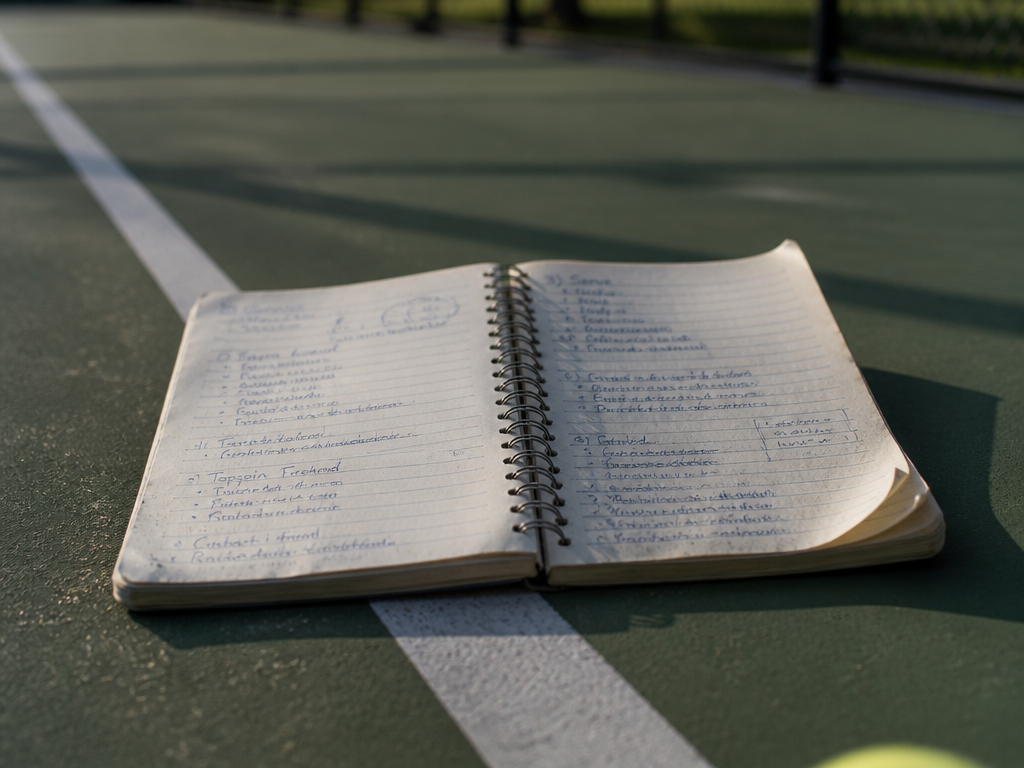
You added a third session a week. You booked the ball-machine time. You are hitting more balls this year than last, and your results have not moved. Somewhere in that frustration, someone hands you the advice that always sounds a little too easy: keep a notebook. Try reflective practice. Write down what happened and what you would do differently. The honest question — the one that deserves a straight answer rather than a motivational one — is whether that does anything at all, or whether it is just a way to feel productive about tennis on the days you cannot get on court.
Our verdict: the published evidence supports structured reflection as a real but modest lever for emerging players, and it works mainly by changing what you practice next — not by changing how you swing today. That is a narrower claim than most coaching content makes, and we think the narrowness is the useful part.
How we evaluated this
We have not run a study, and nobody here has put a stopwatch on your journal. What we did was read across four bodies of published work and weigh them against each other, which is a different kind of authority and worth naming as such.
The first is the deliberate-practice literature that begins with Ericsson, Krampe and Tesch-Römer's 1993 paper in Psychological Review and the meta-analyses that have argued with it since. The second is the self-regulated learning research in sport psychology, where reflection is measured as a distinct skill alongside planning, monitoring and self-evaluation. The third is the motor-learning literature on feedback — the least intuitive of the four, and the one that supplies the sharpest warnings. The fourth is the professional reflective-practice tradition running from Donald Schön's The Reflective Practitioner (1983) through Graham Gibbs's reflective cycle (1988), which is where most of the journal templates circulating in coaching circles actually come from, usually without attribution.
We weighted peer-reviewed experimental work above correlational studies, and correlational studies above coaching consensus. We treated Timothy Gallwey's The Inner Game of Tennis (1974) as an influential argument rather than as evidence.
The honest limitation: almost none of this was done on adult club tennis players. The closest sport-specific work involves elite youth athletes, novice motor tasks in laboratories, and other sports entirely. Anyone who tells you the research shows reflection adds a level to your rating is extrapolating well past what was measured, and so is anyone who tells you it does nothing.
What the research actually says
Start with the premise underneath the reader's frustration, because it turns out to be well supported. Practice volume explains less of performance than the folklore assumes. Macnamara, Hambrick and Oswald's 2014 meta-analysis in Psychological Science found accumulated deliberate practice accounted for roughly 18 percent of the variance in sports performance; their sports-specific follow-up two years later found the share shrinks further among already-elite athletes. Ericsson has disputed the methodology of those analyses at length, chiefly on how loosely they defined deliberate practice. We do not think that dispute needs resolving here, because both camps agree on the part that matters to an emerging player: unstructured repetition without feedback is the weakest form of practice, and the gap between hours logged and level gained is where the interesting question lives.
The most cited evidence for reflection specifically is correlational. Toering, Elferink-Gemser, Jordet and Visscher (2009, Journal of Sports Sciences) compared elite and non-elite youth soccer players on self-regulatory skills and found reflection among the clearest separators. Jonker, Elferink-Gemser and Visscher (2010) extended similar work across a broader group of talented Dutch athletes with a comparable result. These are real findings and they are frequently oversold. They rest on self-report questionnaires, they were run on talented adolescents in development programmes, and they cannot tell you which direction the arrow points — players who are improving fast have a great deal more worth reflecting on than players who are stuck.
The experimental support is thinner but points the same way. Zimmerman and Kitsantas's studies of novice motor learning in the 1990s, and Cleary and Zimmerman's 2001 comparison of experts, non-experts and novices practising basketball free throws, found that the more skilled performers ran a recognisable loop — set a process goal, monitor it during practice, evaluate it afterwards, adjust the next goal — while the less skilled ones mostly aimed at outcomes and attributed misses to ability. That loop is the operational definition of reflective practice worth adopting. It is not "write about your feelings after the match."
The mechanism: it improves your practice selection, not your forehand
This is the part we think most coverage gets wrong, and it explains why the honest answer to the reader's question is yes-but.
Reflection does not install a stroke. Nothing you write on a card on Tuesday night makes your contact point better on Thursday. What it does is make Thursday's session a better-chosen session. The player who notices, across five written entries, that they have lost four consecutive third sets from a break up, is now looking at a conditioning-or-decision problem rather than a technique problem — and will stop spending Thursday on the thing that was never broken. The gain is in allocation. Given how few quality hours a working adult gets, allocation is a large lever wearing modest clothing.

This also sets a ceiling. If you have no capacity to act on what you notice — no court time, no coach, no drill vocabulary — reflection collects observations you cannot spend. Several sources in the coaching literature treat reflection as self-sufficient. We do not think the evidence supports that. It is a routing mechanism, and routing is worthless without somewhere to route to.
Where reflection backfires
The motor-learning literature supplies a genuine warning, and it is not a small one. Kluger and DeNisi's 1996 meta-analysis in Psychological Bulletin remains the most sobering result in the feedback field: across hundreds of effect sizes, the average effect of feedback interventions was positive, but more than a third of them decreased performance. Their explanation was that feedback directing attention to the self rather than to the task tends to hurt, because it consumes the resources the task needs.
Two tennis-relevant corollaries follow. Masters's 1992 work on reinvestment in the British Journal of Psychology showed that consciously reinvesting explicit technical knowledge under pressure degrades skills that had become automatic — the mechanism most people call choking. And Wulf's long research programme on attentional focus has consistently favoured external focus cues over internal ones for skilled movement. Put together, they argue that reflection belongs after play, in writing, aimed at patterns and decisions, and that carrying it onto the court as running technical self-commentary is not a neutral choice but an actively costly one.
So the version of this habit that survives contact with the evidence is smaller and later than the version usually sold.
Five formats, compared
| Format | Time cost | What the evidence supports | Main failure mode |
|---|---|---|---|
| Two-line card: one thing that worked, one thing to change | Under 2 min | Closest match to the self-regulation loop; survives busy weeks | Too vague to act on if written on autopilot |
| Structured journal (Gibbs-style cycle) | 10–20 min | Strong in professional-education research; untested in club tennis | Abandonment — the most common outcome by a wide margin |
| Match charting (unforced errors, first-serve percentage, points won at net) | 0 min if someone else charts | Removes memory bias, which is the weakest link in self-report | Counts events without explaining them |
| Video review | 15–45 min | Useful for verifying what you believe you did | Invites technical self-focus, the pattern Kluger and DeNisi flagged |
| Coach debrief | 5–10 min | Adds the external judgment your own notes cannot supply | Depends entirely on coach quality; not always available |
Where the answer is "it depends"
It depends on level. For a genuine beginner, the binding constraint is technical instruction and repetition, and reflection has little to sort. For a strong tournament player, the loop is usually already running, formally or not. The emerging band — competent strokes, unreliable decisions, results that lag the practice hours — is where reflection has the most to work with. That is an inference from the mechanism, not a directly measured finding, and we will flag it as such.
It depends on whether you compete. Match play generates the pattern data that makes reflection worth anything. A player who only drills has less to notice.
It depends on honesty, which is the failure mode nobody warns about. Self-report is the weakest instrument in this entire body of research, and your own notebook is a self-report instrument with no reviewer. Cards that record only what confirms your existing theory of your game will confirm it forever.
And the sources genuinely disagree on magnitude. The self-regulation researchers treat reflection as a defining skill of developing athletes; the feedback literature treats reflection as one more intervention that can go either way depending on where it aims attention. We read that disagreement as a scope condition rather than a contradiction, but a reader who concluded the effect is smaller than the enthusiasts claim would be reading the same evidence fairly.
Who this is for — and who it isn't
It is for the player who has already added hours and stalled, who competes often enough to have patterns, and who has some means of acting on what they find. It is for coaches who want their players noticing decisions rather than rehearsing technical self-criticism.
It is not for the player still building basic stroke reliability, whose time is better spent on instruction. It is not for anyone who would use it as tennis-adjacent activity that substitutes for playing. And it is not for the player who already knows exactly what is wrong and has simply not been willing to drill it.
If you take one line from this: the two-line card beats the elaborate journal, because the elaborate journal will not exist in six weeks.
Evidence grade for the central claim — that structured reflection improves emerging players by improving practice selection: Moderate. The mechanism is well supported in adjacent literatures and consistent across them; the direct sport evidence is correlational, self-reported, and drawn from populations that are not you.
The myth is that writing down what happened after you play is a way of practising when you cannot practise. The more accurate version is that it is a way of deciding what your next practice is for — worth two minutes, worth doing badly, and worth nothing at all if you never spend what it finds.