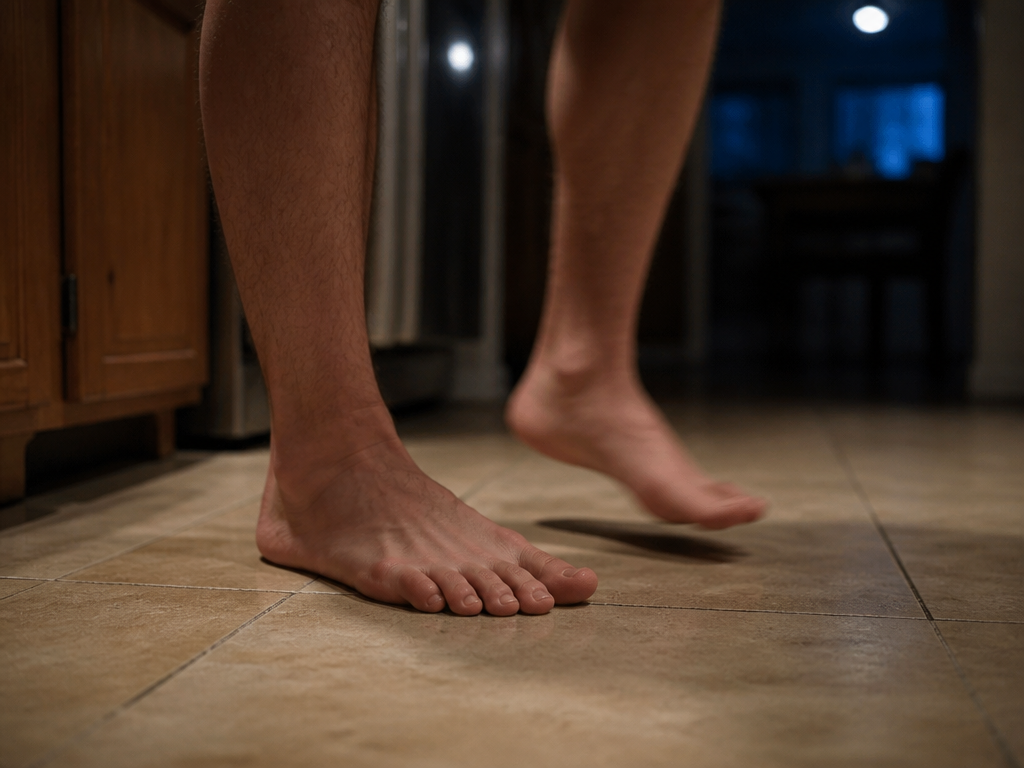
Reviewer's note. Tuesday night, kitchen floor, phone timer. I stood on my right leg with my eyes closed and lasted twenty-two seconds before I had to grab the counter. Left leg: nine. I ran it three more times over the following week and the gap held — right foot in the low twenties, left foot never past eleven. I am forty-seven, I play three times a week, and I had assumed my problem was that I had gotten slow. Most tennis training exercises marketed to players my age are built on that assumption: you are losing speed, here is how to buy some back. Nine seconds pointed somewhere else. I was not uniformly slower. I was unstable on one side, and it happened to be the side I push off from when a ball goes wide to my backhand.
That is an anecdote with a sample size of one, taken on a kitchen floor by a person who wanted a particular answer. Treat it as a prompt, not as evidence.
It is a useful prompt, though, because it lands where the research on aging athletes keeps landing. The quality that degrades first in a forty-something club player usually is not top speed. Top speed barely enters the sport. Mark Kovacs's reviews of tennis physiology (2006, British Journal of Sports Medicine; 2007, Sports Medicine) are the standard reference here, and the picture they assemble from match-notational data is consistent: most points end inside ten seconds, most movements cover a few meters, and the work-to-rest ratio sits somewhere around 1:2 to 1:5 depending on surface and format. You almost never reach a sprint velocity worth the name. You reach, stop, load, strike, and reorganize — four or five times — and then do it again twenty seconds later.
What degrades is the stopping and the reorganizing.
What actually goes first, and how fast
Strength and power decline at different rates, and the gap between those rates is most of the story. The commonly cited figures put maximal strength loss at roughly one to one and a half percent per year after midlife, and power loss — force expressed quickly — at closer to three to four percent. Those numbers come mostly from cross-sectional cohorts rather than long follow-ups of the same athletes, so the precision is softer than the way they usually get quoted. The direction is not in dispute. You lose the ability to produce force fast considerably before you lose the ability to produce force at all.
The tissue-level reason is reasonably well characterized. Lexell, Taylor and Sjöström's 1988 autopsy study in the Journal of the Neurological Sciences examined vastus lateralis muscle from 43 men aged 15 to 83 and found that fiber loss was not evenly distributed: type II fibers, the fast ones, shrank and disappeared disproportionately. That is a post-mortem cross-section, not a longitudinal design, and it is one muscle in one population. But it has held up as the working model, and it explains why a fifty-year-old can still push a heavy leg press and still cannot get off the ground the way they used to.
The second mechanism is less discussed and matters more on a tennis court. Tendon gets more compliant with age. The commonly cited work is Onambele, Narici and Maganaris (2006, Journal of Applied Physiology), who measured Achilles tendon mechanical properties across an adult age range and reported that stiffness tracked with balance performance. A more compliant tendon is a slower spring. When you land from a split-step, some fraction of the energy that should return and launch you instead gets absorbed and dissipated. Ground contact stretches out. The delay is measured in tens of milliseconds, which sounds trivial until you multiply it across the four or five direction changes in a rally.
And then there is the perceptual side, where the news is better. Simple reaction time — light appears, press button — declines steadily and is not very trainable. Anticipation is a different faculty. The occlusion literature on skilled racquet-sport athletes consistently shows that experts read serve and groundstroke direction from opponent kinematics before ball contact, and that this is learned rather than reflexive. A forty-seven-year-old cannot get their reaction time back. They can absolutely get better at knowing where the ball is going, which buys back more time than any amount of sprint work.
What tennis training exercises should older players prioritize?
Braking, balance, and the first two steps — in that order. For a recreational player over forty, the highest-yield work is eccentric and landing-based: controlled deceleration, single-leg stability under load, and short reactive contacts. Straight-line sprint intervals and agility-ladder patterns are the most commonly prescribed and the least defensible for this population, because neither trains the phase of movement where the time is actually being lost.

That is a strong claim, so here is the reasoning behind it rather than the assertion alone.
Sheppard and Young's 2006 review in the Journal of Sports Sciences did the useful work of separating "change of direction speed" — a pre-planned physical quality — from "agility," which they define as change of direction in response to a stimulus. The correlations between straight sprint ability and change-of-direction ability are consistently weak to moderate, meaning they are largely separate qualities trained by separate means. A ladder drill trains a pre-planned foot pattern. Tennis never presents a pre-planned foot pattern. The physical component is real but partial, and the perceptual component — the part that makes it agility rather than choreography — is not addressed at all by a pattern you memorized before you started.
Meanwhile, the braking demand is enormous and under-trained. Harper and Kiely's 2018 analysis in BMJ Open Sport & Exercise Medicine laid out the case that horizontal deceleration imposes higher peak forces over shorter contact times than acceleration does, and that it is systematically neglected in field-sport preparation. Tennis is a deceleration sport dressed as a running sport.
One point, in the order it actually happens
Walk through a single rally ball the way the body sequences it, and the leak becomes visible.
Recognition. Your opponent's trunk rotates and the racquet head starts forward. If you read direction here, you gain 100 to 200 milliseconds over reading it off the ball. This is trainable through exposure and attention, not through fitness.
The split-step. You hop, you land, you are momentarily unweighted with both feet loaded. Uzu, Shinya and Oda (2009, Journal of Sports Sciences) tested this directly in a simulated tennis task with a small group of skilled players and reported that performing a split-step shortened the time to complete a choice-reaction step-and-reach movement, apparently by pre-loading the stretch-shortening cycle. Small sample, laboratory task, one study. Call it plausible and well-mechanized rather than settled. But the mechanism is the same tendon spring that ages badly, which is precisely why the split-step degrades quietly as players get older — it becomes a hop that lands and sits rather than a hop that lands and launches.
The first step. One crossover or drop step. This is where the aging player loses ground, and where it looks like a speed problem, because the deficit shows up as distance. It is usually a stability problem: you cannot push hard off a foot you do not trust.
Two to four accelerating steps. This is the only phase that resembles running, and it is the only phase most recreational conditioning trains.
The brake. You arrive, and now you have to absorb your entire momentum on one leg, in maybe 200 milliseconds, while rotating your trunk in the opposite direction. Peak forces here exceed anything in the acceleration phase. If the leg cannot absorb it, one of two things happens: you take an extra step to bleed off speed, or you hit while still drifting.
The strike, then the recovery push. Recovery requires re-accelerating out of the same leg that just did the braking. If that leg is still stabilizing, the recovery step is late, and you are behind on the next ball. This is how one small deficit compounds across a rally rather than staying local.
So the sequence where a forty-plus player bleeds time runs: split-step spring, brake, recovery push. All three are eccentric. All three are single-leg. None of them is running.
The evidence, graded honestly
The tennis training exercises with the strongest supporting literature are, awkwardly, not the ones sold as tennis-specific.
Balance and proprioceptive training — well-established, for injury. Hübscher and colleagues' 2010 meta-analysis in Medicine & Science in Sports & Exercise pooled randomized trials of proprioceptive and multi-intervention training and found meaningful reductions in ankle sprain and ACL injury rates. Verhagen and colleagues' 2004 balance-board trial in volleyball players (American Journal of Sports Medicine) is one of the cleaner individual studies. What this literature does not show is that balance training makes you faster or better. It shows it keeps you available. For a player at an age when a single ankle sprain costs six weeks of a fifteen-year remaining playing window, availability is the performance intervention.

Eccentric hamstring work — well-established. Van Dyk and colleagues (2019, British Journal of Sports Medicine) pooled the randomized trials on including the Nordic hamstring exercise in prevention programs and reported roughly a halving of hamstring injury rates. That is about as strong as sports-injury evidence gets. The catch is compliance: Bahr, Thorborg and Ekstrand's 2015 survey of professional clubs in the same journal found that adoption of the protocol among teams that knew about it was strikingly low. The intervention works. Humans do not do it.
Heavy slow resistance for tendon — plausible and reasonably supported. Beyer and colleagues (2015, American Journal of Sports Medicine) randomized patellar tendinopathy patients to heavy slow resistance or eccentric training, with fewer than sixty participants total. Both improved; heavy slow resistance produced better patient satisfaction at twelve weeks. Small trial, clinical population, not healthy athletes. Useful signal, not a mandate.
Reactive/plyometric work for masters athletes — plausible but thin. High-velocity resistance training improves functional power in older adults in multiple trials, but the studies are largely in sedentary or frail populations and the outcomes are chair-rise times, not court coverage. The extrapolation to a 4.0 club player is inference.
Agility ladders — folk wisdom. Widely prescribed, visually satisfying, and pre-planned. The mechanistic objection above stands: the ladder trains the cheapest component of a quality whose expensive component is perceptual.
| Quality | What it costs weekly | Evidence grade | What it actually buys |
|---|---|---|---|
| Single-leg balance, eyes closed and open | 10 min | Well-established (injury) | Availability; a trustworthy push-off leg |
| Eccentric hamstring (Nordic or slider) | 10 min, 2 sessions | Well-established | Roughly halved hamstring injury rate |
| Decelerate-and-hold drills | 10 min | Plausible, mechanism strong | Braking capacity; fewer stutter steps |
| Low-height reactive hops | 8 min | Plausible but thin | Shorter ground contact on the split-step |
| Agility ladder patterns | Whatever you give it | Folk wisdom | Warm-up value; unclear transfer |
What we cannot tell you
Almost none of this research was done on the reader of this article. The tennis-specific movement literature is built on juniors and professionals. The aging literature is built on sedentary adults and clinical populations. The forty-seven-year-old who plays three times a week, strings their own racquets, and cares about their record is a demographic that essentially nobody funds studies on.
So the honest position is this: we have good evidence that eccentric and balance work reduces injury across sports, decent mechanistic reasoning that the braking phase is where older tennis players lose time, and no controlled evidence at all that improving your single-leg balance time improves your win rate. Anyone who tells you otherwise is selling a program. The data here is thinner than the confidence with which it is usually delivered.
The forty-minute week
If you accept the reasoning, the prescription is small enough to be embarrassing. Forty minutes across a week, none of it requiring equipment.
- Stand on one leg, eyes closed, 30 seconds a side, daily. Note the asymmetry; train the worse side twice.
- Twice weekly, do slow eccentric hamstring work — Nordics if you have an anchor, slider curls if you do not — three sets of five, lowering over four seconds.
- Before you play, add a deceleration set: jog four steps, plant on one leg, hold the landing dead still for two seconds. Six per side. The hold is the exercise.
- Add twenty low, quick hops in place, landing quietly, with the shortest ground contact you can manage. Quiet is the standard; noise means you absorbed rather than returned.
- Replace one ladder drill with one drill where a partner points and you react.
The first two are supported by trial evidence for injury reduction. The last three are mechanism-led rather than trial-proven, and we would rather say so than dress them up.
Reviewer's note, six weeks later. Left leg: sixteen seconds, eyes closed. Right leg still low twenties. The gap narrowed by roughly half. I want to be careful about what that means, because I ran the test twenty-odd times over six weeks and part of the improvement is certainly familiarization with the test itself. There was no control condition and no blinding, and I knew what result I was hoping for. On court, the thing I noticed was not speed. It was that I stopped taking the extra stutter step on wide backhands, which meant I was arriving set instead of arriving drifting. That could be attention rather than adaptation. I cannot separate them, and neither can anyone else running an experiment on themselves.
Tonight, before you buy another program: stand on your weaker leg with your eyes closed for thirty seconds, and if you cannot, you have found the first thing worth training.