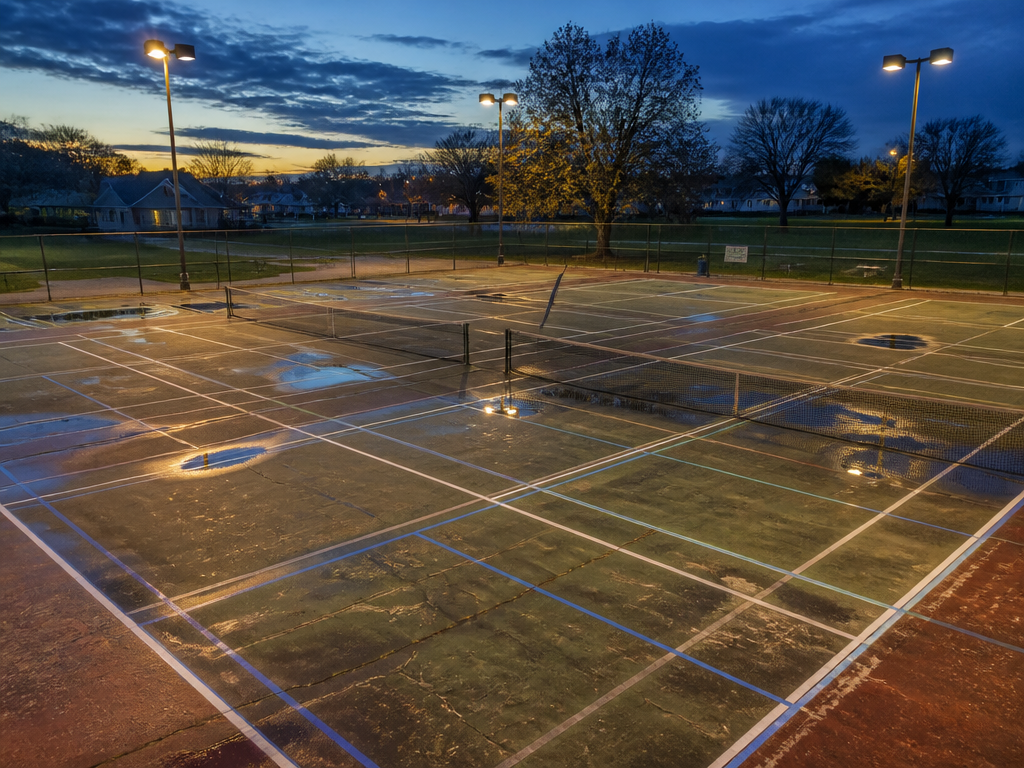
The advice shows up almost word for word in council packets and parks-commission memos across the country: if the tennis courts sit empty on a Tuesday evening and the pickleball group has a forty-person waitlist, restripe the tennis courts. It is cheap. It is fast. It serves more players per acre. And as tennis facility policy it has the outward shape of good governance — count the usage, follow the demand, spend almost nothing doing it.
We think that advice is roughly right about the demand and badly wrong about the arithmetic.
The verdict in one sentence: converting tennis courts to pickleball is often defensible as a capacity decision and rarely defensible as a cost decision, because the conversion gets priced at the cost of paint while the reversal gets priced at the cost of construction.
Let us be clear about what this is not. It is not an argument that pickleball demand is fake, that pickleball players are interlopers, or that a municipality should never convert a court. The growth is real and the people asking for courts are constituents. The problem we want to put in front of decision-makers is narrower and more durable than any sport rivalry: the decision framework itself compares two numbers that are not comparable.
How we evaluated
We did not visit facilities, count players, or take a decibel reading. This is a synthesis of published material, and the reader should weigh it accordingly.
We drew on four bodies of evidence. First, participation data: the Sports & Fitness Industry Association topline participation reports, which have listed pickleball as the fastest-growing sport in the United States for several consecutive years, and the USTA participation figures for tennis, which describe a much larger but slower-growing base. Second, cost guidance: construction, resurfacing, and restriping ranges published by court builders and by the American Sports Builders Association, cross-read against line items in publicly posted municipal capital improvement plans. Third, practitioner commentary — parks directors, contractors, USTA sections, pickleball ambassadors — which functions in this category the way tester reviews function for equipment. Fourth, resident and advocate feedback as it appears in meeting minutes and public comment.
How we weighted them: the participation trend is the strongest evidence here and we treat it as settled. Cost figures are the weakest. Court construction pricing varies enormously by region, site condition, drainage, lighting, and whether the base needs replacing, and most quotable numbers are builder marketing or a single municipality's bid. We use them as orders of magnitude, not as figures. Noise evidence is thinner still: the most-circulated measurements come from a small number of acoustic consultants, frequently retained by one side of a dispute, rather than from peer-reviewed work. We flag it and decline to build an argument on it.
Where the advice holds up
Three things about the standard recommendation survive scrutiny.
The demand signal is genuine. A parks department facing a chartered club with real membership and real hours of intended play is not being lobbied by a fad; the SFIA trend has been consistent long enough that treating it as a spike is now the less defensible read.
The geometry is genuine. A single tennis court footprint accommodates multiple pickleball courts, so the per-acre throughput of converted space is higher — usually cited as three to four pickleball courts per tennis court depending on run-off and fencing. If your metric is participant-hours per maintained square foot, conversion wins and it is not close.
The budget pressure is genuine. Restriping and portable nets sit in an operating budget. New construction sits in a capital budget that may be scheduled years out and bonded. A director who can serve a hundred new players this spring for the price of paint is responding rationally to the constraints actually in front of them.
The four options, side by side
| Option | Cost signal | Capacity added | Reversibility |
|---|---|---|---|
| Blended lines on an existing tennis court | Lowest — striping and portable nets, an operating-budget item | Real, but shared and schedule-dependent | High; lines can be removed at next resurfacing |
| Full conversion (dedicated nets, posts, fencing, resurface) | Moderate — a mid-size capital line | Highest per existing footprint | Low; restoring tennis means construction-grade work |
| New dedicated pickleball build | Highest per court, but adds rather than subtracts | Additive; no sport loses inventory | Not applicable |
| Do nothing | Zero now, deferred maintenance later | None | N/A |

Where the advice breaks down
The two prices come from different budgets and different decades. This is the core of it. The conversion is quoted as a striping job. The reversal — if demand shifts, if a high school program needs courts, if a tournament bid requires them — is quoted as new construction, and the gap between those two figures is not a rounding error but an order of magnitude. Every source we read on court construction, from ASBA-affiliated builders to posted municipal bids, puts a properly built outdoor tennis court well into five figures at minimum and frequently into six once base work, fencing, and lighting are included. Nothing in the striping quote discloses that the municipality has just traded a cheap decision today for an expensive one later. A capital asset was retired and the retirement was recorded as a maintenance savings.
"Underused" is a measurement, and the measurement is usually bad. The utilization counterargument deserves a direct answer, because it is the strongest card on the conversion side. Our reading of the practitioner commentary is that utilization counts in these decisions are rarely instrumented. They are windshield surveys, a few site visits, or a reservation system that half the users never touch. More importantly, they measure a facility in whatever condition it is currently in. A court with a net that sags, standing water at one baseline, and no lighting will read as unpopular, and the reading will be correct without being informative. Low usage is a symptom that has at least two causes, and the conversion decision routinely assumes the flattering one.
Reversibility is asymmetric even when it looks symmetric. Blended lines are genuinely reversible. But conversions rarely stay blended. Once a chartered group holds standing reservations, the practical question becomes scheduling, then dedicated nets, then permanent posts, then a resurface that no longer includes tennis lines. Each step is small and each step is defensible on its own. The cumulative effect is a facility change nobody voted on. Recreation policy that only evaluates the first step will not see the last one coming.
Who this is for, and who it isn't
This is for the official with an actual conversion item on an agenda, and for the advocate who needs an argument that survives contact with a finance director. The useful move is not to oppose pickleball; it is to require that the reversal cost be stated in the same memo as the conversion cost.
It is not for anyone looking for a rule that says never convert. Some tennis inventory genuinely is surplus. Some sites were overbuilt for a program that ended twenty years ago. A jurisdiction with eight courts and two regular players has a different problem than one with two courts and a high school team.
A more honest version of the rule
The original advice — convert the empty court, it's cheap — should be replaced with something a decision-maker can actually apply:
Convert when the tennis capacity is surplus against a defensible count, and only after the memo states what restoring that capacity would cost and who would pay for it. If the reversal cost has not been written down, the decision has not been made — it has only been deferred onto a future council. That is the test tennis facility policy should have to pass, and blended lines pass it far more often than full conversions do.
Evidence grade for the central claim — that conversion decisions systematically underprice reversal — Moderate. The direction of the asymmetry is well supported by published construction and striping costs. The magnitude is not, because no source we found tracks it as a category.
What we could not answer
Three gaps. Nobody appears to publish a national dataset of court conversions and reversals, so the reversal rate — the number that would settle this argument — is unknown. We found no lifecycle costing of an actual conversion-then-restoration at a named facility. And the noise literature is too consultant-driven to cite for policy.
If you have a decision in front of you, the material worth reading is local, not national: your own parks department's asset condition assessment, which will tell you whether the court is unpopular or merely neglected; the last three years of your capital improvement plan, for what a court actually costs in your market; and your state's recreation grant records, which sometimes carry restoration line items no press release ever mentions. That is where the missing number is most likely to surface first.