A dollar spent on preventive maintenance saves six to ten dollars in later rehabilitation. The ratio comes out of highway pavement preservation work, it gets repeated by the FHWA and state DOTs, and it turns up in nearly every parks budget hearing where public tennis court maintenance reaches the agenda. It is a persuasive number, and it is close to useless in the room where the decision actually gets made — because it assumes the dollar was sitting there and someone chose not to spend it.
That is rarely what happened. Usually the dollar was spent already, on a crack that did not have to exist.
How often do tennis courts actually need resurfacing?
An acrylic-coated asphalt court needs a new color coat roughly every four to eight years. That range is the figure given in Tennis Courts: A Construction and Maintenance Manual, co-published by the USTA and the American Sports Builders Association, and it is the number most court builders will quote from their own spec sheets. Which end of the range a given court lands on is decided almost entirely by water: how fast the surface sheds it, and how many places it has found to get underneath.
That is the whole story, and it runs in a specific order.
The failure, in the order it happens
First, something breaches two millimeters
The color coat is not structure. It is an acrylic emulsion loaded with silica sand, squeegeed on in a few thin lifts — on the order of one to two millimeters total once cured. Its jobs are traction, UV protection, color, and moving water off the asphalt before the asphalt can absorb it. It is engineered to be abraded by tennis shoes, which spread a body's weight across a wide, soft, flat contact area.
Almost nothing else that ends up on a court does that. A scooter or bike tire concentrates a rider onto a contact patch the size of a thumbprint, then drags it sideways at the turn. A folding chair leg, a tent stake, a camera tripod spike — point load, metal edge. Roller hockey wheels are hard urethane and they are meant to skid. Consumer fireworks put a thermal shock on a coat that was never rated for one and leave an embrittled ring behind.
None of this is vandalism, and treating it as vandalism gets the problem wrong. Nobody walks onto a public court intending to damage it. The coating simply is not rated for any of it, and the people using it that way have no reason to know that.
Then water finds a path it did not have
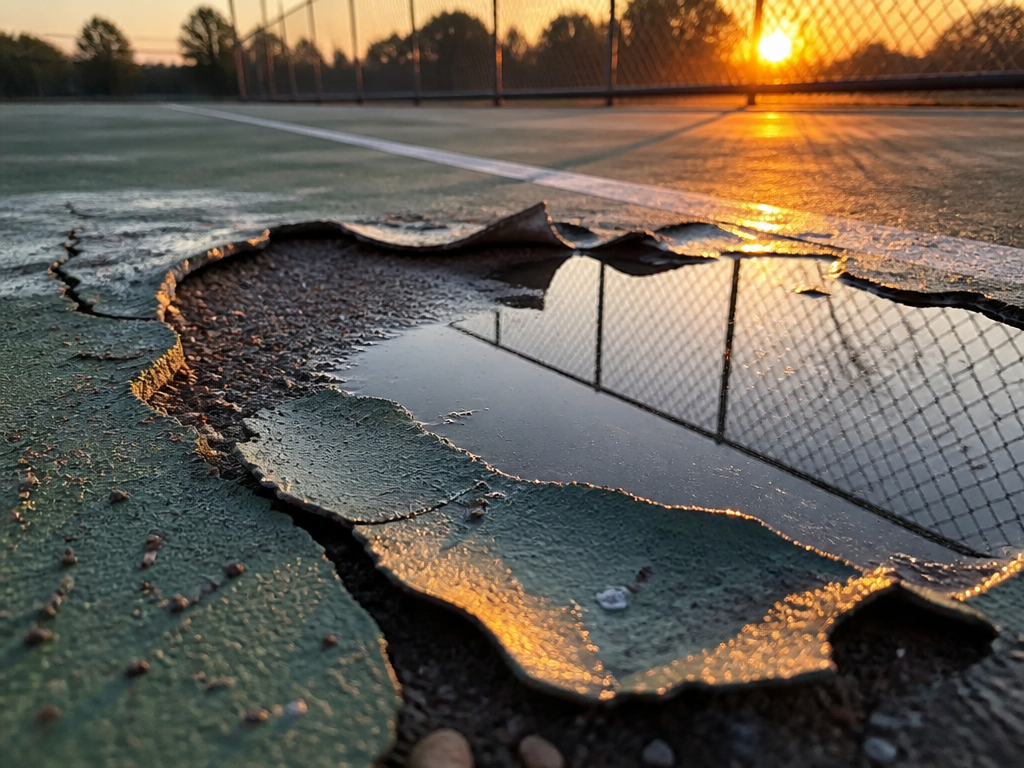
Once the coat is nicked, the failure stops being cosmetic and starts being hydraulic. Water sits in the breach instead of running off it. It wicks laterally under the surrounding coating, and the adhesive bond at the edges of the nick gives up. Delamination spreads outward from the original point — slowly in a dry climate, fast anywhere the water freezes, because ice does the prying. What was a scuff becomes a peeling patch, and the peeling patch exposes bare asphalt to UV, which oxidizes the binder and lets the fines wash out.
Then the crack stops being a crack in the surface
Asphalt courts crack regardless. Thermal cycling and minor base movement will do it on a court nobody ever misuses. The question is only whether the crack is sealed.
A sealed hairline crack is a work order. An open one is a drain. It delivers surface water straight into the aggregate base, and a saturated base loses bearing strength. The slab then deflects under load along the crack edge, which widens the crack, which admits more water. Somewhere in that loop the vocabulary changes: the contractor stops saying patch and starts saying overlay, or reconstruct. A patch will not hold over a substrate that is moving. This is the moment the fix leaves the maintenance budget and enters the capital plan, where it has to compete with roofs and playgrounds and gets scheduled in years rather than weeks.
Last, the budget absorbs it
Here is the part that closes the loop. The avoidable repairs come out of the same operating line that funds the resurfacing cycle. So the resurface slips a year. Then another. Meanwhile the coat is now past its wear life, thinner and more permeable exactly when more cracks are opening beneath it. The cost of waiting does not rise linearly — it rises faster the longer the wait, because each deferred year enlarges the scope of the eventual job. That is the trap, and it is arithmetic, not attitude.
The migration that reads as obsolescence
The last stage is human. Players who have alternatives take them: the club, the high school, the town twenty minutes away with the good surface. Usage counts fall. And then the agency's own data says something false but entirely defensible — these courts are not being used. The next capital plan deprioritizes them, or reallocates them to another sport.
That reallocation is sometimes the right call on the merits. Demand does shift. But the signal it is being made on is contaminated, because low utilization at a degraded facility measures the degradation, not the demand. A court that emptied out over six years of deferred repair is not evidence that nobody wanted a court.
What off-label use actually breaches
| What comes onto the court | What it contacts first | What it turns into |
|---|---|---|
| Scooters, bikes, skateboards | Coat, as a point load plus lateral skid | Delamination patches at the turning points |
| Chairs, tables, tent and tripod stakes | Coat and asphalt, punctured | Discrete holes that feed water to the base |
| Fireworks, grills, fire pits | Binder, thermally shocked | Embrittled rings that ravel from the edge |
| Roller hockey and skating | Coat, abraded by hard urethane | Wear-through in the traffic lanes |
| Climbing or hanging on nets | Center strap, cable tension, post footings | Racked posts and loose sleeves that admit water |
What is established, what is thin, and what is folk wisdom
Well established: water in the base is what ends an asphalt court, and the acrylic coat is a sacrificial waterproofing layer, not a structural one. This is engineering consensus, stated in the USTA/ASBA manual and in essentially every court builder's specification.
Plausible but thin: the six-to-one or ten-to-one preventive maintenance ratio, as applied to a 60-by-120-foot recreational slab. It was derived from highway networks with heavy axle loading and formal pavement management systems. The direction is almost certainly right. The precision is borrowed from a different problem.
Folk wisdom: that courts are destroyed by dramatic events. Also that a court is fine until it looks bad. By the time the coat looks bad, the base has been taking on water for a couple of seasons.
Two rules that the mechanism actually supports
Keep anything with a wheel, a stake, a flame, or a metal edge off the playing surface. This is not etiquette. A one-to-two-millimeter sacrificial coat cannot take a concentrated point load or a thermal shock, and the breach is where every subsequent failure starts.
Report a hairline crack the week you notice it. Photograph it, note the court number, send it to the parks department — most agencies now have a web form for exactly this. A sealed hairline crack is cheap forever. The same crack after one wet winter is a capital project, and the window between those two states is the only point in the whole sequence where a single person can change the outcome.
Which brings the six-to-one ratio back around. It is not really an argument for spending more on public courts. Read against the mechanism, it is a measure of how cheaply one can be lost: the dollar was not withheld by a budget officer, it was spent in advance, by somebody who rode a scooter across the baseline and never knew they had bought anything.