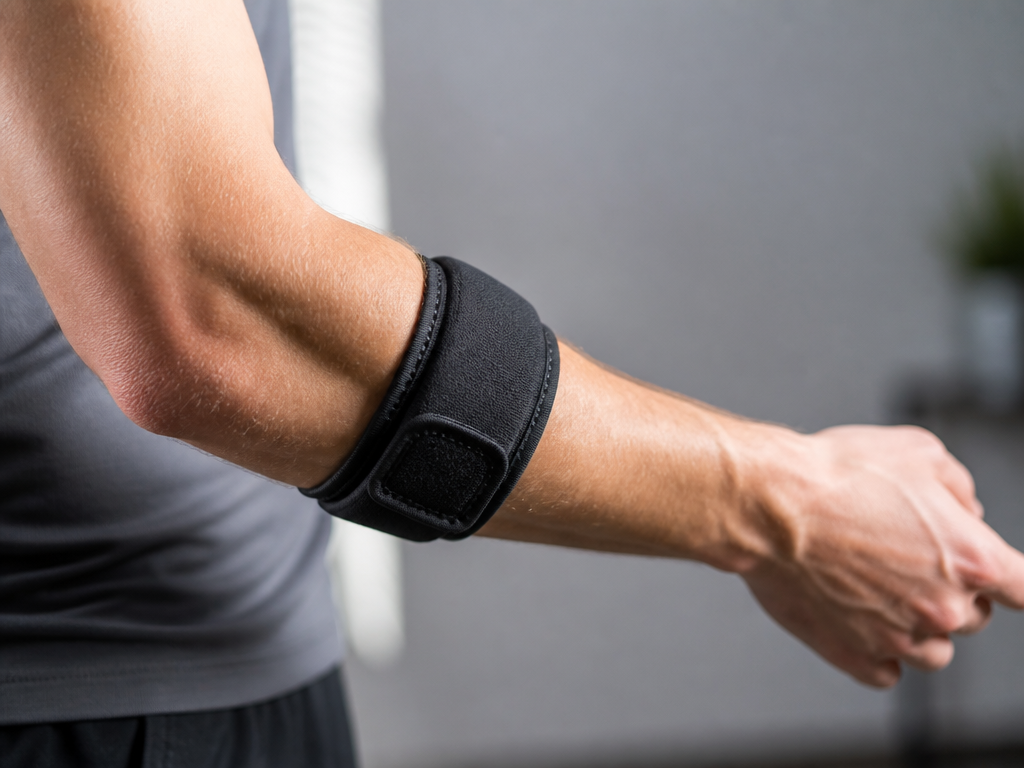
A tennis elbow brace is the rare piece of gear that can be the correct purchase and a total failure at the same time. The strap is right. The padding is right. The problem is usually two inches of skin — the difference between where people put the band and where it actually does something. Most players never find out, because a brace that does nothing also does no harm, and "no harm" feels a lot like "maybe it's helping."
So this is a piece about placement, fit, and what the research can and can't promise. We read the studies, we measured on our own arms, and we tried to be honest about where the confidence outruns the data.
What most people do
Walk into any club and you can spot it. The band sits right on the lateral epicondyle — the bony bump on the outside of the elbow that hurts when you press it. It makes intuitive sense. The thing hurts there, so you put the thing there.
Mechanically, that is the one place it shouldn't be. The pain at the epicondyle comes from the common extensor tendon, mostly the extensor carpi radialis brevis (ECRB), where it anchors to the bone. Pressing a pad directly on an already-irritated insertion does not reduce its load. It just compresses a sore spot, which is why a lot of people report the brace feeling fine at rest and useless mid-rally.
The second common error is tension. The folk rule is "tight enough that it can't slide," so people crank it until the forearm bulges above and below the strap. That much constriction can pinch the posterior interosseous nerve branch and produce tingling or aching into the forearm — a new problem layered on the old one. Comfort at rest becomes the only test, and comfort at rest is close to meaningless here.
The third thing people do is the quietest failure: they never check whether the band is doing anything. They wear it, the elbow still hurts after three weeks, and they conclude braces don't work — without ever confirming the brace was placed where the mechanism requires.
What the evidence suggests
Here is the idea the brace is built on, in the order it actually happens.
The mechanism, step by step
You grip the racquet. Gripping fires your wrist and finger extensors, including the ECRB. That contraction pulls on the tendon at its bony insertion — the part that's already inflamed or degenerated. A counterforce brace sits on the muscle belly of the forearm, roughly two to three finger-widths below the elbow crease, not on the bone. When the muscle contracts against the band, the brace gives it a new point to push against. The theory is that this redistributes some of the pull so less of it reaches the irritated insertion, and possibly damps the vibration that travels up the forearm on contact.
That's the claim: a brace as a movable "false origin" for the muscle, shifting strain away from the sore anchor. The placement only works if the pad sits over contracting muscle, not over the joint. This is the entire reason "two inches down" matters.
What the data actually shows
The mechanical part is reasonably well supported. Snyder-Mackler and Epler (1989) measured EMG activity in the forearm extensors with and without a counterforce brace and found reduced muscle activity with the band on. Several biomechanics studies since have shown counterforce straps reduce strain at the tendon insertion and dampen forearm vibration during loaded gripping. As a load-reduction device, the brace does something measurable.
The clinical part — does that translate into your elbow getting better — is thinner than the confidence with which it's usually sold. A Cochrane review (Struijs et al., 2002) looked at orthotic devices for lateral epicondylitis and concluded the evidence was insufficient to recommend for or against braces; the trials were small, short, and inconsistent. Later work hasn't resolved it cleanly. Garg et al. (2010), a randomized trial comparing a counterforce brace, a wrist splint, and combined treatment, found short-term symptom differences but no clear long-term winner. The honest summary is that braces appear to reduce pain during activity for some people in the short term, and there is no good evidence they speed actual tendon healing.
So two verdicts, kept separate on purpose:
- Counterforce braces reduce extensor muscle load and forearm vibration: well-established mechanically. Multiple biomechanics studies agree.
- Counterforce braces improve clinical outcomes for tennis elbow: plausible but thin. Short-term symptom relief is reported; durable healing benefit is unproven.
That gap matters for how you should think about the brace. It is a symptom-management tool that lets you keep playing or working with less pain in the moment. It is not a treatment for the underlying tendon problem, which responds best to progressive loading exercise — the eccentric and isometric protocols that have the strongest evidence base for lateral epicondylitis. The brace buys comfort; the rehab does the repair.
A fit-check you can actually run
You don't need a diagram to know whether the band is placed right. You need to feel the mechanism work.
| What to check | How to test it | What "right" feels like |
|---|---|---|
| Position | Find the bony bump, slide two to three finger-widths toward the wrist | Pad sits on soft muscle, not bone |
| Pad location | Make a fist and extend your wrist back | The muscle should swell into the pad |
| Tension | Tighten, then slip one finger under the band | Snug at rest, firm under the pad when you flex |
| Pressure point test | Press the sore epicondyle, then grip with the brace on | Gripping should hurt noticeably less |
| Nerve check | Wear it five minutes, hands relaxed | No tingling, numbness, or pins-and-needles below it |
If gripping with the brace on doesn't reduce the pressure-point pain at all, the placement is wrong or the brace is the wrong tool for your case. That test is the whole point. A brace that passes it is doing its job; one that fails it is a wristband.
What I actually do
Reviewer note (first person): I've worn the standard single-strap counterforce band and a wider dual-strap version through a few flare-ups, and the routine below is what survived.
I put it on the same way every time, because consistency is the only way to know whether a change in pain came from the brace or from chance. I find the bump, drop two fingers toward the wrist, and seat the pad on the muscle. Then I make a fist and cock my wrist back — if the muscle doesn't push into the pad, I'm too low, and I slide it up a centimeter. I tighten until it's snug with my hand relaxed, then I clench and feel the band tighten itself as the muscle swells. That self-tightening is the sign the geometry is right. If I have to crank it hard at rest to feel anything, it's in the wrong place.
I take it off between matches and at the desk. Wearing a constricting band for ten hours a day is how the tingling starts, and continuous compression has no evidence behind it anyway.
When the brace doesn't help, I don't assume it's broken. A forearm compression sleeve sometimes works better for people whose pain is more diffuse than pinpoint, because it spreads load instead of concentrating it. If neither does anything across a couple of weeks, that's information: it means the problem may not be classic ECRB tendinopathy, and it's worth a clinician ruling out radial nerve entrapment or a referred neck issue, which masquerade as tennis elbow more often than people expect.
And I treat the brace as the smaller half of the plan. The strap lets me keep gripping. The slow, heavy wrist-extension loading is what actually changes the tendon over weeks. Skipping the second part and relying on the band is the most common way people stay injured while feeling like they're doing something.
If you take one thing into tonight's hit: put the pad two fingers below the bony bump, make a fist, and only trust the brace if the muscle swells into it — otherwise you're wearing a wristband and waiting for nothing.