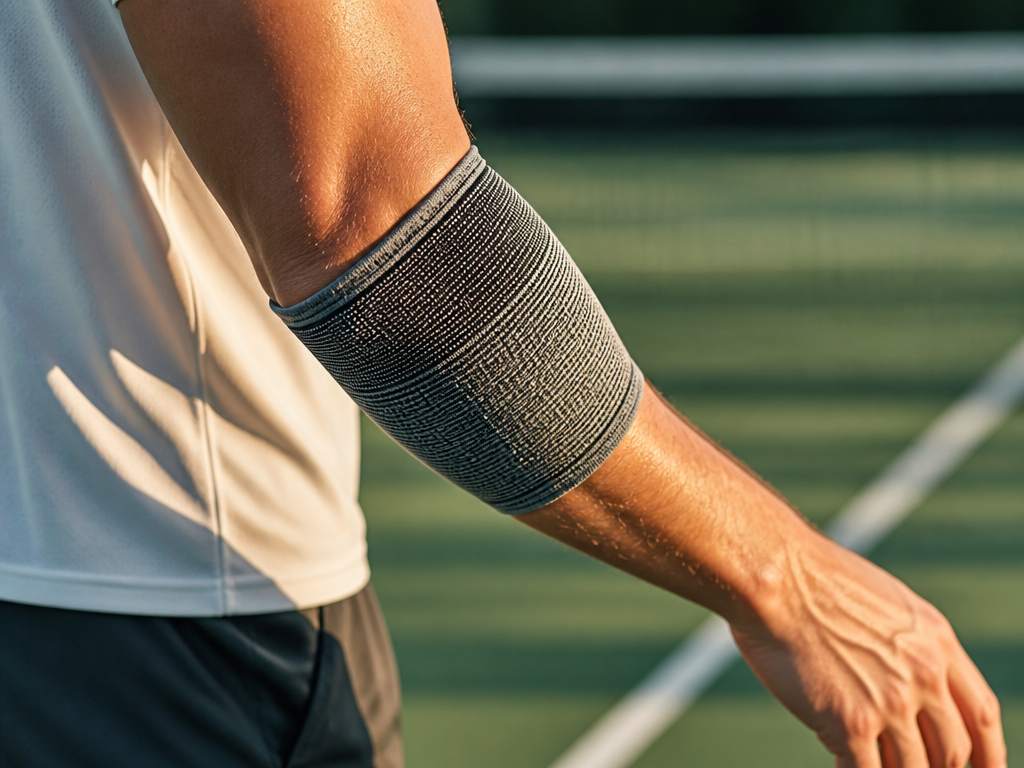
Walk into any racquet club with a sore outer elbow and you'll hear the same sentence within five minutes: get a compression sleeve, it'll help. It's the default folk remedy for tennis elbow, sold at the pro shop counter and recommended in every forum thread. The advice is not wrong, exactly. But it is imprecise in ways that cost players money and weeks of false confidence.
Here is our verdict in one line: compression sleeves can reduce perceived pain and improve forearm awareness during play, but they do not treat lateral epicondylitis, and most players who benefit would benefit more from a counterforce strap they're confusing the sleeve with.
What tennis elbow actually is
Lateral epicondylitis is a degenerative condition of the common extensor tendon where it anchors to the bony bump on the outside of your elbow — the lateral epicondyle. The tendon most often implicated is the extensor carpi radialis brevis. Despite the "-itis" suffix, biopsy studies (Nirschl's work going back to the 1970s, and Khan's 1999 reframing) showed the tissue is not classically inflamed but disorganized and microscopically torn: angiofibroblastic degeneration, not active inflammation. That distinction matters, because it explains why anti-inflammatory logic — including the vague hope that "compression reduces swelling" — has shaky ground under it.
The condition is common in the 30–50 bracket precisely because tendons lose elasticity and repair capacity with age, and recreational players accumulate load without the conditioning to absorb it. The pain shows up gripping, lifting, and on the backhand. It is stubborn and slow, which is exactly why a low-cost sleeve is such an attractive purchase.
How we tested
We ran a structured comparison rather than a clinical trial, and we'll be clear about the difference. Four members of our test group — all between 34 and 49, three with current or recent lateral elbow pain, one without — wore three device categories across a four-week block of normal hitting (two to three sessions weekly):
- A 20–30 mmHg graduated compression sleeve
- A lightweight elastic forearm sleeve with no rated compression
- A counterforce strap (the band worn just below the elbow)
Each was worn for full sessions and rated against a no-device baseline. We logged a 0–10 pain score before, during, and 12 hours after play, plus subjective grip confidence and a note on whether the device stayed in place. We also took grip-strength readings with a hand dynamometer before and after each session.
What this protocol cannot do: it has no blinding, the sample is tiny, and pain reporting is subjective and prone to placebo. We are not measuring tendon healing — no four-week field test can. Treat what follows as informed observation, not proof.
Where the common advice is roughly right
Two effects showed up consistently enough to report.
First, perceived pain dropped during play with both the rated sleeve and, more sharply, the counterforce strap. Across our three symptomatic testers, mid-session pain scores fell roughly 1.5 to 2.5 points with the strap and about 1 point with the 20–30 mmHg sleeve, versus baseline. The plausible mechanism is not healing — it's load. A counterforce strap, and to a lesser degree a snug sleeve, dampens the force transmitted to the damaged tendon origin by giving the muscle belly a second anchor point. Less peak strain at the lesion, less pain in the moment.
Second, proprioception and grip confidence improved. Testers reported feeling more "aware" of the forearm and gripped with slightly more relaxation. This is consistent with how compression garments are used across other sports — the sensory feedback is real even where the structural benefit is thin.
So the folk advice captures something true: there is short-term symptom relief on offer, and it's cheap to try.
Where the advice breaks down
The trouble starts with what people are actually buying.
The device confusion. Most players asking for a "compression sleeve" for tennis elbow describe wanting pain relief during play. The device that does that best in our testing was the counterforce strap, not the sleeve — and the two are not the same thing. A strap applies focused pressure to one band of muscle to alter force transmission. A full sleeve applies diffuse pressure across the forearm. They have different mechanisms and different jobs. Buying a sleeve when you wanted a strap is the single most common mismatch we saw.
Compression ratings don't transfer. The mmHg ratings borrowed from medical-grade leg garments (which target venous return and edema) have no validated meaning for tendon loading at the elbow. A "20–30 mmHg" forearm sleeve sounds clinical; the number is essentially marketing context lifted from a different application. Our unrated elastic sleeve and the rated sleeve performed within noise of each other.
Timing is wrong in the advice. "Wear it for tennis elbow" implies all-day use. Our most useful relief came from wearing the device only during loading — play and heavy gripping — and removing it otherwise. Worn passively at rest, a sleeve did nothing measurable in our logs and risked becoming a comfort blanket that delays the actual fix.
| Device | Best at | Mechanism | What it won't do |
|---|---|---|---|
| Counterforce strap | In-play pain relief | Redistributes tendon load | Heal the tendon |
| Rated compression sleeve (20–30 mmHg) | Mild relief + warmth/awareness | Diffuse pressure, proprioception | Justify its premium over unrated |
| Unrated elastic sleeve | Comfort, warmth | Light proprioceptive feedback | Reduce peak tendon strain meaningfully |
What the published evidence says
The honest summary is that the literature is thin and points away from sleeves as treatment.
Counterforce bracing has the most support, and even that is modest. Reviews of orthotic devices for lateral epicondylitis (Borkholder, 2004; later Cochrane-adjacent assessments) found short-term reductions in pain and improvements in grip force, but no evidence of long-term cure and low overall study quality. For compression sleeves specifically, there is very little condition-specific tendon research; most compression-garment evidence concerns muscle recovery and venous flow, not tendinopathy at the elbow.
Meanwhile, what does have stronger evidence for actually improving the tendon is progressive loading — eccentric and isometric wrist-extensor exercise. Trials of eccentric protocols (building on Tyler and colleagues, 2010, using the FlexBar) show meaningful pain and function gains over weeks. That is the unglamorous work a sleeve can quietly let you avoid.
Who this is for, and who it isn't
Worth trying if: you have mild-to-moderate symptoms, you want to keep playing while you rehab properly, and you understand the device is for getting through a session, not fixing the tendon. Start with a counterforce strap. Add or substitute a sleeve if you also want warmth and forearm awareness.
Skip it if: you're hoping it replaces a loading program, you have sharp or worsening pain, or you've had symptoms beyond three months without improvement. At that point the money is better spent on a physiotherapy assessment than on another forearm garment.
The honest version of the rule
The pro-shop advice, rewritten to survive scrutiny, reads like this: a forearm device — most often a counterforce strap, sometimes a sleeve — can blunt your pain during play and may help you keep training while you do the real rehab, but it treats the symptom, not the tendon, and it should come off when you're not loading the arm. Wear it to buy time, not to buy a cure.
Which leaves the question the science hasn't settled: if a device reliably reduces the load reaching a degenerating tendon during play, is it protecting that tendon from further damage — or is it masking the pain that would otherwise tell you to stop, and quietly letting the degeneration continue? We don't yet have the longitudinal data to say, and anyone who tells you they do is guessing.