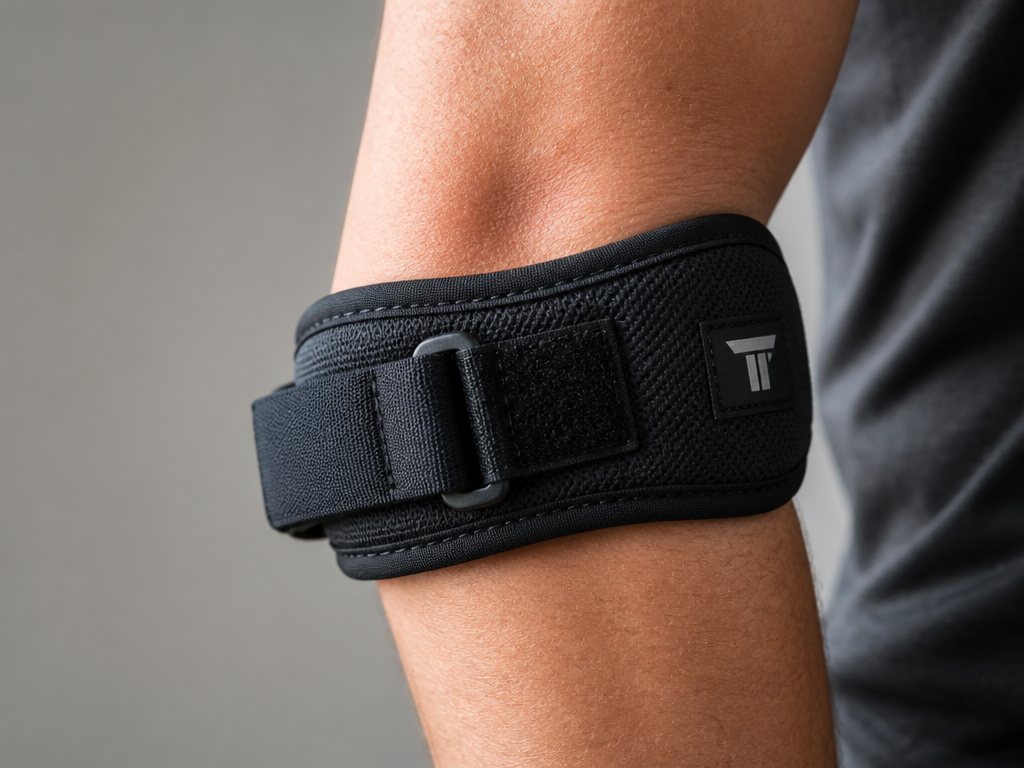
Most people who walk into a pharmacy looking for tennis elbow braces are buying on faith. The wall offers a dozen straps and sleeves, the packaging promises relief, and nothing on the box explains why one design might work and another might be a placebo with Velcro. We spent six weeks testing four of the most common counterforce designs to answer the question the packaging won't: what does a brace physically do to your arm, and which features actually change the load on the painful tissue?
The verdict, in one sentence: a counterforce brace relieves lateral elbow pain not by healing the tendon but by intercepting muscle force before it reaches the inflamed attachment point — so the only features that matter are pad placement, strap width, and a closure that holds tension through a swing.
Everything else on the box is marketing.
Before anything: get the diagnosis right
A counterforce strap is a tool for one specific problem. Lateral epicondylitis — the degenerative, often misnamed "tennis elbow" — involves the common extensor tendon where it anchors to the outer bump of the humerus. The pain is sharp on the outside of the elbow, worse when you grip, lift a kettle, or hit a backhand late.
That is not the same as medial elbow pain (golfer's elbow, the inside), not the same as a radial nerve entrapment that mimics it, and not the same as referred pain from the neck. A counterforce brace placed over the wrong structure does nothing, and in the case of nerve entrapment a tight strap can make symptoms worse. We are reviewers, not your clinician, and the single most useful thing we can tell you is that a fifteen-dollar brace is a poor substitute for a physical exam. If you have not had someone press on the exact spot and reproduce your pain, start there.
What follows assumes you have lateral epicondylitis confirmed, or at least strongly suspected, and you want to understand the device before you buy it.
The mechanism, in the order it happens
A brace earns or loses its keep in the few milliseconds of a forehand. To judge the designs, you have to follow the force through the arm in sequence.
First: the wrist extensors contract
When you grip a racquet and stabilize the wrist against impact, the wrist and finger extensor muscles on the back of the forearm fire. Chief among them is the extensor carpi radialis brevis, the muscle most consistently implicated in lateral epicondylitis. These muscles run down the forearm but they all originate from a shared tendon — the common extensor origin.
Next: the force funnels to a single attachment
All of that muscular tension has to anchor somewhere, and it anchors at the lateral epicondyle, a small bony prominence the size of a fingertip. This is the bottleneck. The combined pull of several muscles concentrates at one degenerated patch of tendon. Every grip, every block volley, every twist of a jar lid loads that patch again before it has healed. That repeated tensile strain at the bone–tendon interface is the engine of the pain.
Then: the brace creates a second, false anchor
Here is the part the packaging never explains. A counterforce strap is placed roughly two to three finger-widths below the elbow, over the muscle belly — not over the bony bump. When you tighten it and then contract the muscle, the muscle bulges against the strap. The strap pushes back. That pressure functions as a new, temporary anchor point partway down the forearm.
The muscle now has somewhere to brace against that isn't the tendon. Bauer and Murray's work on counterforce mechanics describes this as redistributing the origin of the contractile force away from the inflamed insertion. You haven't healed anything. You've given the load a second place to go.
Last: peak strain at the tendon drops
The net effect is that the spike of strain reaching the lateral epicondyle during a hard contraction is blunted. Snyder-Mackler and Epler (1989) measured forearm muscle activity with and without a counterforce brace and found reduced EMG activity in the wrist extensors during gripping — consistent with the brace offloading the work. Meyer and colleagues, using strain measurements, reported reduced strain at the lateral epicondyle region with a counterforce strap in place.
That is the whole trick, and understanding it tells you exactly what to look for. If the pad doesn't sit over the muscle belly, the false anchor never forms. If the strap is too narrow, the pressure concentrates on a sliver of tissue and the muscle slides out from under it. If the closure slips during a rally, the tension that creates the anchor is gone by the third game. Those three failures are what separate a working brace from a wrist accessory.
What the evidence actually supports
We want to be precise here, because the gap between "feels better immediately" and "fixes the problem" is where most buyers get misled.

The short-term offloading effect is reasonably well supported. Multiple electromyography and strain studies show reduced extensor activity and reduced tendon-region strain with a counterforce brace on. Players often report immediate symptom reduction during activity, and that is consistent with the mechanism.
The long-term curative effect is not supported. Braces do not regrow degenerated tendon. A 2014 Cochrane-style appraisal of orthotic devices for tennis elbow (Sadeghi-Demneh and Jafarian among the reviewers in this literature) concluded the evidence was limited and of low quality, with no clear demonstration that braces alter the natural course of recovery. Bisset and colleagues' broader work on lateral epicondylalgia consistently points to progressive loading exercise as the intervention with the strongest medium-term outcomes.
So the honest framing is this: a counterforce brace is a symptom-management and activity-enablement tool. It can let you keep playing or working with less pain while the actual rehabilitation — eccentric loading, grip modification, load management — does the healing. Anyone selling it as a cure is selling past the data.
How we tested
We evaluated four counterforce braces over six weeks. Three of our four testers had clinician-diagnosed lateral epicondylitis at the time of testing (mild to moderate; one acute, two chronic); the fourth was symptom-free and served as a fit-and-slippage reference. All were intermediate-to-advanced players hitting two to four sessions a week.
We assessed each brace on four criteria tied directly to the mechanism:
- Pad placement and contact — does the pressure pad sit over the muscle belly and stay there, or does it migrate toward the bony prominence? We marked the target spot with a skin-safe pen and measured drift after a 45-minute session.
- Effective strap width and pressure distribution — wider straps spread load and resist rolling. We measured the contact band width under tension.
- Closure security — we recorded how much tension was lost (by re-measuring strap circumference at a fixed setting) after 45 minutes of hitting.
- Comfort over duration — pressure marks, numbness, tingling, and the point at which a tester wanted it off.
We did not measure EMG or tendon strain ourselves — we have no lab for that, and we won't pretend otherwise. Our pain ratings are subjective 0–10 scales recorded before and after each session, and with three symptomatic testers the sample is far too small to generalize. Treat our pain numbers as anecdote and our fit-and-slippage measurements as the more reliable findings.
The four braces compared
The four represent the dominant counterforce categories: a basic single-strap with a gel pad, a wide dual-strap, a hybrid sleeve-plus-strap, and an air-pad pneumatic design.
| Criterion | Single-strap, gel pad | Wide dual-strap | Sleeve + strap hybrid | Pneumatic air-pad |
|---|---|---|---|---|
| Contact band width (under tension) | 28 mm | 52 mm | 40 mm | 35 mm |
| Pad drift after 45 min | 18 mm | 6 mm | 4 mm | 11 mm |
| Tension lost after 45 min | Moderate | Low | Low | Low–moderate |
| Reached "want it off" point | ~30 min | not within session | ~50 min (heat) | not within session |
| Repositioning required mid-session | Frequent | Rare | Rare | Occasional |
A few things stood out beyond the grid.
The single-strap gel pad is the design most people buy because it is cheapest and most familiar. It is also the one most prone to the central failure: at 28 mm of contact it rolled, and after 45 minutes the pad had drifted nearly two centimeters — in two testers, up toward the epicondyle, which is precisely where it should not be. When repositioned correctly it worked, but "worked when constantly fussed with" is a real limitation in match play.
The wide dual-strap was the most mechanically sound. The broad contact band created a stable false anchor, drift was minimal, and the second strap kept the pad seated. The cost is bulk; one tester found it caught on the wrist during two-handed backhands.
The sleeve-plus-strap hybrid held position best of all because the sleeve resisted rotation, but the compression sleeve trapped heat and the testers wanted it off soonest in warm conditions. In cooler weather this was our testers' overall preference.
The pneumatic air-pad is the design that markets itself hardest on "targeted pressure." In our testing the inflatable pad concentrated pressure on a smaller area, which is exactly the wrong direction — a narrower, harder anchor was no more effective than the wide static pad and was less comfortable. It is a clever-sounding solution to a problem the wide strap already solves more cheaply.
If you want one recommendation: a wide static counterforce strap with a contact band of roughly 50 mm and a secure two-point closure beats the fancier designs for the money.
How to position and wear it
A correctly designed brace worn incorrectly does nothing. This is the procedure we used, and it follows directly from the mechanism.

-
Find the muscle, not the bone. Bend your elbow, make a fist, and cock your wrist back. Feel the back of your forearm with the other hand — you'll feel the extensor muscles bunch up. The fullest part of that bulge, about two to three finger-widths below the elbow crease on the outer side, is your target. The strap pad goes there, not over the painful bony point itself.
-
Set tension with the muscle relaxed, then test it active. Tighten the strap with your arm loose until it's snug, not biting. Then make a fist and cock the wrist: you should feel the pad firm up against the bulging muscle. If the pad isn't pressing back when the muscle contracts, it's too loose or too high. If your fingers tingle or go cold, it's too tight — back it off.
-
Check for migration after the first few minutes. Mark the spot mentally or move through a few practice swings. If the pad creeps toward the elbow, it's seated too high or the strap is too narrow for your arm.
-
Wear it during loading, take it off at rest. The brace exists to manage force. There is no reason to sleep in it or wear it on the couch, and constant compression has its own downsides. On during play, lifting, and gripping tasks; off otherwise.
-
Reassess week to week, not match to match. If pain is genuinely improving over weeks, that's the rehab working. If the brace is the only thing keeping you on court and nothing else is changing, you're managing a symptom and ignoring the cause.
Counterforce strap vs compression sleeve vs kinesiology tape
These three get lumped together and they shouldn't be — they do different things.
A counterforce strap changes load transmission, as described above. It has a specific mechanical job and the evidence for that job, short-term, is moderate.
A compression sleeve provides uniform pressure, warmth, and proprioceptive feedback over the whole forearm. It does not create a focal false anchor, so it doesn't offload the tendon the same way. Some players find the warmth and light compression comfortable, and there's nothing wrong with that — just don't expect it to do the counterforce job. The sleeve-plus-strap hybrids try to get both, with the heat tradeoff we noted.
Kinesiology tape is where we get skeptical. The marketing claims — lifting the skin, improving lymphatic drainage, "supporting" the muscle — have not held up well under controlled testing. Sham-taping studies, where researchers apply tape with no therapeutic tension or in a non-therapeutic direction, have repeatedly found that the sham performs about as well as the "correct" application. Parreira and colleagues' 2014 review of kinesiology taping for musculoskeletal conditions found little benefit beyond what sham or other treatments provided. That doesn't mean tape does nothing for any individual — placebo and proprioceptive effects are real and not worthless — but it means you should not pay a premium for it expecting a mechanical effect comparable to a counterforce strap. If tape helps you, fine; just know what you're and aren't getting.
Who this is for — and who it isn't
A counterforce brace is worth buying if you have confirmed or strongly suspected lateral epicondylitis, you need to keep playing or working through a manageable level of pain, and you understand it as a bridge while you do the loading rehab that actually heals tendon. For that reader, a wide static strap is one of the highest-value fifteen-to-thirty-dollar purchases in tennis.
It is not for you if you haven't had the diagnosis confirmed and your pain might be nerve-related — a tight strap over a compressed radial nerve is the wrong move. It is not for you if you're hoping to skip rehabilitation; the brace will mask the signal you need to manage your load. And it is not for medial (inside-elbow) pain, where the mechanics are different and a lateral counterforce strap is simply in the wrong place.
We'd also flag the player who buys the brace, feels immediate relief, and concludes they're fixed. That immediate relief is the mechanism working exactly as designed — and it tells you nothing about whether the underlying tendon is recovering. The relief is real and the cure is separate.
Evidence grade
For the central claim — that a counterforce brace reduces strain on the lateral epicondyle and provides short-term symptom relief during activity — we grade the evidence Moderate. Multiple EMG and strain studies support the offloading mechanism, but study quality is uneven and sample sizes are modest.
For the secondary claim that braces improve long-term recovery from tennis elbow, we grade the evidence Weak: the orthotics literature does not show braces altering the natural course, and progressive loading exercise remains the better-supported intervention.
Our own fit testing is a small-sample field assessment, not a lab study, and our pain ratings are anecdotal — weight them accordingly.
If you remember one thing tonight: put the pad on the muscle bulge two fingers below the elbow, not on the sore bony bump, and tighten it just enough that it pushes back when you clench your fist.