The advice gets repeated in every corner of the internet where rackets are discussed: you do not need to pay for coaching. The free tennis community — the forums, the subreddits, the YouTube channels, the stringer who answers your DMs — already contains everything a recreational player needs. Lessons are a luxury. The knowledge is out there for anyone willing to read.
We think this advice is roughly right, and we want to be honest about the parts where it stops being right. Because the gap between "mostly true" and "true" is where a lot of players waste a season.
Where the free advice actually holds up
Start with the strongest version of the claim. For a specific set of problems, a good online tennis community genuinely outperforms what most club players get from a forty-dollar group clinic.
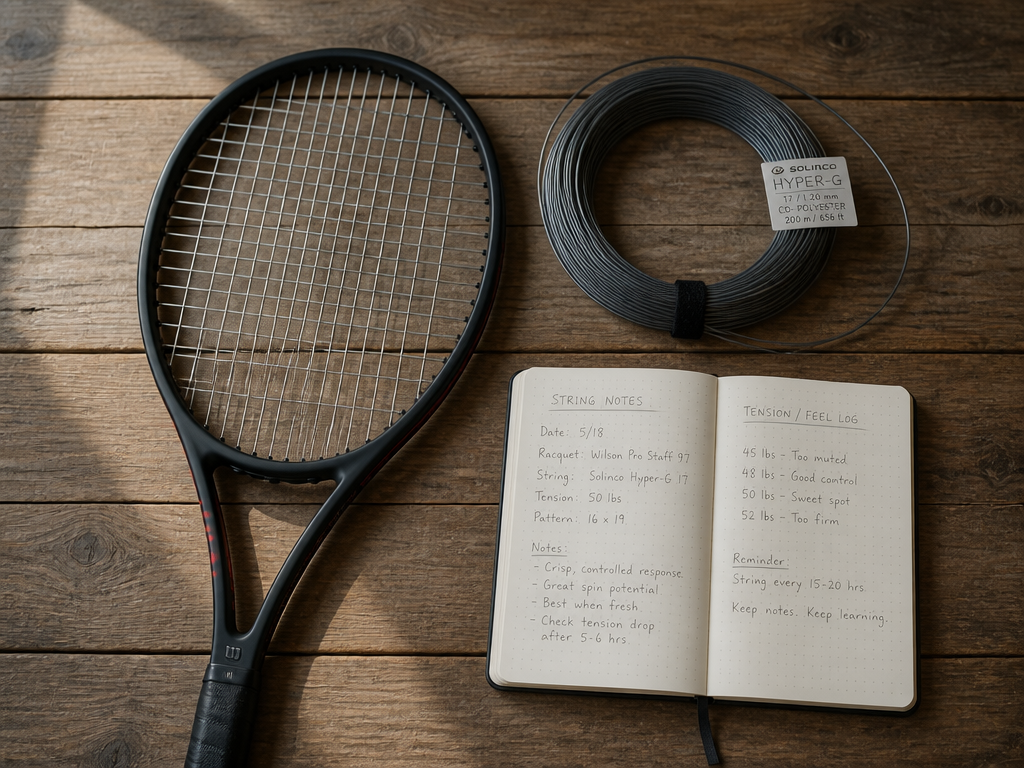
The first is gear diagnosis. If you post your racquet, your string, your tension, and your complaint — "the ball flies on me," "my elbow aches after an hour," "I can't get spin on the second serve" — you will get a usable answer faster from a crowd than from one coach. The reason is sample size. A coach has hit with maybe fifteen frames recently. A 40,000-member forum has collectively strung tens of thousands. When someone says a full bed of a stiff co-polyester at 55 pounds is a known elbow risk, that is not opinion. It is the aggregate of a lot of sore arms reporting back.
The second is factual instruction — the parts of tennis that are genuinely just information. How a continental grip maps to the serve. Why your toss drifting behind you forces a back-arch. What "pronation" actually refers to anatomically. This is knowledge, not skill, and knowledge transmits fine through text and video. A free breakdown from a credentialed teacher reaches you exactly as well as a paid one does.
The third is motivation and accountability, which is unglamorous and real. People who post their match results, who join a weekly hitting thread, who get talked out of a frame they don't need — they stay in the sport longer. Retention is most of improvement. A player who keeps showing up beats a player with better technique who quits in March.
How forum knowledge forms — and where it rots
Here is the mechanism, because the mechanism is the whole story.
A claim enters a community. Someone tried something, it worked for them, they posted it. If it keeps working for the next people who try it, it gets repeated, and repetition becomes consensus. This is a crude but functional form of peer review. Over years, the durable claims — keep co-poly tensions lower than you think, soft strings save arms, beginners over-buy on racquet stiffness — survive because they keep being confirmed.
The problem is that the same mechanism preserves claims that were never tested, only repeated. A confident post from 2014 gets quoted in 2017, screenshotted in 2020, and by 2023 it reads like settled fact with no one able to point to where it came from. The community cannot tell the difference between "this has been confirmed a thousand times" and "this has been copied a thousand times." Both look like consensus.
So the free tennis community is reliable in exact proportion to how testable a claim is. Gear feedback is testable — you string it, you hit it, you report. Stroke advice is barely testable through a screen, because nobody on the thread can see what your body is actually doing.
Where the advice breaks down
Feel skills don't transmit through text
The single largest failure is anything involving feel and timing. You cannot read your way to a relaxed grip at contact. You cannot watch your way into the sensation of the racquet lagging behind your hand on a topspin forehand. These are felt, internal, and they need someone watching your actual swing and saying "there — that one — do that again." A forum cannot do this. A video coach reacting to your clip can do a little of it. A person standing on the court with you can do a lot of it.
This is not a knock on the community. It is a category error to expect text to teach a motor pattern, the same way you cannot learn to ride a bike from a PDF.

Contradiction with no referee
Post a video of your forehand and you will get five answers. Drop your elbow. Raise your elbow. More leg. Less arm. Your grip is too extreme. Your grip is fine, it's your timing. All of these people are pattern-matching your swing to the last swing they fixed, including their own. None of them is wrong exactly, and the crowd has no mechanism to converge. You are left holding five contradictions and the false impression that you now know more.
A coach is worse on sample size and better on this one thing: they pick one fault, the limiting one, and make you work it until it changes. Improvement is usually one fix at a time. Crowds give you all the fixes at once, which is the same as none.
The racquet-spec rabbit hole
The gear forums are excellent and also a trap. The same place that correctly saves your elbow will, if you let it, convince you that a 2-point swingweight difference is the reason you lost on Tuesday. It wasn't. The honest reading of player feedback is that most recreational players are far inside the zone where equipment is the bottleneck. The community is great at answering "is this setup hurting me," and unreliable at answering "will this setup make me better," because the second question is mostly about the engine, not the frame.
A more honest version of the rule
The slogan says skip the coaching, the free community has it all. The honest version is narrower and more useful:
Use the free tennis community for everything that is knowledge or gear. Pay a human, even occasionally, for everything that is feel.
A single in-person lesson every few weeks, aimed at one fault, plus a free community for diagnosis and gear and accountability, beats either one alone. You are using the crowd for what crowds are good at — breadth — and a coach for what only a coach gives you — eyes on your body in real time.
Here is the split we'd actually defend:
| Question | Free community handles it | Needs a human |
|---|---|---|
| Is my string/tension hurting my arm? | Yes, well | No |
| What grip does this shot use? | Yes | No |
| Why does my serve toss drift? | Mostly | Helps |
| Why is my forehand inconsistent? | Poorly | Yes |
| Is this racquet right for me? | Partly | Partly |
| Am I doing this drill correctly? | No | Yes |
A working rule of thumb: if the answer can be confirmed by stringing it and hitting it, trust the crowd; if the answer depends on what your body is doing at contact, the crowd is guessing, and so are you.
One more note on tone. The best free communities are not the ones with the most confident posters. They are the ones where someone is allowed to say "I don't know, film it and ask a pro" without being argued with. A community that knows the edges of its own competence is worth more than one that has an answer for everything.[^1]
What this looks like lived out
I'll drop into the first person here, briefly, because the article's logic only means something if someone runs on it. My string setup — a soft poly in the mains, multifilament cross, low fifties on tension — came almost entirely from a forum thread I never posted in. I just read three years of arm complaints and copied the people who stopped having them. It has held up for two seasons and a re-string every five weeks.
My forehand did not improve that way. It improved the afternoon a coach watched me hit twenty balls, said nothing about my elbow or my grip, and told me I was stopping my feet on contact. Nobody online had said that, because nobody online could see it. I'd read about my forehand for years. I fixed it in an hour, on a court, with one person watching.
The free tennis community will tell you almost everything. It cannot tell you the thing you can't see yourself.