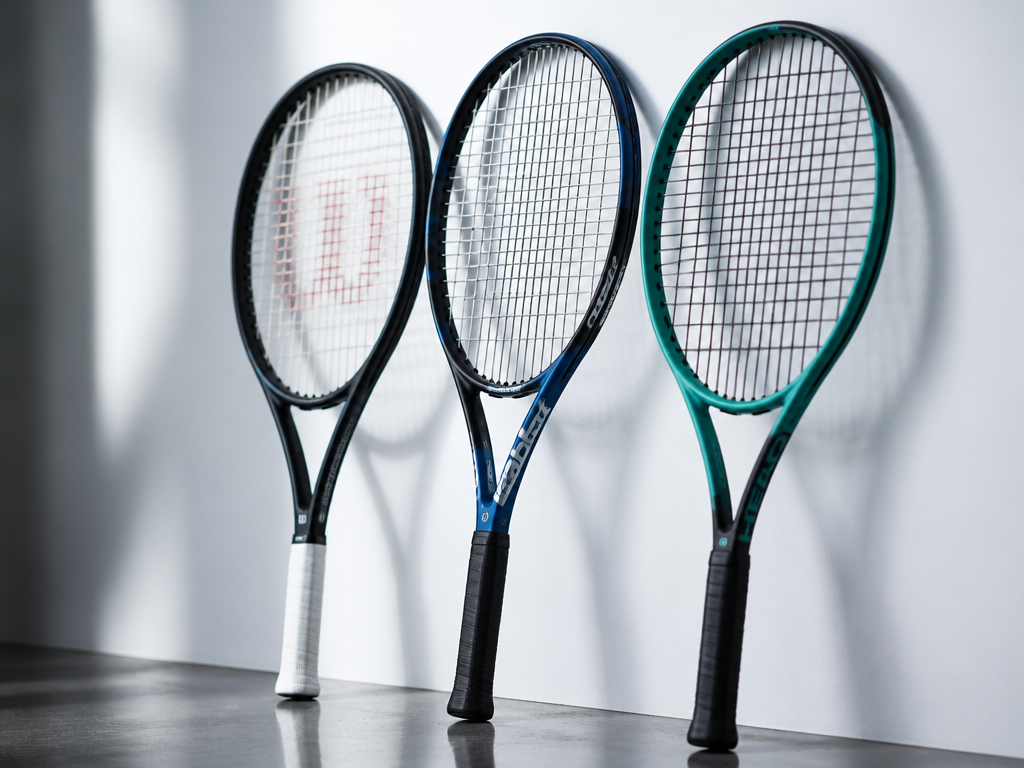
Good tennis racquet selection is less about finding the single best frame than about naming, out loud, what you are willing to give up. Every frame on the wall is a set of compromises wearing a paint job. The marketing will tell you a racquet is powerful and controlled and comfortable and stable; physics tells you it leans one way and pays for it somewhere else. The job of choosing well is figuring out which bill you are happy to pay.
We get asked to settle the same argument constantly, and it almost always comes down to three frames that sit on nearly every intermediate-to-advanced shortlist: the Babolat Pure Drive, the Wilson Blade 98 (16×19), and the Yonex EZONE 98. They are not the only good racquets in the world. They are the three that get cross-shopped against each other more than any others we see, because each one is the clean, uncompromised expression of a different priority. Compare them honestly and the whole logic of racquet buying gets easier to see.
How we evaluated this
A word on what this is and isn't, because tennisyard's whole reason to exist is that we don't pretend. We did not hit forty balls with these three frames on a Tuesday morning and file a report. This is a synthesis. We read the manufacturers' own published specifications, we compared those against the independent stiffness and swingweight numbers that retail testers publish from RDC machines, and we weighed the consensus from named independent reviewers and the long tail of owner feedback that accumulates around frames this popular.
That approach has real limits and we want them on the table. Manufacturer weight and balance figures are unstrung; add strings, grommets, and an overgrip and every number shifts. Stiffness ratings (the RA figure) are notoriously inconsistent between sources — an independent shop's RDC machine routinely reads a point or two off the manufacturer's own claim, and even two units of the same frame vary. So where we cite a stiffness number, treat it as a neighborhood, not a coordinate. Where sources disagree, we say so rather than picking the flattering figure.
What a synthesis like this can do well is map the tradeoffs. The consensus on how these three frames behave is remarkably stable across reviewers who otherwise agree on nothing. That agreement is the signal we're reporting.
The three frames, side by side
Here are the headline specs, with the source of each figure flagged. Manufacturer numbers are the companies' own published values for the current generations at time of writing; stiffness is where independent measurement matters most.
| Criterion | Babolat Pure Drive | Wilson Blade 98 (16×19) | Yonex EZONE 98 |
|---|---|---|---|
| Head size (mfr) | 100 sq in | 98 sq in | 98 sq in |
| Unstrung weight (mfr) | ~300 g | ~305 g | ~305 g |
| String pattern | 16×19 | 16×19 | 16×19 |
| Beam width | thick (~23–26 mm) | thin (~21 mm) | medium |
| Stiffness (RA, independent) | high, low-70s | low, low-60s | mid, mid-60s |
| Signature trait | free depth and pace | flexible precision | plush, pocketed comfort |
The first thing to notice is how much these frames share. All three are 16×19 string patterns. Two of them are 98 square inches at 305 grams unstrung. On paper they look like siblings. The differences that matter — beam thickness, stiffness, and the feel that flows from them — are exactly the ones a spec sheet undersells and a paint job hides. So let's go criterion by criterion.
Power: the Pure Drive's home turf, by design
Power in a frame is not magic; it's mostly geometry. A larger head, a thicker and stiffer beam, and a slightly lighter static weight combine to return more of the ball's energy instead of absorbing it into the frame's flex. The Pure Drive is built to do exactly that. At a manufacturer-listed 100 square inches with a beam that thickens toward the throat and an independently measured stiffness in the low 70s, it is the stiffest and most powerful of the three by a clear margin, and it is not close.
The consensus among independent reviewers is consistent: the Pure Drive gives you free depth. The phrase that recurs in owner feedback is that the ball "jumps" off the strings, which is another way of saying the frame is doing work your swing didn't have to. For a club player whose second serve sits up or whose deep balls land short, that is a genuine, felt upgrade.
The Blade 98 and EZONE 98 are not powerless — both are perfectly capable frames for a full-swinging player — but they ask you to generate more of the pace yourself. The Blade in particular, with its low-60s stiffness and thin beam, is tuned to not add power, which is precisely the point of it. If you measure a racquet purely by how little effort a deep, heavy ball costs you, the Pure Drive wins this criterion outright. What it charges for that win shows up two sections down.

Spin and launch: closer than the marketing suggests
Here the marketing muddies the water badly. Spin gets sold as a feature you buy, when it is mostly a function of string pattern, string choice, and racquet-head speed — all three of which are largely in your hands, not the frame's. All three of these racquets are 16×19 patterns, which is the moderately open layout most spin-oriented players gravitate toward. That shared pattern means the raw spin ceiling of the three is more similar than any brand would like you to believe.
What differs is launch angle and how easy the frame makes it to swing fast. Reviewers broadly credit the Pure Drive and EZONE with a livelier, higher launch that helps a topspin ball clear the net with margin. The Blade's stiffer-sounding reputation is misleading — its flexible layup actually produces a lower, more penetrating trajectory that advanced players read as "control" and beginners read as "the ball's going into the net."
Note what we are not saying: we're not quoting an RPM figure, because we didn't log one and any number we invented would be worthless. The honest verdict on spin is that if maximizing topspin is your single priority, none of these three is the specialist tool — a dedicated spin frame with a more open 16×16 or 18-main pattern and an aero beam would out-spin all of them. Among these three, spin is close to a wash, decided more by the string you install than the frame you buy.
Control and precision: the Blade's reason to exist
Control is the hardest criterion to quantify and the easiest to feel, and it is where the Blade 98 earns its long-standing following. A flexible frame deforms more on contact, keeps the ball on the stringbed a fraction longer, and — this is the part players describe but rarely explain — returns a clearer signal to the hand about where the ball went. Reviewers and owners converge on the same language for the Blade: predictable, connected, a frame that does what you tell it and nothing more.
That is the flip side of the power section. The Pure Drive's stiffness, which gives it free depth, is the same property that costs it precision at the top of the swing spectrum. The common critique in independent reviews — stated as a tradeoff, not a flaw — is that the Pure Drive can feel like it launches the ball a hair before you asked it to, and that hard, flat balls can sail. This is not a defect; it is the direct, unavoidable consequence of the design choice that makes it powerful. You cannot have the free power without the reduced margin for error. Anyone selling you both is selling you a paint job.
The EZONE 98 sits in the interesting middle here. It is stiffer than the Blade but pairs that with Yonex's isometric head shape and a pronounced "pocketing" feel that reviewers describe as plush rather than crisp. Its control is more forgiving than the Blade's but less absolute — it holds the ball rather than reporting on it. Which of those you prefer is genuinely a matter of taste, and it is the clearest example in this whole comparison of two frames being different rather than one being better.
Comfort and arm safety: where the numbers actually matter
This is the criterion we'd argue most players under-weight until an elbow forces the issue, and it is one where the spec sheet earns its keep. Frame stiffness correlates with the shock transmitted to the arm: stiffer frames tend to transmit more, softer frames less, though string choice and technique complicate that considerably. On the raw stiffness numbers, the ranking is unambiguous — the Blade, in the low 60s, is the most flexible and the friendliest to a cranky arm; the Pure Drive, in the low 70s, is the stiffest; the EZONE lands in between but is widely reported to feel softer than its RA suggests, thanks to that pocketing sensation.
We want to be careful here, because comfort is where marketing and owner anecdote get furthest from evidence. "Arm-friendly" is a claim every brand makes and few substantiate. What we can say with confidence: the Pure Drive has a decades-long, well-documented reputation among owners and reviewers as a stiff frame that some players find harsh, particularly strung with a full bed of stiff polyester. That is not a rumor; it is one of the most consistent threads in the frame's owner feedback. Babolat has softened later generations and a smart string setup mitigates a lot, but the underlying stiffness is real and measurable.

If you have any history of tennis elbow or wrist trouble, this criterion should probably dominate your tennis racquet selection more than power ever does. On the evidence, that points toward the Blade first and the EZONE second, with the Pure Drive requiring the most thoughtful string job to stay comfortable. The evidence for the stiffness ranking is strong; the evidence for exactly how much any individual arm will feel it is weak, because that depends on your body, your strings, and your technique.
Stability and forgiveness: the quiet tiebreaker
Stability — how much a frame twists and gets pushed around by a heavy incoming ball — is governed mostly by swingweight and mass distribution, and it separates frames that feel great in a slow rally from frames that hold up against a big hitter. All three of these are plenty stable for club play once strung, but reviewers give a slight nod to the fully-specced Blade and to heavier custom setups for the most solid response against pace. The stock Pure Drive's slightly lower static weight makes it the most maneuverable of the three and the quickest to whip up to speed, which is a real advantage on serve and on the run — and a modest cost in plow-through against the biggest balls.
Forgiveness — how kind the frame is on off-center hits — tilts toward the Pure Drive's larger 100-square-inch head and the EZONE's isometric shaping, both of which are designed to keep the sweet spot generous. The Blade's 98-inch head with a traditional oval asks for slightly more precise contact. None of this is dramatic at club level, but it's the kind of quiet difference that decides which frame you're still happy with in month three.
Who each frame is actually for
The criterion-by-criterion picture resolves into three clear player matches, and the honest thing to admit is that they don't rank — they sort.
The Pure Drive is for the player who needs help generating pace and depth, or who simply likes the feeling of a lively, powerful frame and swings with enough control to keep the free power in the court. It rewards a moderate, fast swing and punishes a flat, over-hit ball. It is the wrong frame for anyone with arm sensitivity who won't commit to a soft string setup, and the wrong frame for the precision player who wants the racquet to stay out of the way.
The Blade 98 is for the player with a full, developed swing who generates their own power and wants the frame to translate it faithfully. It is the most demanding of the three and the most rewarding for the player who's ready for it — and it is the safest bet for a tender arm. It is the wrong frame for a developing player who still needs the racquet to supply pace, who will find it "dead" and blame the frame for their own short balls.
The EZONE 98 is for the player who wants most of the Blade's control-oriented feel with a softer, more forgiving, more comfortable hand feel — and a touch more free power. It is the fence-sitter's frame in the best sense: the fewest hard tradeoffs, at the cost of not being the outright best at any single one. It is the wrong frame for a purist who wants either maximum power or maximum precision and is willing to suffer for it.
So which one wins
It should be clear by now that the question is malformed. There is no winner, because the three frames aren't answering the same question. The Pure Drive wins power and loses precision and comfort. The Blade wins precision and arm-friendliness and loses free power. The EZONE wins the fewest-regrets middle and loses the thrill of being a specialist. Every one of those is the same racquet's strength and weakness stated twice.
The reader who benefits most from this comparison isn't the one hunting for the objectively best frame — that frame doesn't exist — but the one willing to answer a harder question first: what are you actually willing to give up? If the honest answer is "comfort, for power," you already know your frame. If it's "power, for a racquet that never surprises me," you know yours too. If it's "I don't want to give up anything," the EZONE is the frame that asks the smallest price, and that is a legitimate priority, not a cop-out.
Evidence grade for the central claim — that these three frames represent power, precision, and balanced-comfort archetypes with the tradeoffs described: Strong on the directional differences (they are corroborated by manufacturer specs, independent stiffness measurement, and a stable reviewer and owner consensus), Moderate on the precise magnitudes (stiffness figures vary by source and unit, and comfort is individual), and Weak on any claim about exactly how a given frame will feel in your particular hand, which no synthesis can settle and only a demo can.
Which is the last, and only, instruction that matters: hit all three before you buy, because the best racquet is the tradeoff you'll stop noticing.