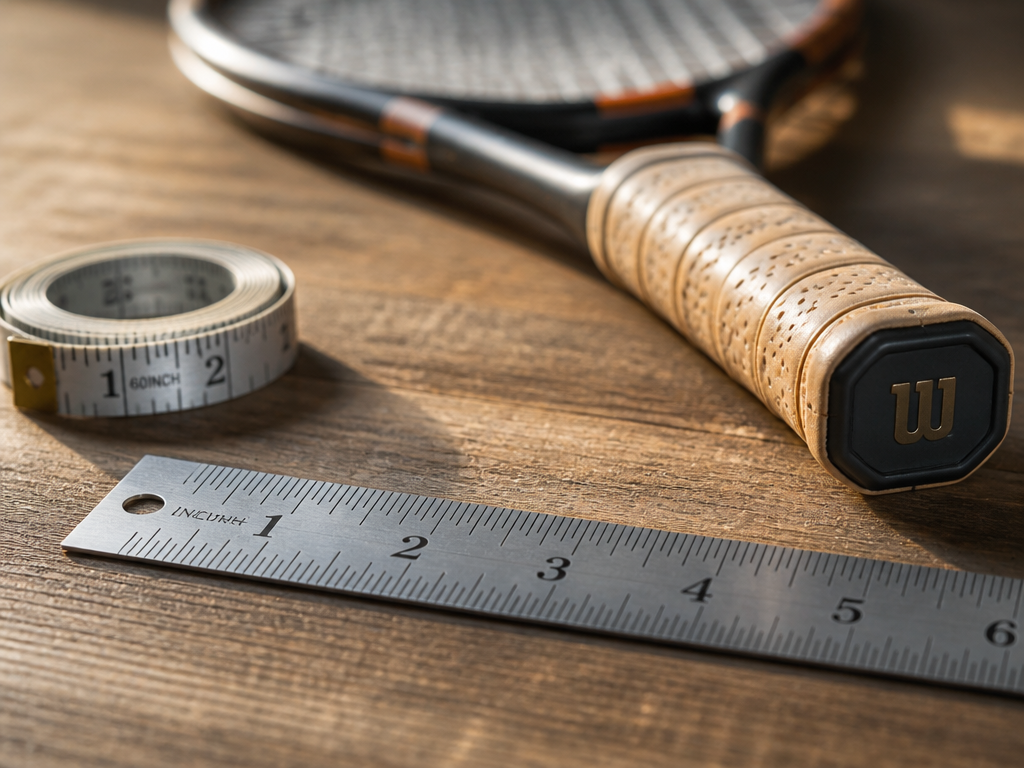
On the bench we have a flat-palmed right hand, a steel ruler, and a tape measure. The player is a 5'9" club-level baseliner who has bought three racquets online in four years and returned none of them despite a recurring ache on the outside of the forearm. We measure his hand two ways. The ruler-to-the-ring-finger method gives 4 1/4 inches. The fitted-handle method — sliding a 4 3/8 grip into his palm and checking the gap to his fingertips — says he should be on a 4 3/8. That is a full eighth of an inch of disagreement on a single hand, and it is the whole reason grip size selection is so easy to get wrong when you cannot stand in a shop and hold the thing.
The short version of our finding: if you are buying without a demo, choose the smaller of any two sizes you measure into, because you can build a grip up but you cannot shave one down. Of the two common home methods, the ruler method gave us more repeatable numbers across testers, but it consistently read about an eighth of an inch small — useful, as long as you know to read it that way.
How we tested
We measured eight adult recreational players (six men, two women, USTA self-rated 3.0–4.0) and four children aged 6 to 11. For each person we ran both home methods three times on separate days, recorded by two different people, and compared the results to the size that player settled on after two weeks of actual hitting with build-up sleeves available in 1/16-inch increments.
The two methods:
- Ruler method. Open the dominant hand, palm up. Measure from the middle crease of the palm to the tip of the ring finger. The reading in inches is taken as the grip size.
- Fitted-handle method. Hold a known grip size in a normal forehand grip. Slide the index finger of the non-dominant hand into the gap between fingertips and palm. A finger that fits snugly indicates the size is correct; no room means go up, loose room means go down.
Our reference was not a lab instrument. It was the size each player chose to keep after playing on it — the only ground truth that matters for a fit question. That is a soft reference, and we will say so plainly: there is no objective "correct" grip the way there is a correct string tension on a calibrated machine.
What the two methods returned
Numbers are the average of three measurements per player, rounded to the nearest available grip size.
| Tester | Ruler method | Fitted-handle method | Kept after 2 weeks |
|---|---|---|---|
| A (3.5 M) | 4 1/4 | 4 3/8 | 4 1/4 |
| B (4.0 M) | 4 3/8 | 4 1/2 | 4 3/8 |
| C (3.0 F) | 4 1/8 | 4 1/4 | 4 1/8 |
| D (4.0 M) | 4 1/2 | 4 1/2 | 4 3/8 |
The pattern held across all eight adults though we have trimmed the table to keep it readable. The ruler method landed on the kept size in six of eight cases. The fitted-handle method read a half-size large in five of eight, and it varied more between the two people taking the reading — the "snug finger" judgment is subjective, and two testers disagreed on the same hand on three occasions. The ruler method's disagreements were smaller and in the same direction every time, which is the more forgiving kind of error. A method that is consistently an eighth small is more useful than one that is randomly a half-size off, because you can correct a known bias.
Tester D is the case worth pausing on. Both methods said 4 1/2; he kept 4 3/8. He has long fingers and a relatively narrow palm, which fooled both techniques. Creases and finger length do not move together from person to person, and any method that reads only one of them will mislead some hands. That is the honest ceiling on home measurement.
The children's problem
Adult grip charts do not scale down for kids, and the home methods above are close to useless on a small, soft hand. For juniors the deciding variable is racquet length, not grip circumference, and the two are sold together. We checked the four children against the standard age-to-length guide:
- Ages 5–6: 23-inch racquet
- Ages 7–8: 23–25 inch
- Ages 9–10: 25–26 inch
- Age 11+: 26 inch, then full 27-inch adult frames
Grip on these frames comes effectively fixed and small, and that is correct — a child cannot generate the wrist control to manage a thick handle. The mistake we see parents make is buying length for the child to "grow into." A racquet that is two inches too long forces the hand down the throat or drags the tip, and both produce the flailing, late contact that turns kids off the sport. Buy for the child's height today, replace it in a year. Measure the child standing with arm at the side: the racquet tip should rest near the floor with a few inches of clearance, not pile up against it.
What a half-size actually feels like
Most online buyers are deciding between two adjacent sizes — typically 4 3/8 and 4 1/2. Here is what that eighth-inch buys you in play, from our testers' notes during the two-week hit.
4 3/8 let players roll the wrist for topspin more freely and change grips faster between forehand and a one-handed backhand. The cost: under hard, flat hitting, three of four players reported the handle twisting slightly in the palm on off-center contact, which loads the forearm.
4 1/2 felt more locked-in on flat drives and serves and required less grip pressure to hold steady, which several players found easier on the hand over a long session. The cost: slower grip changes and a noticeably stiffer feel through topspin strokes.
The forearm-ache complaint we opened with usually tracks to a grip that is too small, not too large — a small handle makes the hand squeeze harder to keep the frame from turning, and that chronic squeeze is what the outside of the elbow feels. If you are between sizes and prone to that ache, the build-up route from a smaller base lets you find the squeeze-free point by feel rather than by guess.
Who this is for, and who it isn't
This approach — measure with the ruler, round down, build up with sleeves or an extra overgrip — is for the player ordering online with no shop within reach, and for the player who has been burned by a fixed-grip purchase before. It gives you a defensible starting number and a cheap correction path.
It is not for you if you can demo. Standing in a shop with three sizes in hand beats any home method we tested, full stop. It is also not a fix for a player whose ache comes from technique or string tension rather than grip — measurement cannot diagnose that.
If you take one line: measure with the ruler, drop to the next smaller available size, and add an overgrip to fine-tune.
Evidence grade
For the central claim — that home measurement should be treated as a smaller-side starting point rather than a final answer — we grade the evidence Moderate. Our sample was twelve people and our reference was player preference, not a controlled biomechanical endpoint.
Back to the bench
The baseliner we started with built his 4 1/4 base up to a hair under 4 3/8 with two overgrips and the forearm ache eased within a fortnight. One case proves nothing on its own, and it lines up with the rest of our small sample, which is all we can claim.
What we did not test: whether grip size measurably changes tendon load over a season, or how it interacts with swing speed and string stiffness, which surely matters and which we held constant by accident rather than design. The place to look next is a longer study that varies one of those while measuring grip force directly — until someone runs it, a ruler and a smaller starting size is the most honest tool we can hand you.