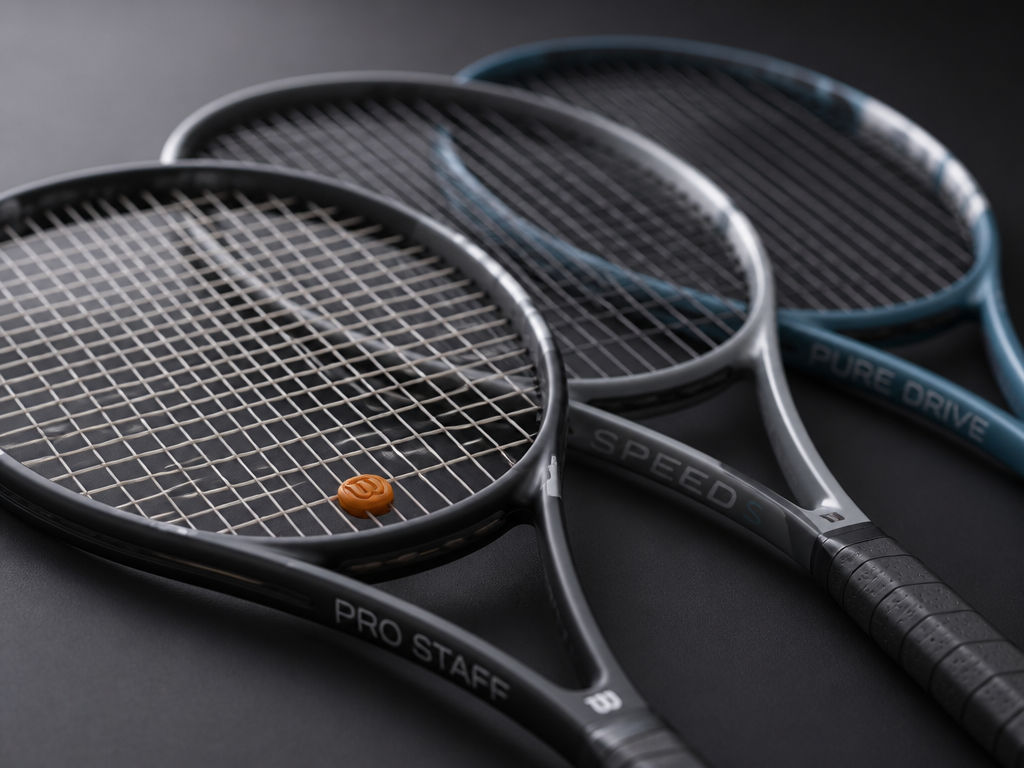
A salesperson once told one of our editors that the racquet in his hand was "the most powerful frame on the market." The next salesperson, a week later, said the same thing about a different racquet. Both were technically defensible. Neither was useful. This is the trap that stalls most recreational buyers at the point of purchase: every frame is the best frame, every spec is the spec that matters, and the advice online contradicts itself by the second forum thread.
Good racquet selection is not a hunt for the best stick. It is a matching problem, and matching problems have a method. The trick we keep coming back to is to stop thinking about the racquet sitting on a shelf and start thinking about what it has to do, in order, the moment you swing it. The frame has a job with a beginning, a middle, and an end. Line your decision up with that sequence and the spec sheet stops being noise.
How do I choose a tennis racquet as a recreational player?
Start with grip size, which is close to objective, then choose a head size of 100–105 square inches and a strung weight in the 285–305 gram range. That single combination handles most recreational players between roughly NTRP 2.5 and 4.0. Everything else — string pattern, stiffness rating, balance point — is a refinement, not a starting point. If you buy a 100-square-inch frame around 300 grams strung with a correct grip, you have not made a mistake. You have made a normal, defensible choice that thousands of club players hit happily for years.
That is the whole answer, compressed. The rest of this piece explains why those numbers fall where they do, by walking through what the racquet actually has to accomplish.
Why the spec sheet feels like noise
A modern racquet listing carries a dozen numbers: head size, unstrung weight, strung weight, balance, swingweight, stiffness (RA), beam width, string pattern, length, and a marketing "power level" that means whatever the brand wants. Presented as a flat list, they look equally important. They are not. Some describe the same physical behavior from different angles. Some matter enormously and some barely move the needle for a recreational swing.
The reason these numbers feel overwhelming is that they are usually given to you all at once, with no order of operations. So we impose one. The order is the order the ball gets struck.
Follow the contact, in the order it happens
First, the racquet has to get to the ball
Before anything else, you have to bring the frame to the contact point on time. This is maneuverability, and the number that governs it is swingweight — how heavy the racquet feels when it is swinging, not when it sits on a scale. A high swingweight frame plows through the ball with stability but demands earlier preparation and more strength to position. A lower swingweight frame whips around faster and forgives a late take-back.
Most stock recreational racquets land somewhere between a swingweight of about 285 and 320. Lower in that band is easier to handle; higher rewards a longer, more grooved swing. If you find yourself routinely arriving late on fast balls, the frame is asking for more than your swing currently gives. That is a maneuverability mismatch, and it is the first thing to get right because nothing downstream matters if you cannot get the strings to the ball cleanly.
Next, it has to forgive where you actually hit it
Recreational players do not strike the center of the string bed every time. Nobody does, but better players miss the center by less. So the second job of the frame is to forgive off-center contact, and that is what head size buys you.
A larger head — say 105 square inches — has a bigger sweet spot and twists less in your hand on shots struck toward the edges. A smaller head — 95 to 98 square inches — concentrates the response and gives more feedback to a player who already finds the middle reliably, but it punishes a mishit. For most of the readers we are writing for, 100 to 105 square inches is the sane range. It is forgiving enough to keep mishits in play without floating every ball long. This is why our default recommendation sits there and not at the extremes.

Then it has to put energy back into the ball
Only after the frame arrives on time and catches the ball does power enter the conversation. Power is widely misunderstood as a single dial labeled "stiffness." Stiffer frames (a higher RA rating) flex less and return more energy on a clean strike, which reads as power. But the same stiffness that returns energy to the ball also returns shock to your arm, and it does so most on the mishits a recreational player produces all afternoon.
Here is the honest part. The relationship between frame stiffness and arm injury is plausible but not cleanly settled. The mechanism — stiffer frame, less flex, more shock transmitted — is sound, and lab measurements of vibration support it. But controlled studies tying a specific RA number to a specific injury rate in club players are thin, because the confounders are everywhere: string choice, tension, technique, hours played, and the player's own arm all move at once. We are comfortable saying a very stiff frame strung with a stiff string is a known recipe for arm complaints. We are not comfortable handing you a precise RA cutoff and pretending the number is gospel.
Last, it has to survive a season with you
The final job spans the whole match: the racquet has to remain comfortable and stable through the third set without wearing out your arm or your timing. This is governed by weight and balance working together. A heavier frame (290–310 grams strung) absorbs more shock and stays planted against pace; a head-light balance keeps that weight from feeling sluggish at the tip. A very light frame is easy to wave around for ten minutes and increasingly transmits shock to your arm over an hour, because there is less mass to soak up the impact.
This is the quiet argument against buying the lightest frame on the wall. It feels effortless in the shop. It can feel like a hammer with no head by the end of a long match.
The one number with a near-objective answer
Grip size is the least debatable spec in the whole process, so it is worth fixing early. Measure from the middle crease of your palm to the tip of your ring finger; the result in inches lands close to your grip size. For most adults that is 4 1/4 or 4 3/8 inches. When unsure, size down — you can build a smaller grip up with an overgrip, but you cannot shave a grip that is too large. A grip that is too big quietly forces you to squeeze harder, which feeds straight into the arm-comfort problem above.
An honest rule of thumb
If you take one thing from this, take the matching table, not a model name.
| If you... | Lean toward |
|---|---|
| Arrive late on fast balls | Lower swingweight, ~290 g strung |
| Mishit often, want forgiveness | 100–105 sq in head |
| Have any arm history | Lower stiffness, softer string, avoid the lightest frames |
| Hit a clean, grooved center | 98–100 sq in, you can go heavier |
| Aren't sure on grip | Size down, build up with an overgrip |
There are no wrong answers inside these ranges. There are only better and worse matches to your swing, and your swing is allowed to change. Demo when you can; a fifteen-minute hit tells you more than a spec sheet. But if demoing is not possible, a 100-square-inch frame around 300 grams strung with a correct grip is a choice you will not regret while you learn what you actually prefer.
What we genuinely don't know
We cannot tell you the exact frame that will feel best in your hand, because feel integrates everything above plus the strings, the tension, and the day. We cannot give you a stiffness number that guarantees a pain-free arm. And the marketing "power level" on the box remains, as far as we can tell, a number with no agreed definition. Treat it as decoration.
The myth is that somewhere out there sits the perfect racquet, and your job is to find it before you buy. The more accurate version is that there is a range of racquets that fit how you already swing, and your job is simply to land inside it.