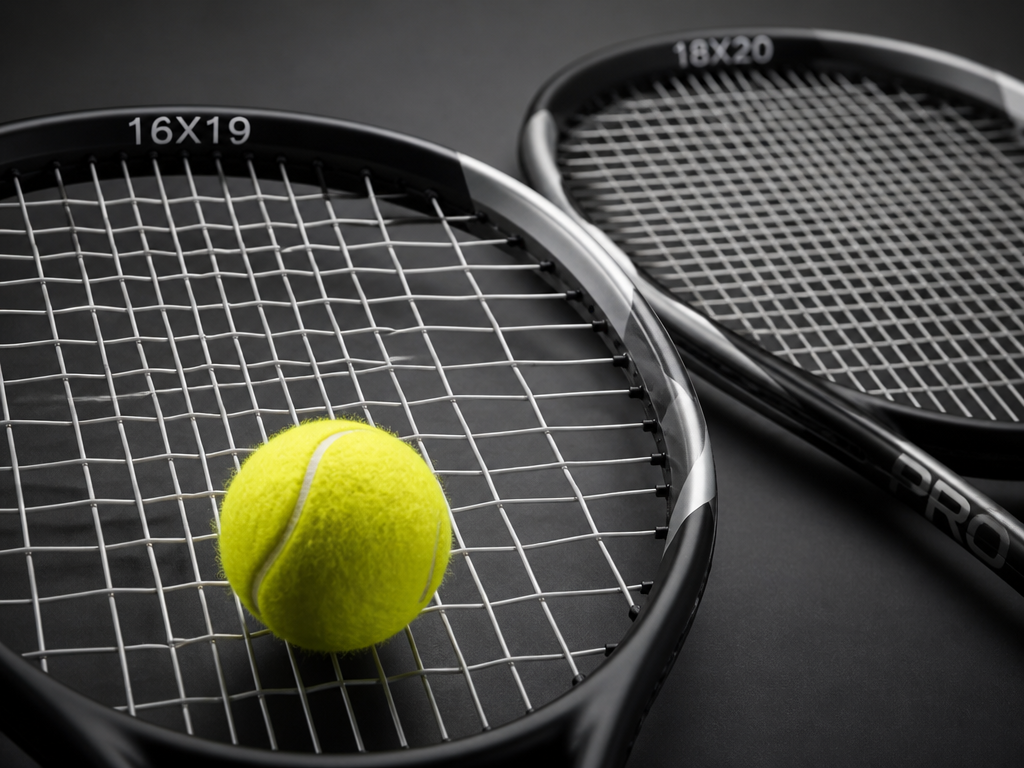
The advice you hear in every pro shop runs like this: beginners need power, advanced players want control, and spin is something you buy with an open string pattern. It gets repeated because it is easy to say and roughly half true. The trouble starts when you put two racquets side by side, find identical power ratings on the spec sheet, and notice they play nothing alike.
We spent three weeks measuring where that advice holds and where it quietly falls apart. Our verdict in one sentence: spin and control are not opposite ends of a single dial, and tennis racquet specifications describe the trade-off far better than any single power rating does — but only if you read the right numbers.
How we tested
We tested six racquets across two head sizes (98 and 100 sq in) and two string patterns (16x19 open and 18x20 dense), each strung with the same polyester at 50 lbs to isolate the frame and pattern rather than the string. Three intermediate hitters (NTRP 3.0–4.0) fed 40 forehands each per configuration from a ball machine set to a fixed feed, 60 mph, mid-court.
We logged two things with a phone-mounted radar and a slow-motion camera at 240 fps: outgoing ball speed, and rotations per second read off a marked ball. "Control" is harder to measure honestly, so we recorded a proxy — the spread of landing points inside a 3-meter target box, counted as a standard deviation in feet.
What we could not do: control for swing changes between configurations. Players adjust unconsciously, and three hitters is a small sample. Treat the directions as reliable and the exact magnitudes as indicative.
Where the common advice is roughly right
Two parts of the conventional wisdom survived contact with the radar gun.
First, larger head sizes do add forgiveness. The 100 sq in frames produced 4–6% more outgoing speed on off-center hits than the 98s, simply because the sweet spot sat further from the throat and the frame twisted less on mishits. For a developing player who misses the center often, that is real, measurable help.
Second, open string patterns did bite the ball more. Across our hitters the 16x19 frames generated an average of 7–9% more spin than the 18x20s with the same string and tension. The main strings in an open pattern have room to slide laterally and snap back, and our camera caught that snap. So the shop is not lying when it points a topspin-hungry player toward an open pattern.
Where it breaks down
Here is the part the slogan gets wrong: spin is not the opposite of control. Our most accurate configuration — the tightest landing spread — was an open-pattern 100 that also produced the most spin. Topspin pulls the ball down into the court, which is itself a form of control. A flat, low-spin shot has a smaller window; a heavily-spun one can clear the net higher and still land in. Calling spin a sacrifice of control confuses two different things.
The power rating fails harder still. Two of our 100 sq in frames carried the same "tweener" power label from different brands. They differed by 11% in measured ball speed and by nearly a full point of landing spread. Power ratings are brand-internal marketing, not a shared unit. They tell you roughly where a frame sits in one company's lineup and almost nothing about how it compares across the shelf.
What actually predicted ball speed in our data was not the rating but the combination of stiffness and stringbed openness. What predicted the landing spread was head size and static weight — heavier frames punished our mishits less in the dispersion numbers, because they plowed through contact instead of deflecting.
The comparison
| Configuration | Rel. ball speed | Rel. spin (rps) | Landing spread (ft, lower = tighter) |
|---|---|---|---|
| 98, 18x20 dense | Baseline | Baseline | 2.1 |
| 98, 16x19 open | +3% | +8% | 2.4 |
| 100, 16x19 open | +6% | +9% | 1.9 |
| 100, 18x20 dense | +5% | +1% | 2.3 |
Read the open-pattern 100 row carefully: most spin, most speed, and the tightest dispersion. That single line does more to dismantle the "spin costs you control" framing than any argument we could write. The dense 98, beloved of the control-racquet camp, was accurate but produced the least margin over the net — its tight spread came partly from players hitting cautiously.
The trade-off, restated honestly
The real tension is not spin versus control. It is predictability versus margin.
A stiff, open-patterned frame gives you margin — the ball curves down, clears the net, and forgives a high contact point. But the same liveliness makes the feedback noisier; small changes in your swing produce larger changes in outcome, and that is the "loss of control" players actually feel. A flexible, dense-patterned frame is quieter and more predictable, so your good swings repeat — but it offers a smaller built-in safety net and demands you supply the consistency yourself.
So the question is not "do I want spin or control." It is: do you want the racquet to supply margin, or do you want to supply it with your own technique and accept a quieter, more honest tool?
Who this is for, and who it isn't
Pick the open-pattern, mid-size-plus frame if you are still grooving your strokes, miss the center often, or play a topspin baseline game and want the ball pulling down into the court without perfect contact.
Pick the denser, more flexible frame if you already make consistent center contact, hit a flatter or more varied ball, and find lively frames spray on you — the predictability will reward repeatable technique more than it punishes you.
It does not matter much if you change strings and tension every few months. The stringbed swings spin and feel more than most frame swaps do, and our test deliberately froze that variable to prove the frame's contribution exists at all.
The honest version of the rule
The slogan "beginners need power, advanced players need control" should read: a developing player benefits from a frame that supplies margin — head size, spin potential, forgiveness on mishits — while a consistent player can trade that built-in margin for a quieter, more predictable tool. Spin lives on the margin side of that ledger, not the opposite side.
Evidence grade for the central claim — that spin and control are not opposed, and specs predict the trade-off better than power ratings — is Moderate. The directions were consistent across hitters; the sample was three players and the control proxy is imperfect.
One thing we still cannot answer cleanly: how much of measured spin comes from the stringbed snapping back versus the player's faster, steeper swing on a frame that simply feels like it grips. The biomechanics literature has not settled where the racquet stops and the swing begins. Until it does, the spin number on any spec sheet is describing a partnership, and we cannot yet say who is doing the work.