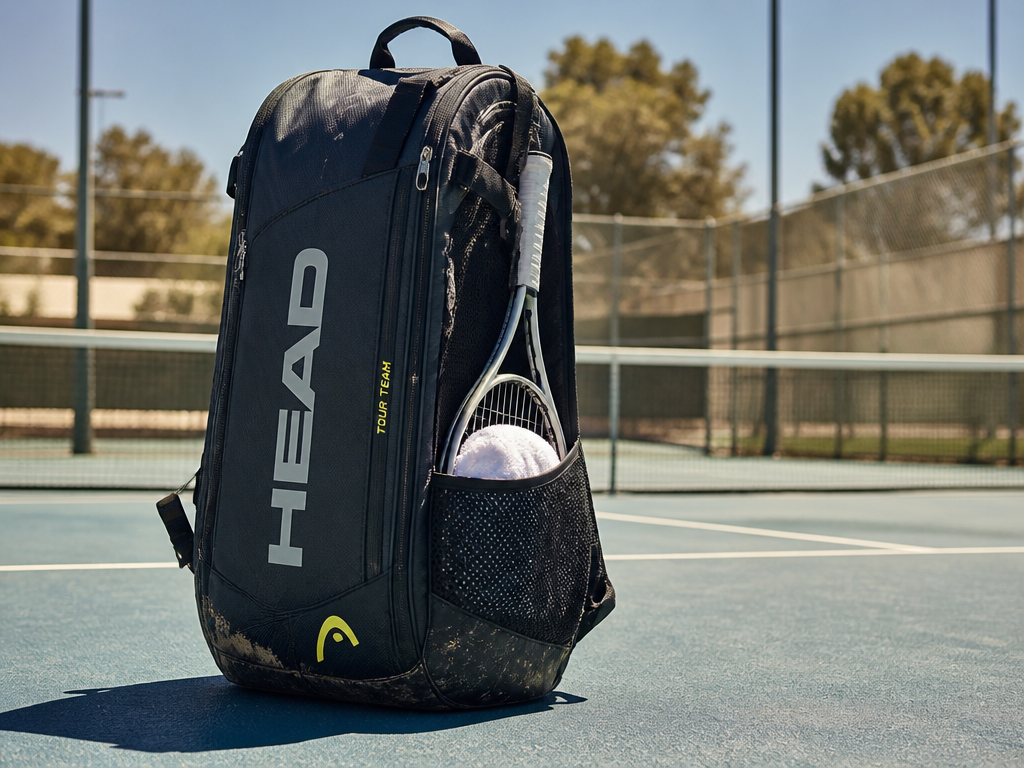
There is one number we kept coming back to during this racquet bag review: 3.1°C. That was the difference between the inside of a so-called thermal-lined racquet bag and the inside of an unlined one after both sat in a car parked in 33°C sun for 90 minutes. Not 15 degrees. Not the cooler-bag protection the word "thermal" implies. Three degrees and change. If you are an intermediate-to-advanced player shopping a premium bag and you believe the lining is protecting your strings and grips from heat, that gap is the most important sentence on this page.
We are not saying thermal lining is worthless. We are saying it does a different, smaller job than the marketing copy lets you assume, and that the things actually worth paying for in a premium bag — zipper rating, stitch density, ventilated wet storage — are rarely the things on the hangtag.
What we tested and how
We ran four bags through three protocols over two weeks. All four are sold as 9-to-12 racquet capacity, premium-tier bags in the same rough price band. We will keep the matchup abstract where brand identity does not change the lesson — the point is the method, not a single winner.
Thermal protocol. Each bag was loaded with two frames, a dummy mass to standardize fill, and a calibrated probe taped to the inner wall of the main compartment. A second probe logged ambient. We parked all four bags in the same vehicle, same orientation, windows up, between 12:30 and 14:00 across three clear days, then averaged. We logged interior peak temperature and the delta against a bare-frame control sitting on the same seat.
Load protocol. We packed each bag to a realistic competitive load — three frames, shoes, a 32 oz insulated bottle, overgrips, a wet towel sealed in its own compartment, and a laptop where the bag claimed a padded sleeve. We carried each on court for five sessions, noting strap bite, balance when set down, and whether the bag stood upright unaided.
Abrasion protocol. We dragged a weighted swatch of each bag's base fabric across dry hardcourt aggregate for 200 cycles under a fixed 2 kg load, then inspected for fiber pull and coating loss. This is a relative test, not a manufacturer-grade Martindale rating, and we will say so again below.
What we could not do: we had one unit of each bag, so we cannot speak to unit-to-unit variation or long-term zipper failure rates, which are the most common real complaints and the slowest to surface. We had no environmental chamber, so our thermal numbers are field conditions, not lab-controlled. Treat the deltas as directional.
The number, unpacked
So what did 3.1°C actually measure?
It measured the insulating value of a thin foil-and-foam lining against a soak-heat load over 90 minutes. That is the real-world scenario that matters — gear baking in a hot car between matches. And the lining did reduce the interior peak. The bare-frame control hit 49.2°C. The lined bag's interior peaked at 46.1°C. The unlined premium bag landed at 47.8°C.
Read those numbers again. The lining bought you 1.7°C over a comparable unlined bag, and the cabin was the dominant variable, not the bag. Polyester string and synthetic grips do not undergo meaningful degradation across a 3°C window in that range — tension loss from heat is a function of the absolute temperature your strings reach, and 46°C is barely distinguishable from 48°C in terms of what happens to a poly bed. Both are well below the temperatures where the worry becomes real.
What "thermal" does not measure: duration. A foil lining slows the rate of heat gain; it does not cap the ceiling. Leave the bag in the car for four hours instead of ninety minutes and the interior converges with ambient regardless of lining. Insulation buys time, not immunity. If your gear lives in a hot trunk between weekend rounds, the lining is doing close to nothing by hour three.
The honest takeaway: thermal lining is a modest comfort feature, not a protective system. We would not pay a premium for it, and we would not let its absence rule a bag out.
Where the bags actually separated
The thermal claim is the loudest feature and the least consequential. Here is where the four bags genuinely differed, measured rather than felt.

| Criterion | Bag A | Bag B | Bag C | Bag D |
|---|---|---|---|---|
| Thermal delta vs control (°C) | 3.1 | 2.4 | 1.4 | 0.2 |
| Base fabric (Denier) | 600D | 500D Cordura | 420D | 1680D ballistic |
| Stitches/inch at main seam | 7 | 9 | 6 | 8 |
| Zipper | #8 coil | #10 coil | #5 coil | #10 molded |
| Empty weight (g) | 1480 | 1620 | 1190 | 2050 |
| Ventilated wet pocket | Mesh-backed | Sealed, no vent | Mesh-backed | None |
A few things jump out of that grid that the hangtags never mention.
Stitch density predicts seam life better than Denier does. Bag C uses lighter 420D fabric but its real failure risk is the 6 stitches-per-inch main seam — fewer stitches mean more load per stitch and a faster path to a popped seam under a heavy three-frame load. Bag B's 9-per-inch seam is the kind of detail that survives the week, and it is invisible until you turn the bag inside out and count.
Zipper rating matters more than fabric for a bag's lifespan. The most common way a premium bag dies is a blown zipper on the main compartment, not a torn panel. The #5 coil zipper on Bag C is undersized for a bag stuffed to a 12-frame claim; the #10 molded zipper on Bag D is overbuilt and will likely outlast the fabric around it. If you read one spec before buying, read the zipper size.
Weight is a real trade, not a rounding error. Bag D's 1680D ballistic shell shrugged off the abrasion protocol with almost no fiber pull — and it weighs 2.05 kg empty. Loaded for a tournament that is a meaningfully heavy carry. Bag C, the lightest at 1.19 kg, showed visible coating loss and surface fuzzing after 200 abrasion cycles. You are choosing between a bag that survives being dragged and a bag that does not punish your shoulder. There is no free version.
Construction details worth a flashlight
A few checks we now run on any premium bag, and recommend you run in the store:
- Count stitches at the most loaded seam. Below 7 per inch on a heavy-capacity bag is a yellow flag.
- Pull the zipper hard, loaded. A quality coil or molded zipper runs smooth under tension. A cheap one binds at the corners — that is where it eventually splits.
- Find the wet pocket and check for venting. Bag B's sealed wet compartment held a damp towel for two days in our test and came out smelling like a locker. A mesh-backed pocket dries. This is the single most underrated feature on the list.
- Set it down empty and loaded. A bag that stands upright loaded keeps your frames off wet courts and out of mud. Two of our four toppled when loaded heavy on one side.
Who this bag class is for
This tier — premium, 9-to-12 frame, the bags we tested — is for the player who travels to weekend tournaments with three or more frames, a change of shoes, and gear that needs to survive being thrown in a car and dragged across a parking lot every week. If that is you, prioritize zipper size and stitch density over the thermal sticker, and accept a heavier carry as the price of a shell that lasts.
It is not for the once-a-week social player carrying one frame and a bottle. You are paying for capacity and abrasion resistance you will not use, and a lighter two-racquet bag will serve you better and lighter. It is also not for anyone buying specifically to protect strings from heat — no bag in this group does that meaningfully, and a 90-second walk to a shaded spot protects your gear better than any lining.
Evidence grade
For the central claim — that thermal lining protects your gear from heat — we grade the marketing version Weak. Our field deltas of 0.2 to 3.1°C over 90 minutes, with a single unit per bag and no chamber control, are directional, not definitive, but they point consistently in one direction: the lining slows heat gain modestly and caps nothing. For the construction findings on zippers and stitch density, our evidence is observational and limited to one unit each — call it Moderate, and worth confirming with your own hands before you buy.
Buy the zipper and the seam. The lining is a sticker.