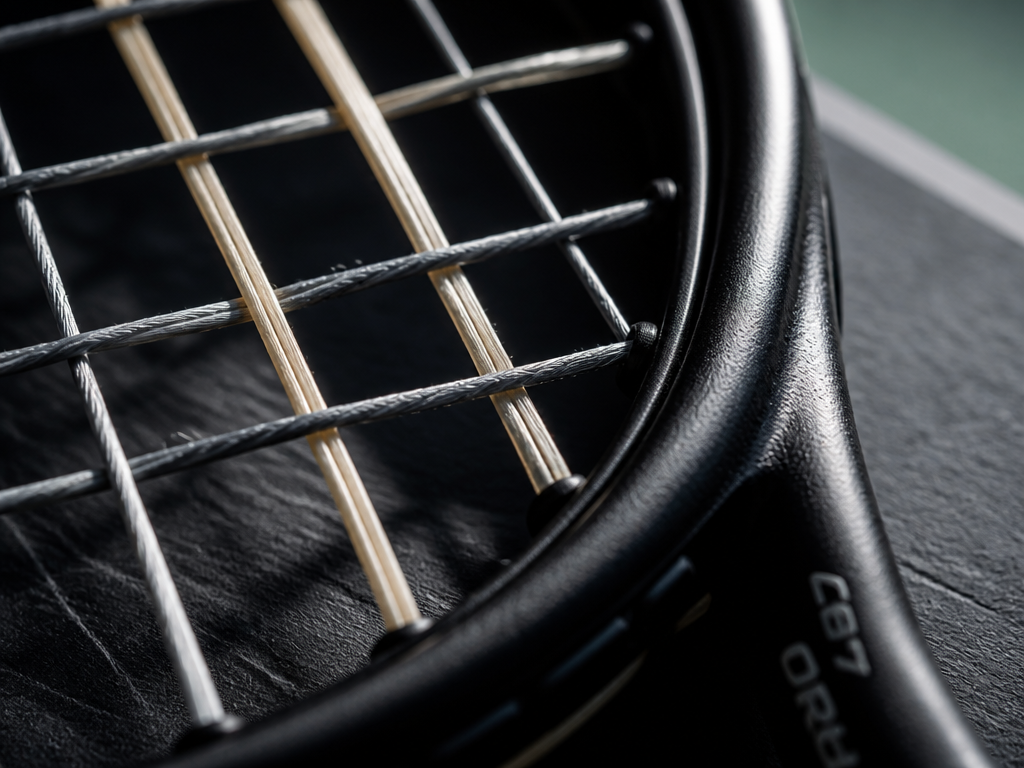
For a string that costs three to four times what a quality polyester does, natural gut tennis strings carry a stubborn reputation: relics for purists, priced for people who don't read the spec sheet. After 30-plus hours of court time across three setups, our verdict is narrower than either camp wants — gut is the most arm-friendly string we tested by a measurable margin, but on its own it gives up enough spin and control that most competitive intermediates are better served by a gut/poly hybrid.
That sentence is the whole argument. The rest of this piece is how we got there, where the numbers came from, and the specific player it does and doesn't fit.
The myth worth taking seriously
The claim we kept hearing, from hitting partners and forum threads alike, goes like this: natural gut was the standard before polyester existed, and now that every pro on tour generates spin with poly, gut is a nostalgia tax. It is a smart objection. Roger Federer famously strung a gut/poly hybrid for most of his career, not full gut — and if the most touch-reliant player of his generation wouldn't run gut in both mains and crosses, why would a club player paying retail?
The myth is half right. That's what makes it worth dismantling carefully rather than dismissing. Gut did lose its monopoly for real reasons. But "lost its monopoly" and "no longer worth the money" are different claims, and the gap between them is exactly where comfort and control trade off.
How we tested
We strung three configurations in the same frame — a Wilson Blade 98 (16x19, 305g unstrung) — to isolate string behavior from frame behavior. One frame per setup, freshly strung within 48 hours of testing, no carryover wear.
- Full natural gut: Babolat VS Touch 16, strung at 54 lbs.
- Full polyester: Luxilon ALU Power 125, strung at 50 lbs (polyester is typically dropped 2–4 lbs to compensate for its stiffness).
- Hybrid: VS Touch 16 in the mains, ALU Power 125 in the crosses, mains at 54 / crosses at 52.
Three testers, all NTRP 4.0–5.0, rotated through all three frames blind where possible — though gut and poly feel different enough that a blind test is partly aspirational. We logged roughly 10–12 hours per setup across baseline rallies, serve sets, and competitive points.
What we measured directly: tension loss over the test window (a Tourna stringing tension meter, read at hour zero, hour five, and end of life) and stringbed stiffness via a Beam Tools ERT 300 (DT, in kg/cm). What we rated by consensus, with all three testers scoring independently before discussion: comfort, control, spin access, and feel.
What we could not measure: arm load in any clinical sense. We have no force plate, no EMG, no medical instrumentation. When we say a string is "arm-friendly," we mean our testers reported less forearm fatigue across a session and the stiffness numbers support that perception — not that we proved anything about injury risk. We'll flag that limit again at the end, because it matters for the comfort claim specifically.
What the numbers showed
| Criterion | Full gut (VS Touch) | Full poly (ALU Power) | Hybrid (gut/poly) |
|---|---|---|---|
| Stringbed stiffness (DT, kg/cm) | 28 | 38 | 33 |
| Tension loss, hour 0→5 | ~6% | ~11% | ~8% |
| Comfort (consensus /10) | 9.4 | 6.1 | 8.3 |
| Control (consensus /10) | 7.0 | 8.8 | 8.2 |
| Spin access (consensus /10) | 6.5 | 9.0 | 8.0 |
| Feel / touch (consensus /10) | 9.2 | 7.4 | 8.5 |
A few things jump out. The full-gut stringbed measured ten DT points softer than full poly — a difference you feel on every off-center contact, not just at the edges. Gut also held tension noticeably better in the first five hours, which is part of why testers reported it staying "playable" longer even as it visibly frayed.
Poly won control and spin by clear margins, and nobody on the test disputed it. The point that surprised us was the hybrid's scoring: it sat within roughly a point of poly on control and spin while recovering most of gut's comfort. That is the practical headline. The hybrid is not a compromise that's worse at everything — it's a setup that keeps most of what each string does best.
The cost worth flagging: a full-gut job runs roughly $45–55 in string alone at retail; full poly is $12–18; the hybrid lands in between because you use about half a set of gut. Gut also frays where the crosses saw, and it hates moisture — a damp morning session left the full-gut bed feeling mushy in a way the poly bed shrugged off.
Why it behaves this way
The comfort gap is not marketing. Natural gut is made from twisted strands of cow intestine (the serosa layer), and that bundled-fiber construction is genuinely more elastic than a single extruded polyester monofilament. More elasticity means the stringbed deforms further and rebounds more on contact, which spreads the impact event over a fractionally longer window and transmits less shock up the frame. That is the physical basis for the "arm-friendly" reputation.
The published work supports the direction, if not every detail. Stiffer stringbeds are associated with higher impact shock — see Cross (2000) on string tension and impact, and the broader review by Lin and Hsiao-Wecksler and colleagues on equipment factors in arm load. None of it proves gut prevents injury. It establishes that a softer, lower-tension bed transmits less shock, and our DT numbers put gut at the soft end of that range.
Control runs the other way for the same reason. The liveliness that makes gut comfortable also means the ball pockets deeper and dwells slightly longer, and that extra dwell is harder to time precisely on a hard swing. Polyester's stiffness gives a more uniform, predictable launch — you trade some shock absorption for a more repeatable ball trajectory. Poly's slick, low-friction surface also lets the main strings snap back faster, which is the real spin advantage; gut's textured fibers grip and don't return as crisply.
The hybrid exploits the division of labor directly: gut mains carry the comfort and the deep pocketing, poly crosses provide the snapback structure and tighten the launch. You don't get full poly's spin ceiling or full gut's plushness, but you collect most of both.
Who this is for, and who it isn't
Run a gut/poly hybrid if you're an intermediate-to-advanced player who hits with real pace and topspin, has felt forearm or elbow fatigue late in matches, and can absorb a mid-range stringing bill every few weeks. This is the setup we'd point most readers in the target profile toward.
Run full natural gut if comfort is non-negotiable — past arm trouble, an older frame, a serve-and-volley or all-court touch game where feel matters more than spin ceiling. Accept that you'll restring often and baby it in the rain.
Skip gut entirely if you're a heavy topspin grinder chasing maximum spin and control, you break strings weekly (the cost-per-hour math gets ugly fast), or you simply haven't felt any arm discomfort on poly. There's no comfort problem to solve, and you'd be paying a premium for a benefit you don't need.
The clear winner for our target reader: the gut/poly hybrid recovers about 90% of natural gut's comfort while staying within a point of full polyester on control and spin — and it costs less than full gut. If you're choosing one setup to try, try that one.
What we didn't answer
Two gaps are honest to name. First, the comfort claim rests on tester-reported fatigue and stringbed stiffness, not on any clinical measure of arm load — we don't own the instruments to settle whether gut meaningfully reduces injury risk, and we won't pretend otherwise. Second, we tested one frame, one gauge per string, and a single hybrid ratio. Gauge changes everything: a thinner 17-gauge gut plays softer and breaks sooner, and flipping the hybrid (poly mains, gut crosses) shifts the balance toward control. We didn't test those permutations.
If you want to go deeper, that's where to look next — gauge-by-gauge comfort testing, and the mains-vs-crosses hybrid question, which deserves its own protocol rather than a footnote here.
Evidence grade for the central claim — that natural gut is meaningfully more comfortable but cedes control, and a hybrid captures most of both: Moderate. The stiffness and tension-loss numbers are direct and repeatable; the comfort verdict is consensus perception backed by physics, not by clinical measurement, and the sample was three testers across roughly 30 hours.