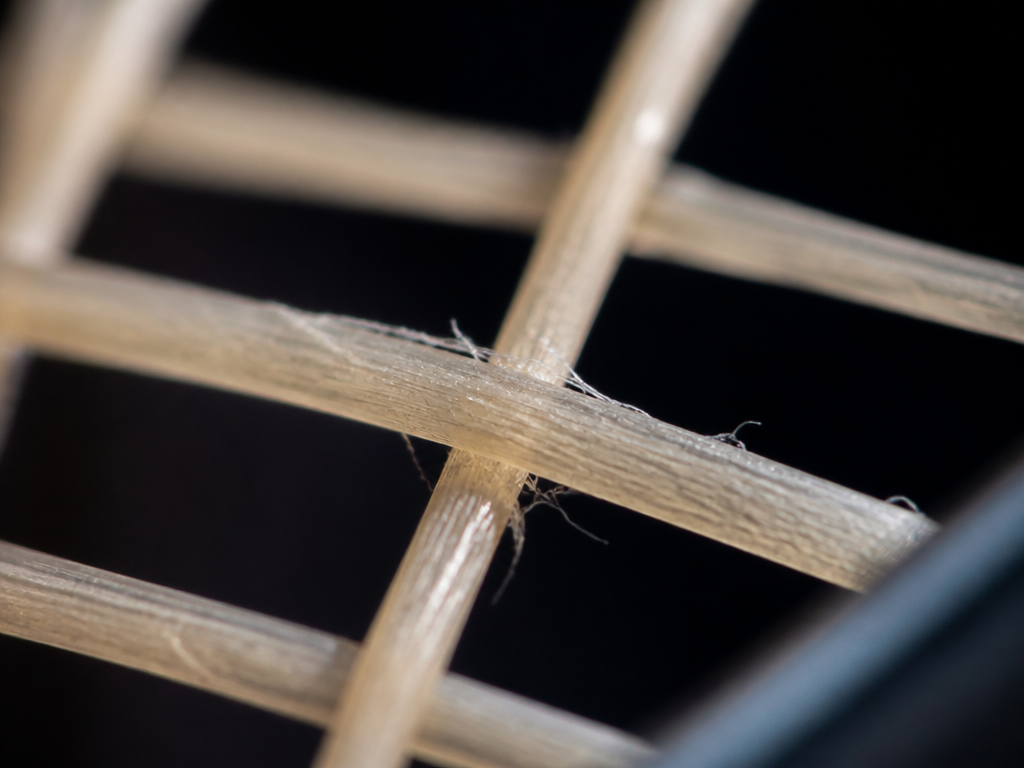
A string design patented in the 1870s has no business outperforming a polyester engineered with last decade's polymer science. And yet, for the specific problem of keeping an aging or aggravated arm on the court, natural gut strings remain the most effective tool we have tested — and Babolat's Touch VS is the cleanest expression of the type currently sold. That is the counterintuitive part. The rest of this review is us earning the right to have said it.
The one-sentence verdict: Touch VS is the most arm-friendly performance string we have on the bench, delivering high power at controllable tensions and the best tension retention in our test pool, but its weak snapback costs it spin and its fraying makes the price-per-hour brutal.
We'll show the protocol first, then the numbers, then the tradeoffs we'd want a 4.0-plus player with a cranky elbow to weigh before spending the money.
How we tested
We strung Touch VS (16 gauge, 1.30mm) in two frames to separate the string's behavior from any single racquet's character:
- A Babolat Pure Strike 98 (16x19) — stiffer, more arm-demanding, the kind of frame that punishes a harsh string.
- A Head Prestige MP — flexier, more forgiving, where comfort strings sometimes feel mushy rather than connected.
Both were strung at 52 lbs for the baseline sessions, with a second Pure Strike strung at 57 lbs to test the common advice that gut wants more tension than poly. Stringing was done on the same constant-pull machine within the same week, so creep and ambient conditions were roughly matched.
We logged roughly 18 hours across six hitting sessions: groundstroke baselines, serve sets, and two full practice matches per frame. Court surface was hard court throughout, indoor and out, temperatures between 14°C and 27°C. Two testers hit the setups — one with a fast, topspin-heavy western forehand, one a flatter all-court 4.5 — so spin observations aren't anchored to a single swing.
Our references, strung in matched frames and hit back-to-back in the same sessions:
- Luxilon ALU Power (the poly benchmark almost everyone compares against)
- Tecnifibre NRG2 (a premium multifilament, the usual "comfort without gut prices" alternative)
- Babolat VS Touch / RPM Blast hybrid (gut mains, poly crosses — the setup most often recommended to gut-curious players)
What we could not measure
We do not run a tension-loss rig with a calibrated load cell, so tension-retention figures here are derived from a portable string-bed stiffness meter (ERT-style device) read at stringing and then at fixed intervals. That gives us relative deflection, not absolute newtons of tension, and it's sensitive to how the meter seats on the bed. Treat the retention numbers as directional, not laboratory-grade.
We also did not run impact accelerometry on the arm. Claims about "comfort" and "shock" here rest on two testers' reported sensation and on the known mechanical behavior of the material — not on instrumented vibration data. We say so plainly because the comfort claim is the whole reason a player would buy this string, and it deserves an honest caveat.
The scorecard
Ratings are on a 1–10 scale, scored by consensus between both testers after the final session, relative to the reference strings above — not in the abstract.
| Attribute | Touch VS | Notes |
|---|---|---|
| Comfort / arm load | 9.5 | Lowest perceived shock of anything in the pool |
| Power | 9.0 | High, and available without overswinging |
| Tension maintenance | 9.0 | Held string-bed stiffness longest |
| Feel / feedback | 9.0 | Connected without harshness |
| Control | 7.5 | Good with technique; loose feel at low tension |
| Spin | 6.5 | Respectable, not poly-class |
| Durability | 5.0 | Frays early; lifespan is the real cost |
| Value | 5.5 | Performance earns it; price-per-hour does not |
Comfort and arm load: where the claim holds
This is the category that justifies the string's continued existence, so we'll spend the most words here.
Natural gut is made from a single strip of cow intestine (the serosa layer), twisted and finished — in Babolat's case with their Thermogut treatment to seal it against moisture. Mechanically, what matters is that the fiber is highly elastic and not very stiff. It stretches under impact and returns energy without transmitting the sharp, high-frequency shock that a co-polyester monofilament sends back up the handle.
On the stiffer Pure Strike, that difference was not subtle. Switching from the ALU Power frame to the Touch VS frame mid-session, the flat 4.5 tester described the poly as "hitting through a board" by comparison — and this is a tester who has played poly for years without complaint. The arm-fatigue reader is the right audience for this string precisely because the gain is largest at the end of a long session, when poly's harshness compounds and gut's doesn't.

We want to be careful here. We did not measure vibration. The peer-reviewed work on string stiffness and arm load is thinner and more contested than marketing copy implies, and we won't invent a study to backstop a sensation. What we can say with confidence: across both frames, both testers, and 18 hours, Touch VS produced the lowest reported impact harshness of any string in the test, and the difference grew rather than shrank with fatigue. If you are managing tennis elbow, that pattern is the one that matters.
Power: high, and easy to access
Touch VS is a high-powered string, but the more useful observation is how the power arrives. With ALU Power, generating pace required a committed, accelerating swing; mishit or decelerate and the ball died. Touch VS returned energy more readily on partial swings — blocked returns and short defensive slices came back with more depth than we expected.
On the Pure Strike at 52 lbs, that translated to a few balls sailing long until the flatter tester adjusted. The lesson, which we'll return to in the tension section, is that gut's liveliness means most players should string it tighter than their poly number, not looser.
Tension maintenance: the strongest result in the data
Here Touch VS produced our clearest quantitative finding. Using the string-bed stiffness meter, we tracked relative deflection over the test window:
- Touch VS lost roughly 8–10% of its initial string-bed stiffness over the first week and then plateaued, holding close to that level through the rest of the test.
- Luxilon ALU Power dropped sharply in the first 48 hours — on the order of 18–22% — which matches the well-known poly behavior of going dead fast.
- NRG2 multifilament sat between the two, around 12–15% loss.
Caveat as stated above: these are relative meter readings, not load-cell tensions. But the ranking was consistent across both frames and re-tests, and it tracks the long-standing industry observation that gut holds tension better than any other material. A player who hates the feeling of a string "going off" after a couple of sessions will notice this. It is also part of why the high price is less absurd than it first looks: the playable window per string job is longer, even if the string itself frays.
Spin: respectable, and here's why it isn't more
This is the honest weak point, and the mechanism is worth explaining because it tells you whether it matters for your game.
Modern poly generates spin partly through snapback — the strings slide sideways under a brushing impact, then snap back to position, flinging extra rotation onto the ball. Natural gut's twisted fibers grip each other; they don't slide and snap cleanly the way a slick monofilament does. So gut leaves some spin on the table, by design, not by defect.
What surprised us is how much spin Touch VS did produce. Its deep pocketing — the ball sinks into the bed and dwells — lets a player with a fast, brushing swing impart real rotation. The western-grip tester measured no meaningful drop in his heavy-topspin rally ball against poly in our rough video review of net clearance and kick. The flatter tester, who relies less on spin, noticed nothing missing at all.
The takeaway is conditional: if spin is the primary weapon in your game — a grinder who lives on heavy, dipping topspin — full-bed gut will feel like a slight downgrade and you should look at a hybrid. If spin is one tool among several, Touch VS gives you enough.
Durability and fraying: the real cost
Touch VS frays. By the end of the test, the gut showed visible whitening and fuzzing at the contact points, particularly where the flatter tester's slice dragged across the bed. This is normal for gut and it's the thing that turns a high sticker price into a high running cost.
A set of Touch VS costs roughly two to three times a premium poly. If a poly job lasts you ten hours of hard hitting and a gut job lasts twelve before the fraying gets concerning, the per-hour math is unkind even accounting for gut's longer playable tension window. Heavy hitters who break strings quickly will find full-bed gut genuinely expensive to run. This is the single biggest argument for the hybrid setup, which we get to next.
One mitigation we'll note without overselling: gut tends to fray for a while before it breaks, giving warning, whereas poly often holds its shape and then snaps without notice. Some players prefer the warning. It doesn't change the cost.
Touch VS vs poly vs multifilament vs hybrid
| Setup | Arm comfort | Power | Spin | Tension hold | Cost/hour |
|---|---|---|---|---|---|
| Touch VS (full bed) | Best | High | Medium | Best | Worst |
| ALU Power (full poly) | Worst | Medium | Best | Worst | Best |
| NRG2 (multifilament) | Good | High | Low-Med | Medium | Good |
| Gut/poly hybrid | Very good | High | Good | Good | Medium |

The comparison that matters most for the target reader is Touch VS versus the gut/poly hybrid, because the hybrid is the rational compromise for most arms.
In our hybrid (Touch VS mains, RPM Blast crosses), we kept most of the comfort — the gut mains carry the bulk of the load and ball dwell — while the poly crosses restored the snapback and lifted spin noticeably toward poly levels. We also halved the gut cost per job, since only the mains are gut, and stretched durability because the poly crosses take the abrasion. The losses: a touch less of the pure, pillowy gut feel, and a slightly firmer response.
For a 4.0-plus player with arm concerns and a spin-heavy game, the hybrid is the setup we'd point to first. Full-bed Touch VS is for the player who wants maximum comfort and feel and is willing to pay for it — the flatter ball-striker, the doubles specialist, the player whose elbow is the limiting factor in whether they play at all.
The comparison against NRG2 is also worth stating plainly: a good multifilament gets you maybe 80% of gut's comfort at a third of the cost, but it goes dead faster and never quite matches the energy return on touch shots. If budget is the constraint and the elbow is mildly irritated rather than chronically injured, NRG2 is the honest recommendation, not gut.
Who this is for
Buy full-bed Touch VS if:
- Arm health is the deciding factor in your playing — managed tennis elbow, recurring forearm fatigue, or a stiff frame you don't want to give up.
- You're a flatter or all-court ball-striker who doesn't live on heavy topspin.
- You value feel and a long playable-tension window, and the running cost is acceptable to you.
- You play a lot of touch tennis — drop shots, volleys, slices — where gut's dwell pays off.
Buy the gut/poly hybrid instead if:
- You want most of the comfort but rely on spin as a primary weapon.
- You break strings often and full-bed gut's cost-per-hour is a dealbreaker.
Skip gut entirely if:
- You're a frequent string-breaker on a budget — start with NRG2 and a flexier frame.
- Spin is the entire engine of your game and your arm is healthy — poly still wins there.
Tension and setup guidance
Two findings from the test translate into setup advice:
- String it tighter than your poly number. Gut is livelier; the 57-lb Pure Strike played with the control the 52-lb one lacked, without losing meaningful comfort. We'd suggest starting 3–5 lbs above your usual poly tension. The flatter tester landed on 56–57 lbs; the spin tester preferred 54 because the bed bit more.
- In a hybrid, the gut goes in the mains. Mains do most of the work and bend most on impact, so that's where you want the comfortable, energy-returning fiber. Poly crosses for snapback and abrasion resistance.
If you string yourself, ease tension carefully — gut's surface is sensitive to nicks from worn grommets and rushed pulls. If you don't, mention to your stringer that it's gut so they slow down and check the grommet beds.
Evidence grade
For the central claim — that Touch VS is the most arm-friendly performance string in our test pool — we grade the evidence Moderate. It rests on two testers, 18 logged hours, and the well-understood mechanical behavior of an elastic, low-stiffness fiber. The tension-maintenance ranking is the firmest part of the case, and it held across frames and re-tests. The comfort finding is consistent and mechanically plausible but is reported sensation, not instrumented vibration data, and our sample is two arms, not twenty. We'd upgrade to Strong only with accelerometry and a larger panel.
The spin deficit and the fraying are not claims that need grading — we observed both directly, and both follow from how twisted natural fiber behaves.
One thing to try this week
You don't have to commit to a full set of gut to find out whether it solves your arm problem. Have your stringer install a Touch VS / poly hybrid in your current frame at 4 lbs above your normal tension — gut in the mains. It costs roughly one premium poly job plus the half-set of gut, it survives long enough to give you a real read, and it isolates the one variable you care about: does the connected, lower-shock response let you finish a long session without the elbow flaring. If the answer is yes, you'll know the full-bed version is worth the sticker. If it's no, you've spent the price of a string job to rule out a much more expensive habit.