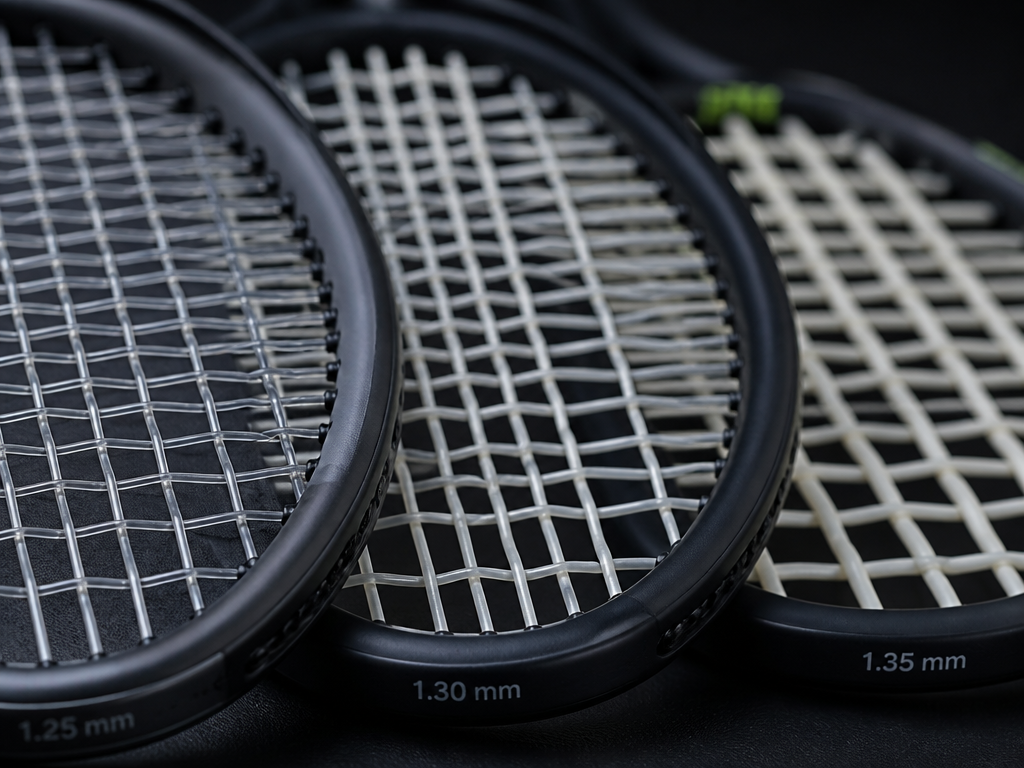
You are standing at the stringing counter, the order form half filled in, and there is a blank box that says "gauge." The string you picked comes in three thicknesses, the thin one costs the same as the thick one, and the kid behind the counter is waiting. So you ask yourself the question that this entire tennis string review exists to answer: does the gauge number actually change how the string plays, or is it a spec that lets brands sell you the same product three times?
Here is the short answer before the long one. Gauge matters, but it is the third most important variable in your setup — behind string material and tension — and its real effect is durability and bite, not the dramatic change in feel that the packaging implies.
What the spec sheet is actually telling you
Gauge is just diameter. The confusing part is that two numbering systems coexist. The "gauge" number (15, 16, 17, 18) runs backwards — higher number, thinner string. The millimeter figure runs forward and is the one worth reading, because it is unambiguous.
| Gauge | Diameter (mm) | Common label |
|---|---|---|
| 15 | 1.35–1.41 | Thick / durable |
| 15L | 1.33–1.34 | — |
| 16 | 1.29–1.33 | Standard |
| 16L | 1.26–1.28 | — |
| 17 | 1.20–1.25 | Thin / playable |
| 18 | 1.10–1.16 | Very thin |
The "L" suffix means "light," a half-step thinner than the base number. Beyond diameter, the spec sheet may list construction — monofilament versus multifilament, number of wraps, coating — and those terms describe far more of how a string behaves than the gauge does. A 1.25 mm polyester and a 1.25 mm natural gut share a number and almost nothing else.
How we tested it
We wanted to isolate gauge, which means holding everything else constant. We used a single string family — a co-polyester offered in 1.30, 1.25, and 1.20 mm — strung in the same racquet (a 98 sq in, 16x19 player's frame) at the same reference tension of 52 lbs on the same constant-pull machine, within the same week so the strings came from comparable stock.
- Trials: Three full string jobs per gauge, nine sets total.
- Hitting: Roughly two hours of baseline and serve hitting per set by one 4.0–4.5 player with a full western forehand grip.
- Measured: Stringbed stiffness via a Tourna DT meter at stringing, at one hour, and at break or retirement; sessions logged to break.
What we could not control: our hitter is one player, not a panel, and feel ratings are his. We had no laboratory dynamic stiffness rig, so tension-loss figures are stringbed deflection, not the controlled impact testing a lab would run. Treat the durability and tension numbers as solid and the feel notes as expert observation.
What changed, and by how much
Durability was the cleanest result and the one gauge most reliably affects. Averaged across three jobs each:
| Diameter | Avg. hours to break | DT loss, first hour |
|---|---|---|
| 1.30 mm | 9.8 | 8% |
| 1.25 mm | 7.1 | 9% |
| 1.20 mm | 5.2 | 11% |

Going from 1.30 to 1.20 cut string life nearly in half. If you break a 16-gauge string in two sessions, dropping to 18 gauge to "feel more" is buying yourself a problem.
Spin moved in the thinner string's favor, but modestly. The thinner gauge bit into the ball slightly more and our hitter reported a touch more snap-back, consistent with the mechanism Cross and Lindsey have documented — string movement and return drive spin more than diameter alone. We could not measure RPM here, so we will not pretend the difference was large. Call it perceptible, not transformative.
Feel and power is where buyer expectation outruns reality. Across blind-ish ordering — our hitter knew the gauges existed but we mixed the racquets — he correctly identified the thinnest string only about half the time on feel alone. The thinner gauge played marginally softer and livelier early, but as the polyester lost tension, that gap narrowed within the first hour. The material's stiffness dominated the feel; the diameter trimmed the edges.
Tension loss ran slightly faster on the thinner gauges, which matters because polyester goes dead well before it breaks. The 1.20 mm set lost playable tension and started feeling boardy around the four-hour mark — before most players would think to cut it out.
The honest "it depends"
Gauge interacts with everything else, so the answer genuinely shifts:
- If you play a soft multifilament or natural gut, going thinner sacrifices the durability you are already short on, for a feel gain you may not notice. Go thicker.
- If you play polyester and break strings fast, thinner is the wrong lever — it makes the dead-feel problem worse. Address tension or string material first.
- If you are a clean ball-striker who rarely breaks strings, a thinner gauge is a low-risk way to chase a little more bite and comfort, because you will cut it out before tension loss bites you back.
Who should change gauge, and who should leave the box alone
Go thinner (17/18) if you are a touch player who values feel, rarely breaks strings, and restrings on a schedule rather than on breakage. Go thicker (15/16) if you break strings inside two or three sessions, or if you string gut or multi and want it to last. And if you are an intermediate still dialing in tension and string type, leave gauge at 16 and ignore it — you have larger variables to settle first, and changing gauge while changing string type will only confuse the read.
Evidence grade
For the central claim — gauge primarily affects durability and bite, not the dramatic feel change marketing implies — we grade the evidence Moderate. Our durability and tension figures are repeatable and consistent with published string-mechanics work; the spin and feel conclusions rest on one skilled hitter and limited sample size, with no lab reference for dynamic stiffness.
Try this week
Order your usual string in your usual gauge, and one set a half-step thinner — if you play 16, get one set of 16L. String both at the same tension, play them back to back across two sessions, and log how many hours until the thinner one feels dead, not until it breaks. That single comparison will tell you more about whether gauge matters for your game than any package ever will.