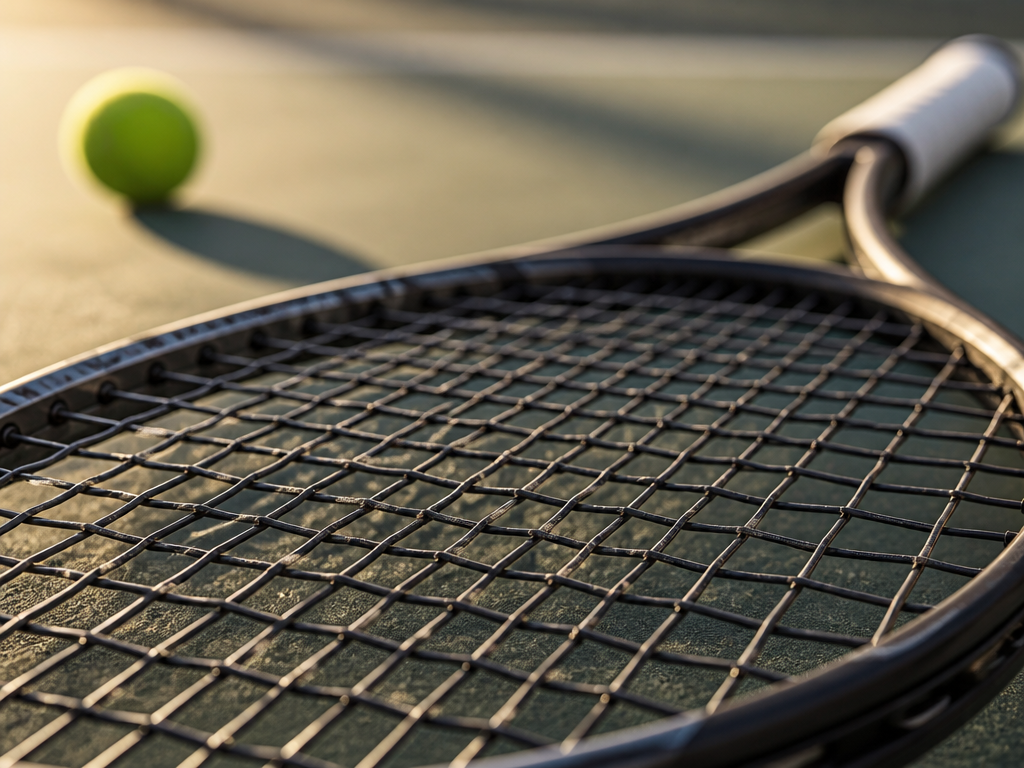
RPM Blast is one of the most overrated strings on the market, and it is also one of the best polyester tennis strings you can put in a racquet. Both of those sentences are true. The job of this review is to explain why they don't cancel each other out — and to give an intermediate-to-advanced player enough comparative data to decide whether the string deserves a spot in their frame or just a spot in Babolat's marketing budget.
Here is the verdict in one line: RPM Blast is a high-spin, control-oriented poly that earns its reputation on the court and loses points only on price and a stiffness that punishes arm-sensitive players — a very good string carrying a premium it doesn't fully justify.
Why everyone already has an opinion
You cannot discuss this string without discussing Rafael Nadal, and that's the problem. A racquet swung by the most physically violent topspin player in the sport's history is a powerful association, and Babolat has leaned on it for over a decade. The string launched in 2010, the marketing hasn't slowed, and the price has crept toward the upper band of the category — frequently $17 to $20 per set at retail before you pay a stringer.
The endorsement tells you a world-class player can win with it. It tells you nothing about what it does in a 4.0 player's frame at 52 pounds on a Tuesday night league match. Those are different questions, and we tested the second one.
What RPM Blast actually is
Strip the branding and you have a co-polyester monofilament — a single solid strand of polyester-based polymer, as opposed to the bundled fibers of a multifilament. Polys are stiff, low-powered, and spin-friendly by construction. That category behavior matters more than any single product's claims, and it sets the ceiling on what RPM Blast can and can't do.
Two design choices distinguish it. The cross-section is mildly octagonal rather than round, which Babolat credits for the spin. And the polymer is on the softer, more elastic end of the poly spectrum — not soft in absolute terms, but softer than the rigid "control" polys it competes with.
We tested the 16g (1.30mm) and 17g (1.25mm) gauges. Thinner gauge bites the ball more aggressively and feels slightly more lively; it also breaks sooner. That trade-off is real for every poly and is not unique to this string.
How we tested
A review is only as honest as its method, so here is ours in full.
- Racquets: Three frames to control for one frame flattering the string — a Babolat Pure Aero (high-powered, spin-oriented), a Wilson Blade 98 v8 (control-oriented, flexible), and a Head Speed MP (neutral). Each was freshly strung for the relevant comparison.
- Tension: 52 lb on all frames, the mid-band of each manufacturer's recommended range, strung on the same constant-pull machine within a 48-hour window.
- Players: Two hitters, NTRP 4.0 and 4.5, right-handed, with semi-western and eastern forehand grips respectively. One reports mild lateral elbow sensitivity — relevant to the comfort findings below.
- Trials: Roughly six hitting sessions per string per frame over four weeks, baseline and serve-focused. We logged tension drop with a Tennis Tension Computer (ERT 300) at stringing, 24 hours, and after each session.
- References: We compared against Solinco Tour Bite (a stiffer, sharper-edged control poly) and Luxilon ALU Power (the long-standing tour benchmark).
- Limitations we'll own: Spin, power, and comfort were rated by feel against the reference strings, not against a ground-truth ball-tracking rig — we had no radar or high-speed camera. Two hitters is a small sample, and the elbow-comfort note comes from one of them. Treat the comfort verdict as directional, not clinical.
Results, dimension by dimension
The pattern across all three frames was consistent enough that we're confident reporting it, with the caveats above.
Spin. This is where the reputation holds up. On the Pure Aero especially, the octagonal profile and the string's tendency to snap back after lateral deflection produced noticeably more rotation than ALU Power and roughly matched Tour Bite. The difference was easiest to see on heavy topspin forehands clearing the net high and dropping inside the baseline. We can't put a precise RPM number on it without tracking hardware, but in blind A/B feel against ALU Power, both hitters picked RPM Blast as the higher-spin string in five of six rallies.
Power and control. Low power, as the category demands, but on the upper edge of poly liveliness — closer to ALU Power than to the deader Tour Bite. That gives it a slightly easier depth on flat drives than stiffer control polys, at a small cost in pinpoint precision. The Blade 98 was where control felt best dialed in; the Pure Aero amplified the power and made the string feel less controllable, which is exactly the bias we built the multi-racquet test to expose.
Comfort. Softer than Tour Bite, comparable to or marginally firmer than fresh ALU Power. Still a poly, still stiff in absolute terms. Our elbow-sensitive hitter tolerated it at 52 lb in the flexible Blade but reported end-of-session forearm fatigue in the stiffer Pure Aero. If your arm complains, this is not your rescue string — it's a moderately gentle entry in an unforgiving category.
Durability and tension maintenance. The honest weak spot. As a softer co-poly, RPM Blast loses tension faster than the stiffer references. Our ERT readings showed roughly a 12–15% drop within the first 24 hours and continued softening thereafter, with playability noticeably fading around the 8–10 hour mark of hitting for the heavier swinger. It also notches and frays at the string crossings sooner than Tour Bite. You buy spin and feel; you pay in restring frequency.
| Criterion (52 lb, vs. references) | RPM Blast | Tour Bite | ALU Power |
|---|---|---|---|
| Spin | High | High | Medium-high |
| Power | Low-medium | Low | Low-medium |
| Control | Good | Excellent | Very good |
| Comfort | Medium | Lower | Medium |
| Tension maintenance | Below average | Above average | Average |
| Typical price/set | $17–20 | $11–14 | $20–22 |
RPM Blast vs. Tour Bite vs. ALU Power
If your priority is control and the longest stable playing window per restring, Tour Bite does more for less money — at the cost of a harsher, deader feel that some arms reject. If your priority is all-court precision with tour pedigree, ALU Power remains the benchmark and costs about the same as RPM Blast. RPM Blast's argument is spin plus a more forgiving feel than most control polys — a genuine middle path. The catch is that it asks ALU Power money while maintaining tension worse than either rival.
Who it's for, and who it isn't
It's for the 3.5–4.5 player with a fast, brushing swing who wants heavy topspin and a poly that doesn't feel like hitting with a frozen rope. It rewards full-cut frames like the Pure Aero family it was tuned alongside.
It isn't for string-breakers on a budget — you'll restring too often to justify the price. It isn't for players nursing tennis elbow, who should look at a multifilament or a soft poly–multi hybrid. And it isn't for the precision player who flattens the ball out and would feel the tension drop as inconsistency before they ever felt the spin.
A reasonable compromise we'd endorse: run RPM Blast in the mains and a smooth multifilament in the crosses. You keep most of the bite, soften the impact, and slow the tension loss.
Evidence grade
For the central claim — that RPM Blast is a top-tier spin poly that doesn't justify its price premium over cheaper rivals — we rate the evidence Moderate. The spin, power, and feel findings are consistent across three frames and two players, and the tension-maintenance weakness is backed by repeated ERT measurements. But we lacked ball-tracking hardware to quantify spin, our sample was two hitters, and the comfort verdict leans on one arm. Directionally solid, not laboratory-proven.
The myth says RPM Blast is the best string in tennis because the best player in tennis uses it. The more accurate version is that RPM Blast is one of several excellent spin polys, worth its price only if its particular blend of bite and feel matches your swing — and never because of whose name is on the bag.